Artwork
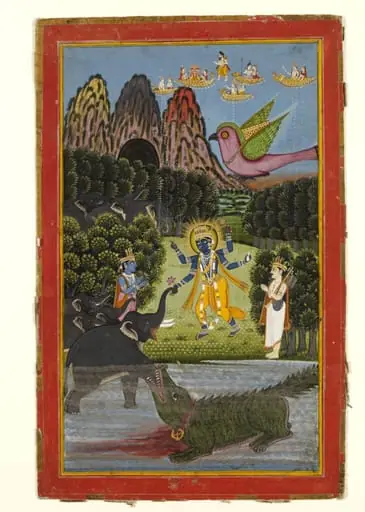
Vishnu and Gajendra
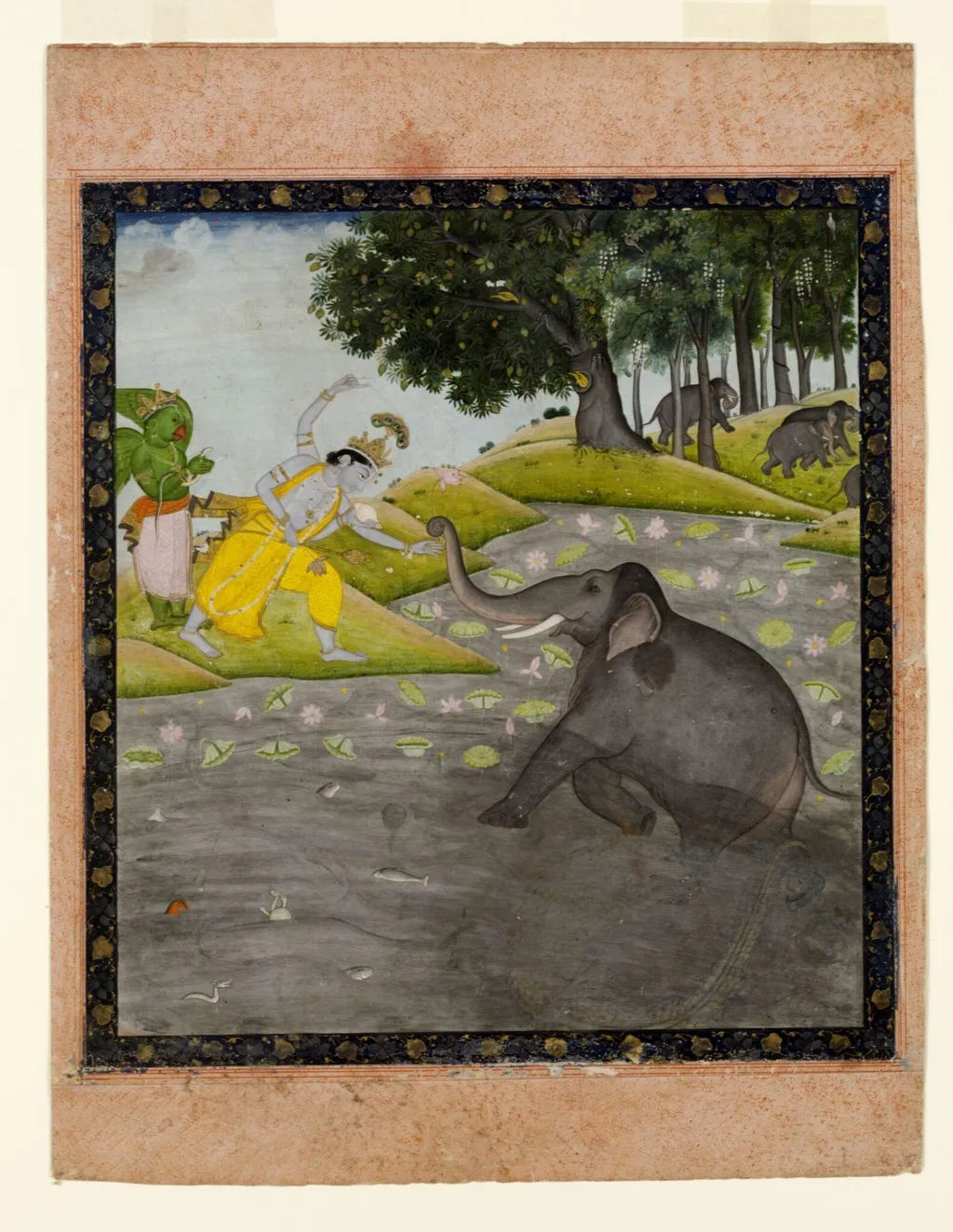
Vishnu and Gajendra is a paint painting by the Romanticist artist Unknown. It dates from 1830 and is held in the collection of the Victoria and Albert Museum.
About this work
Overview
The composition balances naturalism with symbolic elements, characteristic of early 19th-century Pahari or Rajasthani court painting traditions.
This opaque watercolor and gold painting on paper, dated around 1830, illustrates the Hindu myth of Gajendra Moksha—the liberation of the elephant king Gajendra by the god Vishnu. Rendered with delicate detail, the scene unfolds in a tranquil aquatic setting with lilies and reeds, framed by a soft sky and distant trees. The composition balances naturalism with symbolic elements, characteristic of early 19th-century Pahari or Rajasthani court painting traditions.
Subject & Meaning
The painting captures the moment Vishnu descends to rescue Gajendra, who is trapped by a crocodile, symbolizing the soul’s struggle against worldly bondage. Other elephants observe passively, emphasizing Gajendra’s isolation and devotion. Garuda, Vishnu’s eagle mount, stands nearby holding a serpent, representing the victory of celestial order over chaotic forces. The scene embodies the Hindu ideal of divine intervention in response to sincere prayer.
Technique & Style
The artist employs opaque watercolor with gold leaf accents to define forms and enhance spiritual radiance. Subtle gradations in color—gray for the elephant, muted greens and blues for the water and sky—create atmospheric depth. While not strictly chiaroscuro, the careful modulation of light and shadow around Vishnu’s form suggests divine presence. Fine brushwork details flora and fabric, reflecting the refined aesthetic of regional courtly painting traditions.
History & Provenance
Created circa 1830, the work likely originated in a Rajasthani or Pahari atelier, where devotional themes were commonly commissioned by royal patrons. Its preservation suggests it was valued within a collector’s circle, possibly displayed in a temple or palace chamber. No documented ownership prior to the 20th century is known, but its style aligns with works produced in the declining phase of Mughal-influenced Indian painting.
Context
This painting emerged during a period when Hindu devotional narratives were being revitalized in regional courts, even as Mughal patronage waned. Artists adapted classical iconography to local tastes, blending naturalistic landscapes with symbolic figures. The inclusion of Garuda and the aquatic setting reflects theological texts like the Bhagavata Purana, which were widely illustrated in this era to reinforce dharma and divine grace.
Legacy
The painting contributes to a broader corpus of Indian miniature art that preserved mythological stories through visual means. While not widely published, it exemplifies how regional schools sustained religious iconography with quiet sophistication. Its restrained palette and emotional stillness distinguish it from more ornate contemporaries, offering insight into the evolving spiritual aesthetics of 19th-century Indian painting.
Artist & collection

 Domestic Scene
 Giacomo and Cardinal Marco, investing Andrea, Abbot of San Zeno, with his Benefice
 The Nymph of Fontainebleau
 Portrait of a Woman
 Madonna and Child with Saints in the Enclosed Garden
 Venus and Minerva
 Family Group of Four on Sofa
 Wall painting from Room H of the Villa of P. Fannius Synistor at Boscoreale
 Krishna asks for sweets, from a Sursagar of Surdas (Indian, c. 1480–1580)
 Krishna and Aghasura
 Akbar Crosses the Ganges on an Elephant
 Untitled
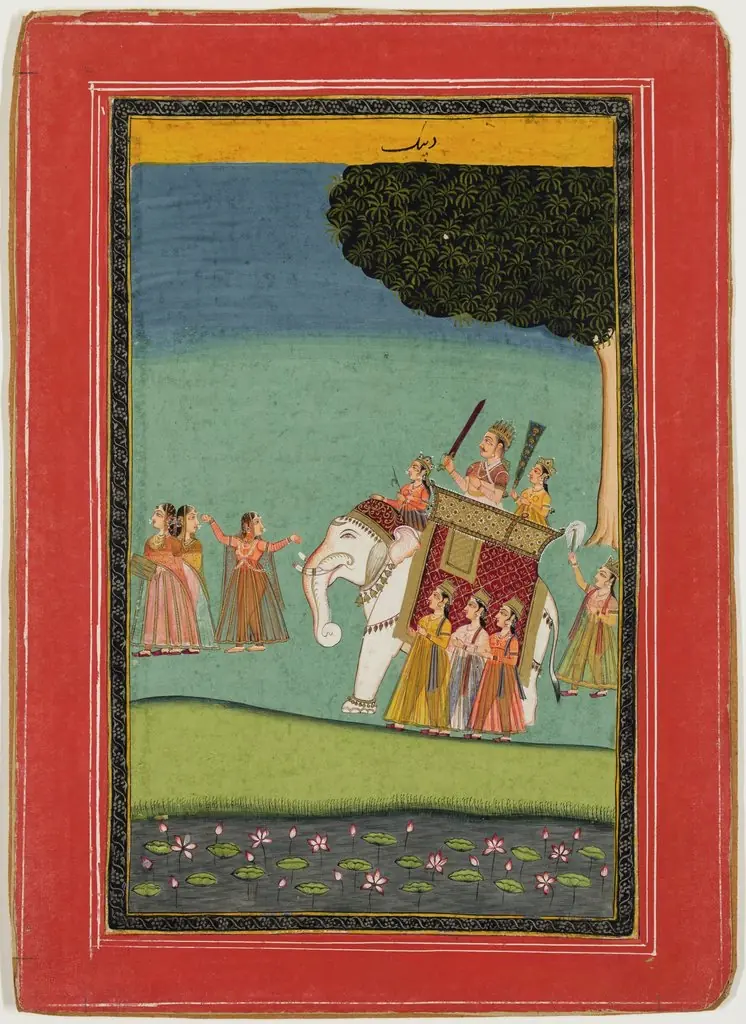 Raja on White Elephant with Female Attendants
 Akbar
Akbar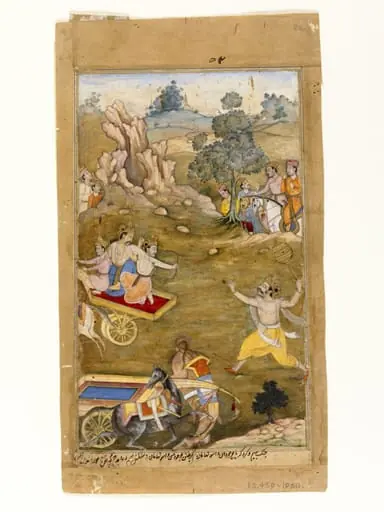 Bhima and Aswathama
 Nata Ragini
 Krishna asks for sweets, from a Sursagar of Surdas (Indian, c. 1480–1580)
 Lakshmi
 Salim spearing a lioness
 Gajendramoksha