Artwork
Krishna and Radha
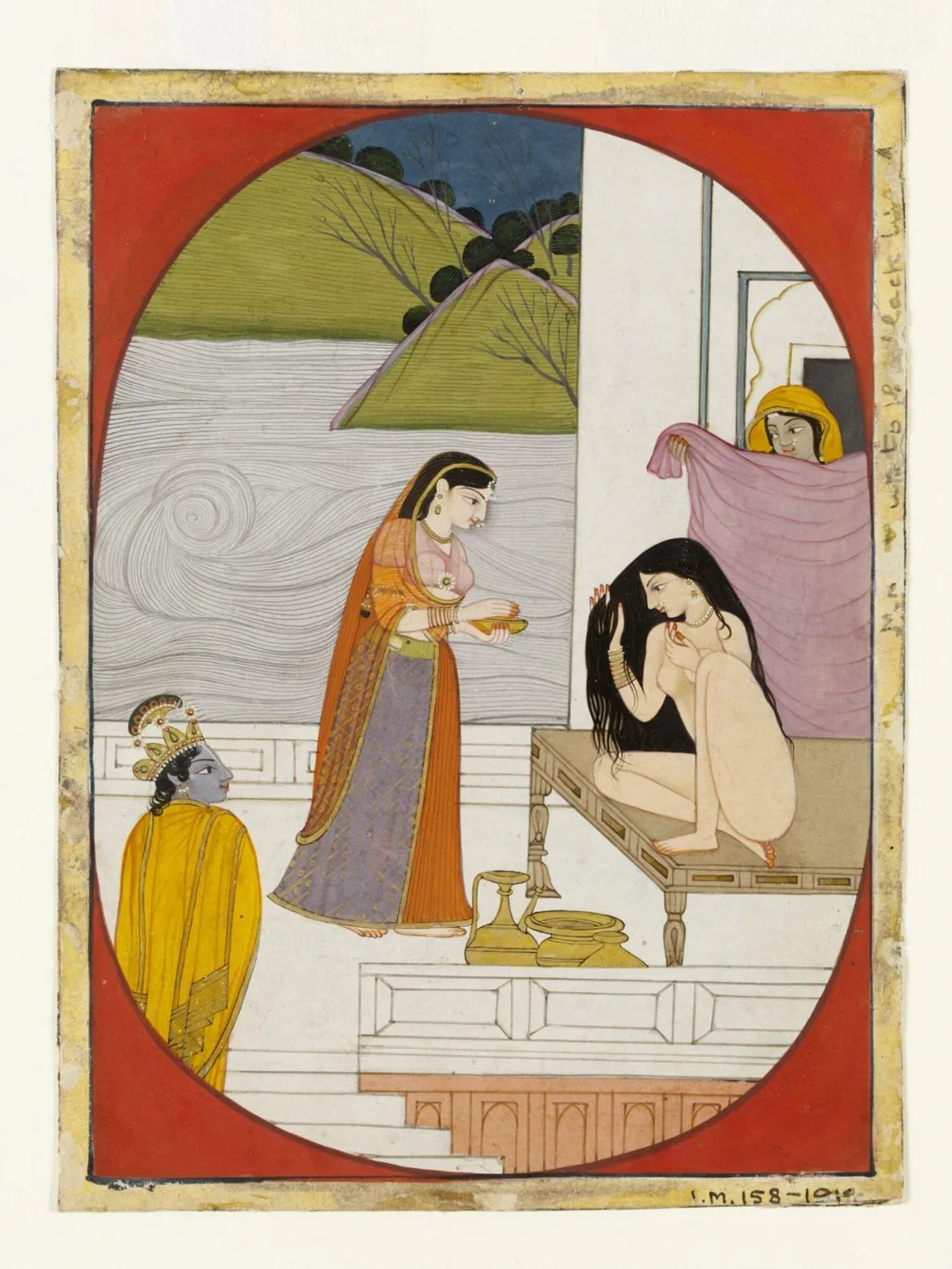
Krishna and Radha is a paint painting by the Rococo painting artist Unknown. It dates from 1780 and is held in the collection of the Victoria and Albert Museum.
About this work
Overview
The work reflects the stylistic conventions of Pahari painting, emphasizing flat planes of color and stylized forms over naturalistic perspective.
This watercolour on paper, dated to around 1780, belongs to a small series of illustrations from the Bihari Sat Sai, a collection of poetic verses on divine love. It was acquired by the museum in 1914 from the collector and scholar Dr. A. K. Coomaraswamy and is catalogued as part of a group numbered IM 158 to 168-1914. The work reflects the stylistic conventions of Pahari painting, emphasizing flat planes of color and stylized forms over naturalistic perspective.
Subject & Meaning
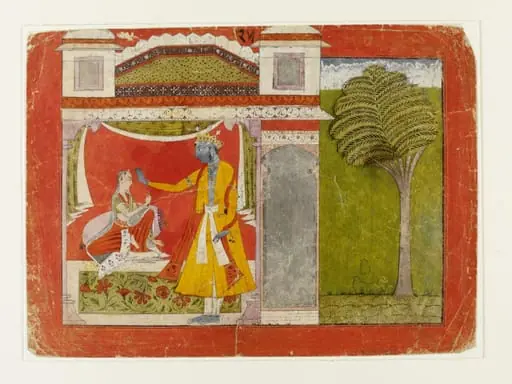
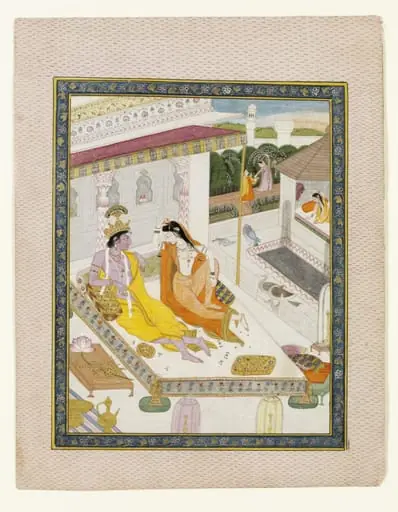
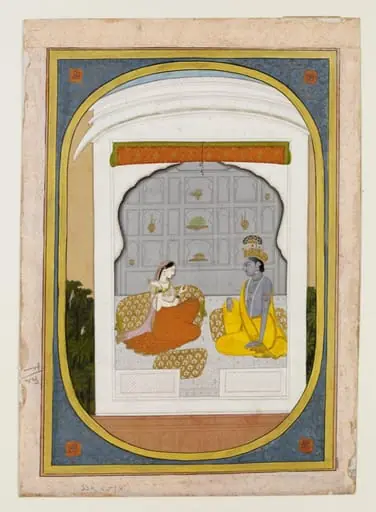
The scene depicts Krishna watching Radha as she bathes, a moment drawn from the Bihari Sat Sai’s lyrical portrayals of divine romance. The presence of two additional figures—one observing from a window, another seated nearby—suggests a private, intimate setting. The calm expressions and composed postures convey spiritual stillness rather than physical passion, aligning with the devotional intent of the text, where earthly love symbolizes the soul’s yearning for the divine.
Technique & Style
The painting employs opaque watercolour on paper with minimal shading and no attempt at spatial depth. Figures are rendered with clean outlines and saturated, unmodulated hues—blue, gold, orange, pink—arranged in a flat, decorative composition. Architectural elements like the window and bed are simplified into geometric shapes. Faces are serene and uniform, lacking individualized expression, characteristic of the Pahari tradition’s focus on symbolic representation over realism.
History & Provenance
The painting entered the museum’s collection in 1914 through Dr. A. K. Coomaraswamy, a leading authority on Indian art who systematically collected and documented Pahari miniatures. His donation formed a foundational part of the museum’s South Asian holdings. The work is one of eleven in a numbered series, likely produced in a single workshop, possibly in the Kangra or Guler region, known for their refined lyrical style during the late 18th century.
Context
Created during the height of Pahari miniature painting, this work reflects the cultural patronage of hill-state rulers who commissioned illustrated manuscripts of devotional poetry. The Bihari Sat Sai, composed in the 17th century, became a favored subject for artists in the Himalayan foothills, blending poetic imagery with local aesthetics. These paintings were often kept in royal libraries, used for private contemplation rather than public display.
Legacy
As part of Coomaraswamy’s collection, this painting helped shape early 20th-century Western understanding of Indian miniature traditions. Its inclusion in institutional holdings preserved a genre that had declined with the end of princely patronage. Today, it remains a reference point for scholars studying the intersection of poetry, devotion, and visual art in North Indian court culture during the late Mughal period.
Artist & collection

 Domestic Scene
 Giacomo and Cardinal Marco, investing Andrea, Abbot of San Zeno, with his Benefice
 The Nymph of Fontainebleau
 Portrait of a Woman
 Madonna and Child with Saints in the Enclosed Garden
 Venus and Minerva
 Family Group of Four on Sofa
 Wall painting from Room H of the Villa of P. Fannius Synistor at Boscoreale