Artwork
Madrasah and Tomb of Sultan Hasan
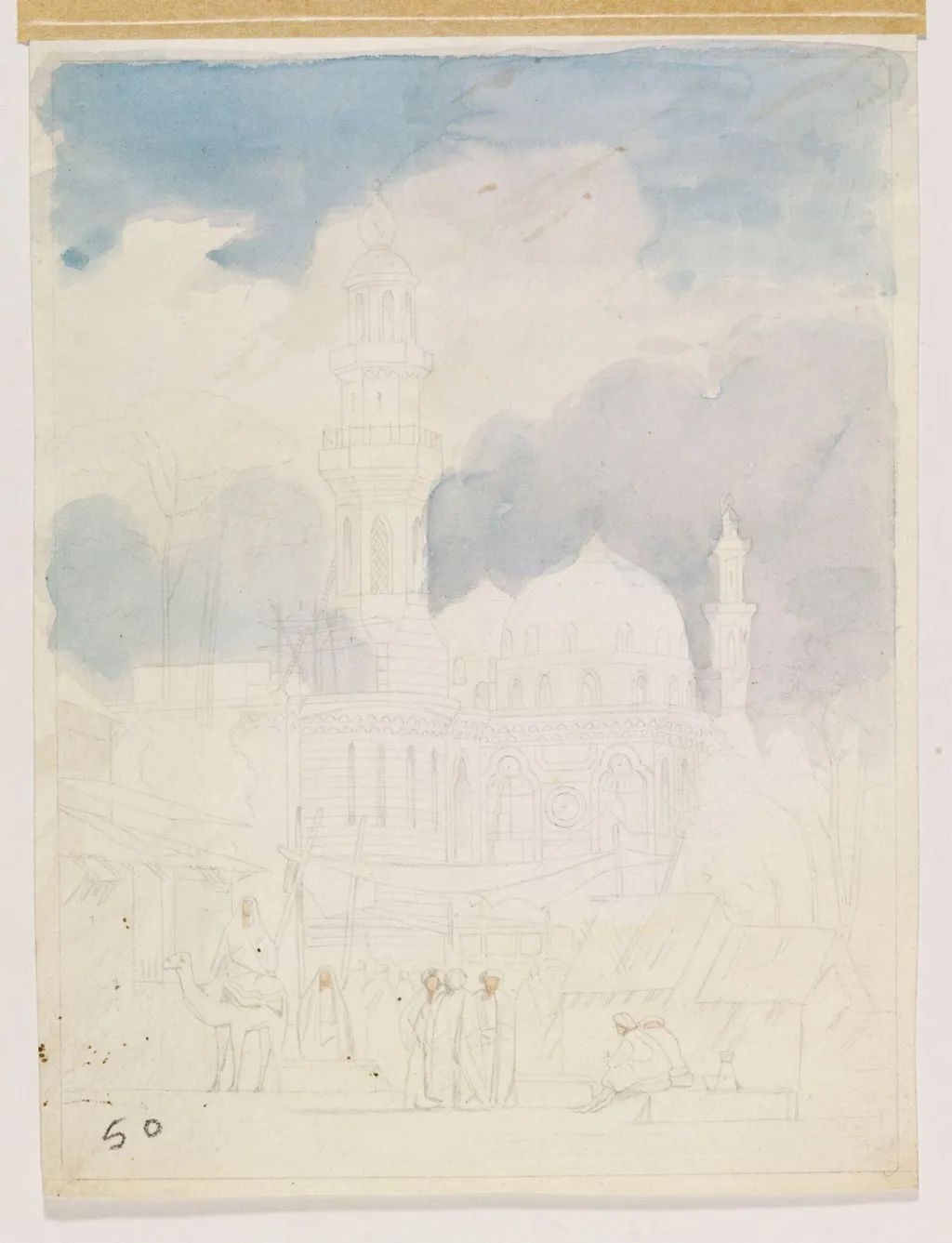
Madrasah and Tomb of Sultan Hasan is a watercolor work on paper by the Orientalist artist Unknown. It dates from 1809 and is held in the collection of the Victoria and Albert Museum.
About this work
Overview
Its paper and handling differ from other works in the collection, indicating it was made by a different hand than those attributed to Jones.
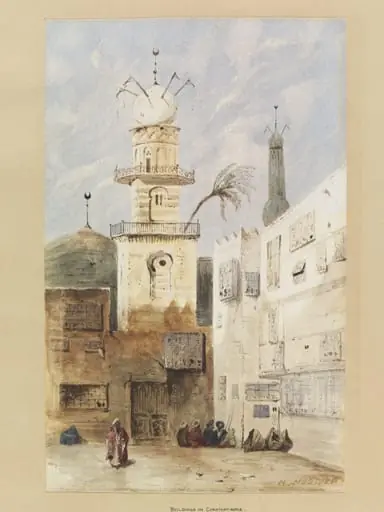
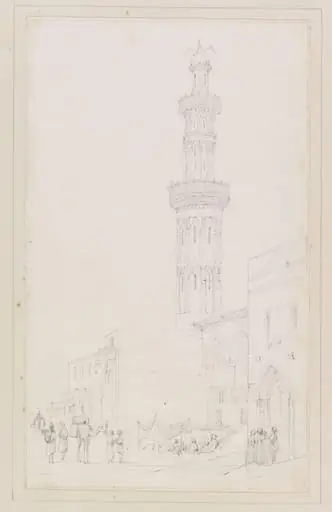
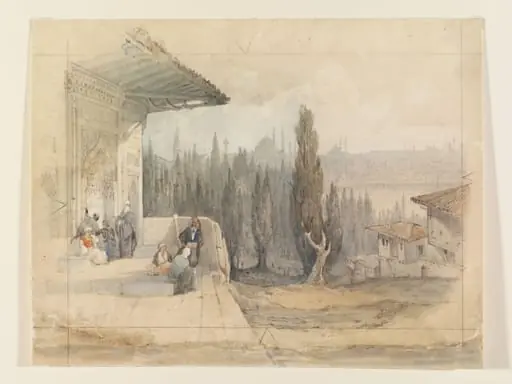
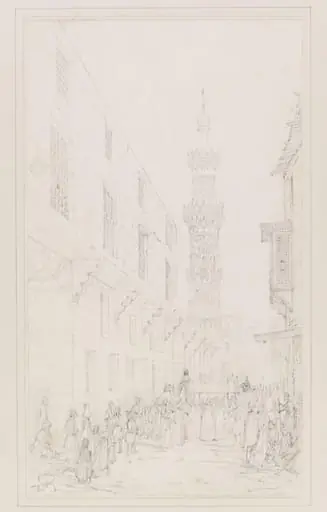
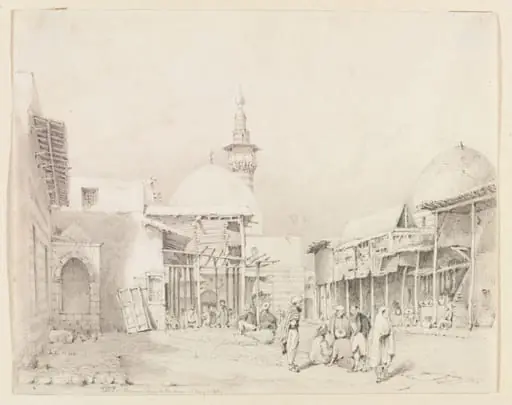
This watercolour, dated 1809, captures the Madrasah and Tomb of Sultan Hasan in Cairo. Attributed to an anonymous artist, it is part of a group of drawings acquired together by the Victoria and Albert Museum. Its paper and handling differ from other works in the collection, indicating it was made by a different hand than those attributed to Jones. The sketch’s informal quality suggests it was made on-site as a visual record rather than a finished composition.
Subject & Meaning
The drawing portrays the monumental complex built by Sultan Hasan in the 14th century, combining a religious school and mausoleum. Figures near a camel in the foreground imply daily life around the structure, grounding the architecture in human activity. The absence of facial details and the casual placement of people reflect an observational approach, emphasizing the building’s presence over individual narratives. The scene conveys the site’s enduring role as both spiritual center and public space.
Technique & Style
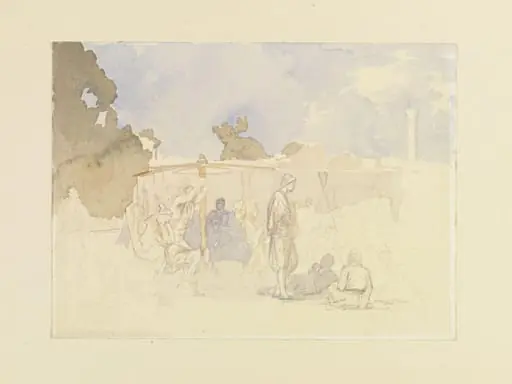
Executed in light watercolor washes and faint pencil lines, the work exhibits a rapid, spontaneous technique. Areas such as the figures’ faces and some architectural details remain deliberately blank, suggesting the artist prioritized overall form over precision. The sky is rendered with soft, even tones, and shadows are suggested rather than modeled. This restrained method aligns with travel sketches of the period, where speed and clarity took precedence over finish.
History & Provenance
The drawing was acquired by the Victoria and Albert Museum as part of a group including SD.532–SD.542, likely during the early 19th century. Its attribution to an unknown artist stems from stylistic differences with other works in the collection, particularly those by Jones. Rodney Searight’s research confirms its inclusion in this specific acquisition, situating it within a broader corpus of British travelers’ records of Egyptian monuments during the post-Napoleonic era.
Context
Created during a period of growing European interest in Middle Eastern architecture, the sketch reflects the practice of travelers documenting historic sites with quick studies. The Madrasah of Sultan Hasan, a landmark of Mamluk architecture, attracted attention for its scale and grandeur. This watercolour, like others of its kind, served as a personal record rather than a commissioned illustration, offering insight into how foreign observers engaged with Islamic monuments before widespread photography.
Legacy
As part of the V&A’s collection of 19th-century topographical drawings, this work contributes to the historical record of how Western artists encountered and interpreted Islamic architecture. Its unpolished character preserves the immediacy of first-hand observation, distinguishing it from later, more idealized depictions. It remains a modest but valuable artifact of early visual documentation, offering a window into the act of seeing rather than the final representation.
Artist & collection

 Domestic Scene
 Giacomo and Cardinal Marco, investing Andrea, Abbot of San Zeno, with his Benefice
 The Nymph of Fontainebleau
 Portrait of a Woman
 Madonna and Child with Saints in the Enclosed Garden
 Venus and Minerva
 Family Group of Four on Sofa
 Wall painting from Room H of the Villa of P. Fannius Synistor at Boscoreale