Artwork
Nala
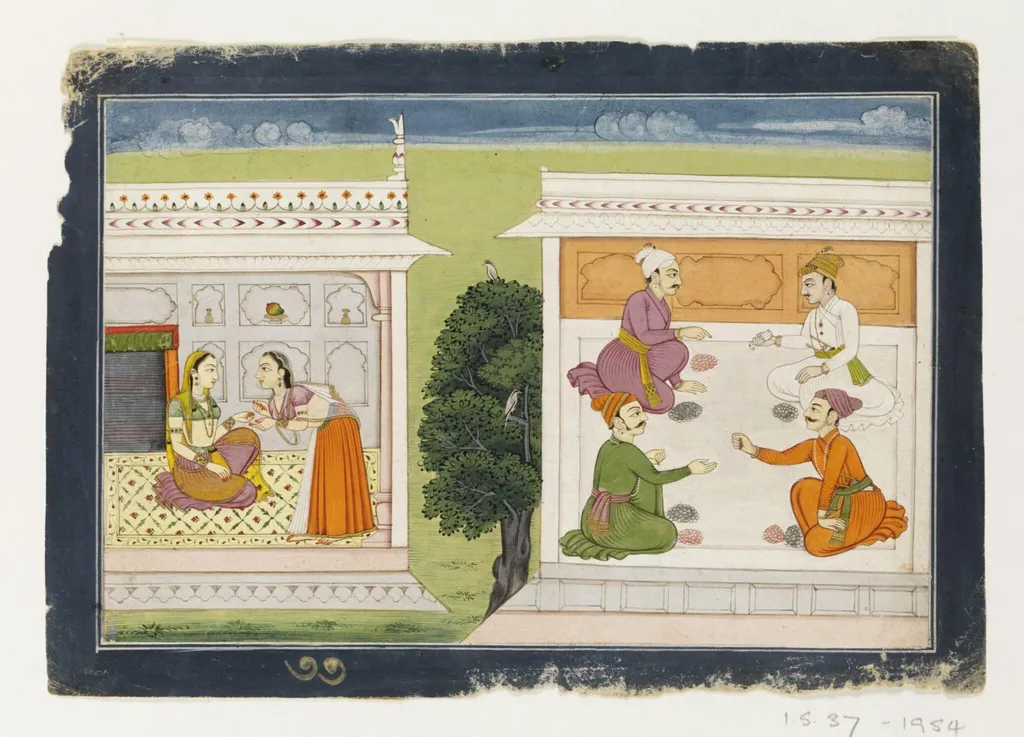
Nala is a paint painting by the Rococo painting artist Unknown. It dates from 1760 and is held in the collection of the Victoria and Albert Museum.
About this work
Overview
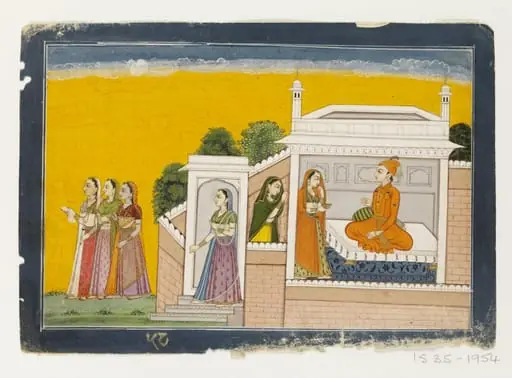
This watercolor painting belongs to a series illustrating episodes from the ancient Indian epic tale of Nala and Damayanti.
This watercolor painting belongs to a series illustrating episodes from the ancient Indian epic tale of Nala and Damayanti. Executed on paper with opaque pigments, it captures a quiet moment of decision amid a larger narrative of loss and loyalty. The composition is divided into two distinct groups, each rendered with delicate brushwork and restrained color, reflecting the refined aesthetic of Pahari court painting traditions.
Subject & Meaning
The scene portrays Damayanti, seated with her nurse, as she sends her to summon the charioteer Varshneya, likely to intervene as Nala loses his kingdom in a game of dice to his brother Pushkara. The separation of the two groups—women in intimate conversation, men engaged in the fateful gamble—emphasizes the gendered spheres of influence and the emotional weight of the moment. The act of sending a messenger signals a turning point, where agency shifts from the gambler to those who seek to restore balance.
Technique & Style
The artist employed opaque watercolor on paper, using fine brushstrokes to define intricate textile patterns and soft contours to model forms. Colors are muted yet vivid—floral embroidery on garments, layered robes in reds and purples—applied without harsh outlines, creating a sense of harmony. The background, with its stylized tree and patterned architecture, avoids perspective, instead offering a decorative frame that enhances the narrative’s intimacy rather than its spatial realism.
History & Provenance
This work originates from the Pahari region of northern India, likely produced in a royal atelier during the late 18th century. It is part of a larger illustrated cycle commissioned to depict the love story of Nala and Damayanti, a popular subject among Hindu courts. The painting entered the Victoria and Albert Museum’s collection through documented acquisitions from Indian princely states, preserving its cultural context within a broader tradition of manuscript illustration.
Context
Paintings like this were created for private royal collections, intended for intimate viewing rather than public display. The Nala Damayanti narrative, rich in themes of virtue, temptation, and redemption, resonated with courtly ideals of dharma and devotion. Artists adapted literary sources into visual form, blending poetic detail with symbolic composition, ensuring the story’s moral and emotional depth remained accessible through imagery.
Legacy
The painting exemplifies the enduring influence of Pahari miniature traditions in Indian art, where narrative clarity and emotional subtlety were prioritized over grandeur. Its preservation in major collections allows continued study of how regional styles interpreted classical texts. Though not widely exhibited, such works remain vital references for understanding the visual language of early modern Indian court culture and its engagement with epic literature.
Artist & collection

 Domestic Scene
 Giacomo and Cardinal Marco, investing Andrea, Abbot of San Zeno, with his Benefice
 The Nymph of Fontainebleau
 Portrait of a Woman
 Madonna and Child with Saints in the Enclosed Garden
 Venus and Minerva
 Family Group of Four on Sofa
 Wall painting from Room H of the Villa of P. Fannius Synistor at Boscoreale
 Ala-ud-din
 Princess Served by Female Attendants
 Story of Krishna and Radha
 Usha viewing the portrait of Aniruddha
 Story of Krishna and Radha
 Story of Krishna and Radha
 Krishna and Balarama
 Story of Krishna and Radha
 Untitled
 Untitled
 Illustrations to Life of Dhurva Maharaj: #1 Durbar of King Uttan Pad
 Nala and Damayanti