Artwork
Narasimha, the man-lion, the fourth avatar (incarnation) of Vishnu
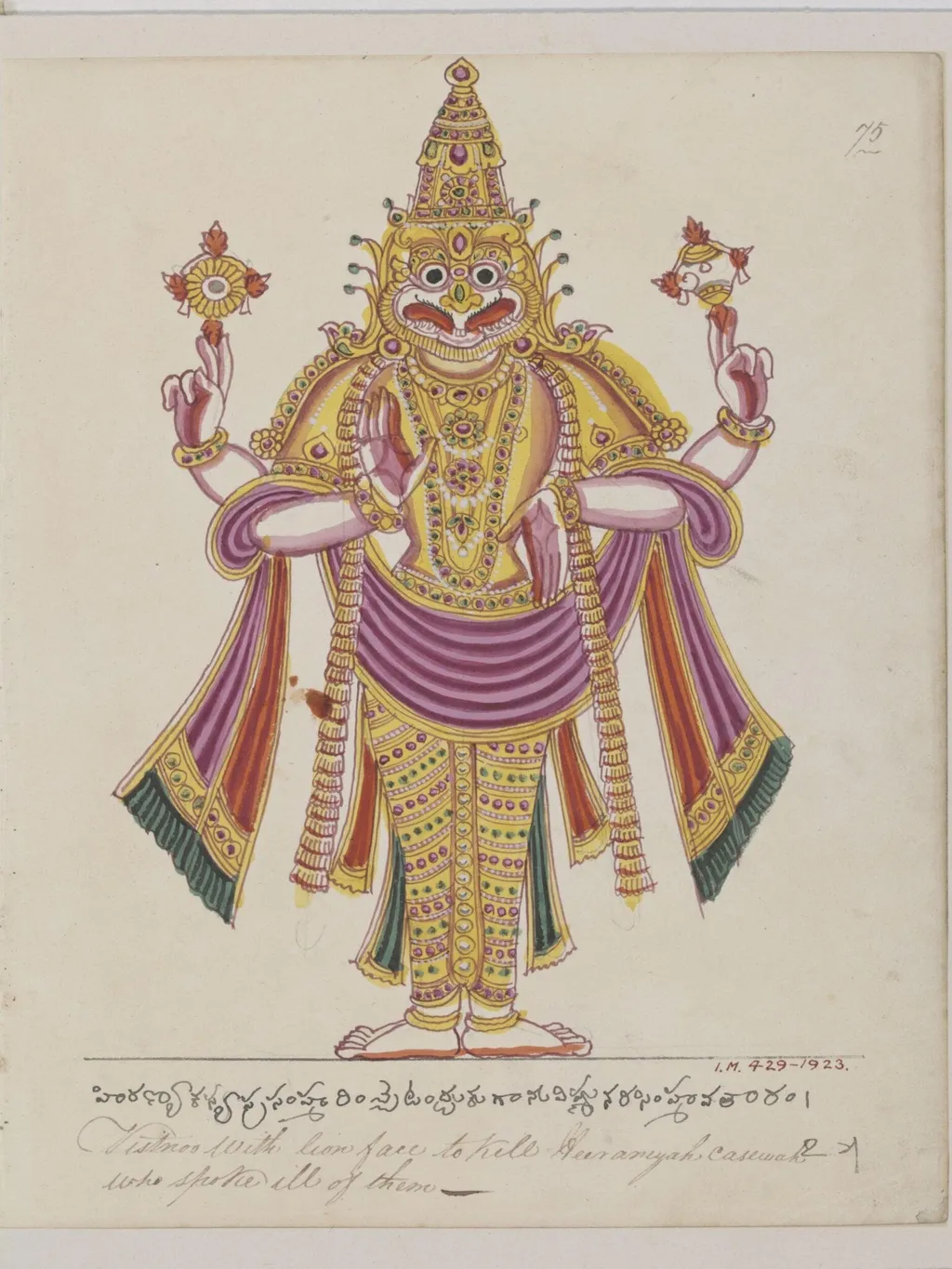
Narasimha, the man-lion, the fourth avatar (incarnation) of Vishnu is a paint painting by the Mughal Painting artist Unknown. It dates from 1825 and is held in the collection of the Victoria and Albert Museum. This 1825 painting depicts Narasimha, the fourth incarnation of the Hindu deity Vishnu, in a hybrid human-lion form.
About this work
Overview
The composition emphasizes divine power through vivid color and dynamic posture, aligning with regional stylistic traditions rather than European Romanticism.
This 1825 painting depicts Narasimha, the fourth incarnation of the Hindu deity Vishnu, in a hybrid human-lion form. Created during a period of active devotional art production in northern India, the work illustrates a key moment from the Puranas: Vishnu’s intervention to restore cosmic order by destroying the tyrant Hiranyakashipu. The composition emphasizes divine power through vivid color and dynamic posture, aligning with regional stylistic traditions rather than European Romanticism.
Subject & Meaning
Narasimha embodies the convergence of human intelligence and animal ferocity, symbolizing divine justice beyond conventional form. The figure emerges to slay Hiranyakashipu, a demon who believed himself invincible due to a boon that protected him from death by man or beast, day or night. By appearing at twilight on a threshold, neither fully man nor beast, Vishnu circumvents the loophole, affirming the inevitability of dharma. The small figure in Narasimha’s grasp is the demon, now subdued.
Technique & Style
The painting employs bold, saturated pigments—yellow fur with crimson stripes, gold and purple garments—to heighten emotional intensity. Facial features are rendered with sharp definition: wide eyes, bared fangs, and a snarling mouth convey ferocity without cruelty. The figure’s muscular form is outlined with fluid lines, and the ornate clothing suggests courtly influence. Brushwork is precise yet expressive, typical of Pahari or Rajasthani miniature traditions, prioritizing symbolic clarity over naturalism.
History & Provenance
Created in 1825, the work likely originated in a royal atelier in Rajasthan or the Punjab Hills, where devotional imagery flourished under patronage of Hindu rulers. Such paintings were often commissioned for temple use or private worship, serving as aids to meditation and storytelling. While specific provenance is unrecorded, stylistic elements align with regional schools active in the early 19th century, reflecting continuity in iconographic conventions despite political change.
Context
This image emerged during a time when Hindu devotional practices were being reaffirmed across northern India, even as colonial influence grew. Artists drew from centuries-old textual sources like the Bhagavata Purana, adapting them for contemporary audiences. The emphasis on divine intervention and moral order resonated in a period of social flux. Unlike European Romanticism, which idealized nature and emotion, this work channels theological narrative through established iconography.
Legacy
Narasimha’s depiction in this painting continues a visual tradition that has endured for over a millennium. Its iconographic elements—hybrid form, weapons, and demonic victim—remain standard in temple sculpture and festival art across South Asia. The painting exemplifies how religious imagery preserves doctrinal narratives through consistent visual language, ensuring their transmission across generations without reliance on textual literacy.
Artist & collection

 Domestic Scene
 Giacomo and Cardinal Marco, investing Andrea, Abbot of San Zeno, with his Benefice
 The Nymph of Fontainebleau
 Portrait of a Woman
 Madonna and Child with Saints in the Enclosed Garden
 Venus and Minerva
 Family Group of Four on Sofa
 Wall painting from Room H of the Villa of P. Fannius Synistor at Boscoreale