Artwork
The god Subrahmanya as Velayudha-Subrahmanya or Palani-andavar
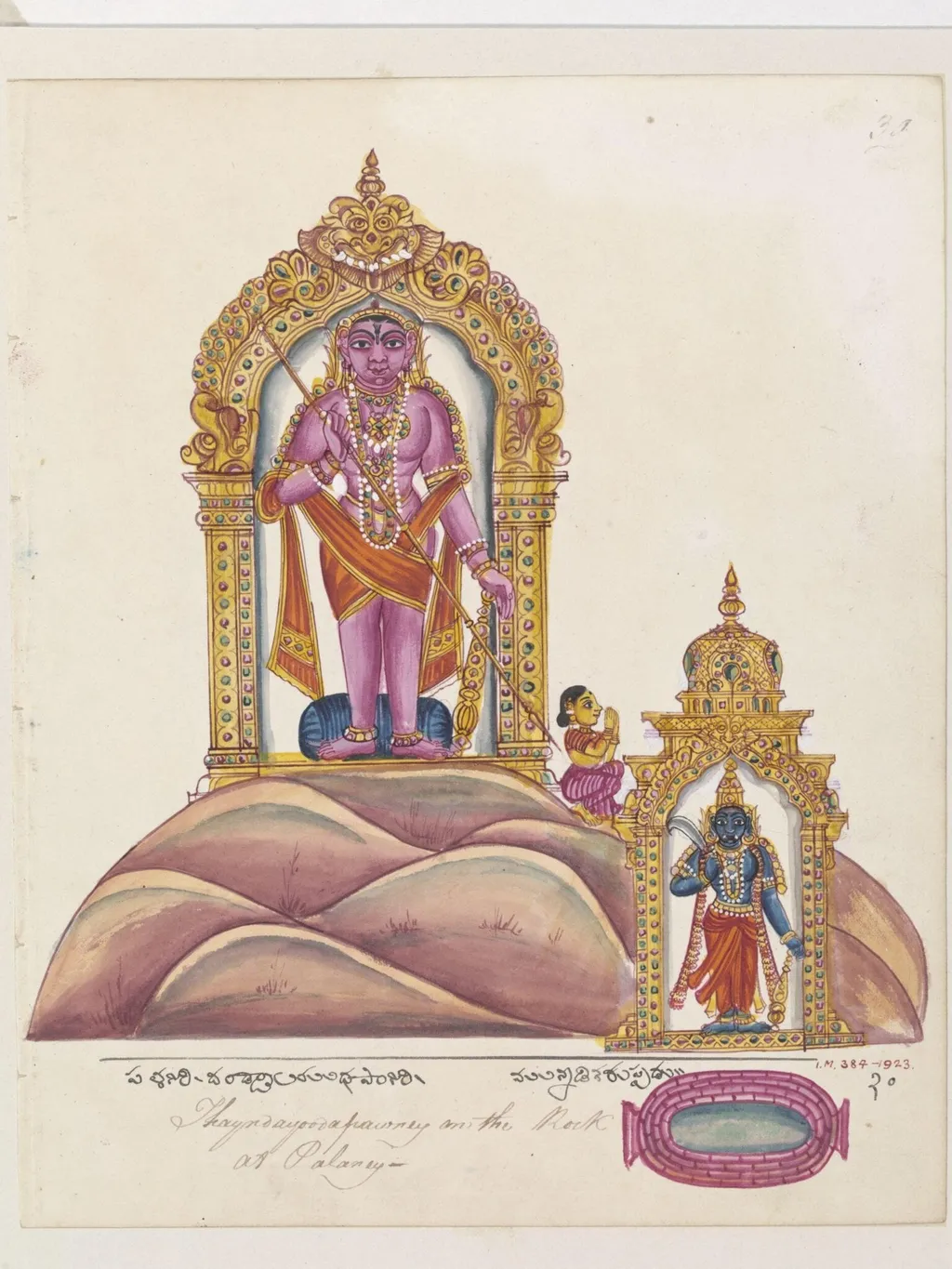
The god Subrahmanya as Velayudha-Subrahmanya or Palani-andavar is a paint painting by the Romanticist artist Unknown. It dates from 1820 and is held in the collection of the Victoria and Albert Museum.
About this work
Overview
This painting portrays Subrahmanya, a Hindu deity revered in South India, in his local manifestation as Velayudha-Subrahmanya or Palani-andavar.
This painting portrays Subrahmanya, a Hindu deity revered in South India, in his local manifestation as Velayudha-Subrahmanya or Palani-andavar. The composition centers on the deity standing atop a stylized hill, referencing the sacred Palani hills near Madurai. Surrounding elements include a jeweled arch and a female figure, suggesting devotional context. The work belongs to a regional tradition of devotional painting, not European Romanticism, despite superficial color contrasts.
Subject & Meaning
Subrahmanya is depicted as a warrior god, holding a spear—symbolizing spiritual authority and the destruction of ignorance. His posture on the hill evokes the pilgrimage site of Palani, where he is believed to have retreated for meditation. The accompanying female figure may represent his consort or a devotee, reinforcing the theme of divine presence in sacred landscape. The imagery serves both devotional and narrative purposes, anchoring worship in a specific geographic and mythological context.
Technique & Style
The painting employs bold outlines and flat areas of vivid color, typical of South Indian devotional art. The deity’s skin is rendered in a soft pink, contrasting with his red dhoti and gold ornaments, enhancing his divine presence. The archway is decorated with gem-like dots, suggesting ornate temple architecture. Background tones are muted, directing focus to the central figure. The style reflects local conventions rather than European movements, emphasizing symbolic clarity over naturalism.
History & Provenance
This work likely originated in Tamil Nadu, where the worship of Palani-andavar has been practiced for centuries. Such paintings were often created for temple use or private devotion, commissioned by devotees or religious institutions. While exact provenance is unrecorded, its iconography aligns with 18th–19th century South Indian miniature and scroll painting traditions, produced by artisan communities specializing in religious imagery.
Context
The depiction of Subrahmanya on a hill reflects the physical and spiritual geography of Tamil Shaiva traditions. Pilgrimage to Palani involves ascending the hill to reach the temple, making the landscape itself sacred. The water tank in the foreground may reference ritual purification practices. Such paintings functioned as visual aids for devotion, reinforcing local myths and reinforcing community identity through shared iconography.
Legacy
Paintings like this continue to inform contemporary devotional practices in Tamil Nadu, where images of Palani-andavar remain central to temple rituals and home altars. Though mass-produced prints now dominate, hand-painted versions preserve traditional iconography and craftsmanship. This work stands as a testament to enduring regional religious art, where visual form and sacred narrative remain tightly interwoven across generations.
Artist & collection

 Domestic Scene
 Giacomo and Cardinal Marco, investing Andrea, Abbot of San Zeno, with his Benefice
 The Nymph of Fontainebleau
 Portrait of a Woman
 Madonna and Child with Saints in the Enclosed Garden
 Venus and Minerva
 Family Group of Four on Sofa
 Wall painting from Room H of the Villa of P. Fannius Synistor at Boscoreale