Artwork
Old and New London Bridge, from the Surrey shore
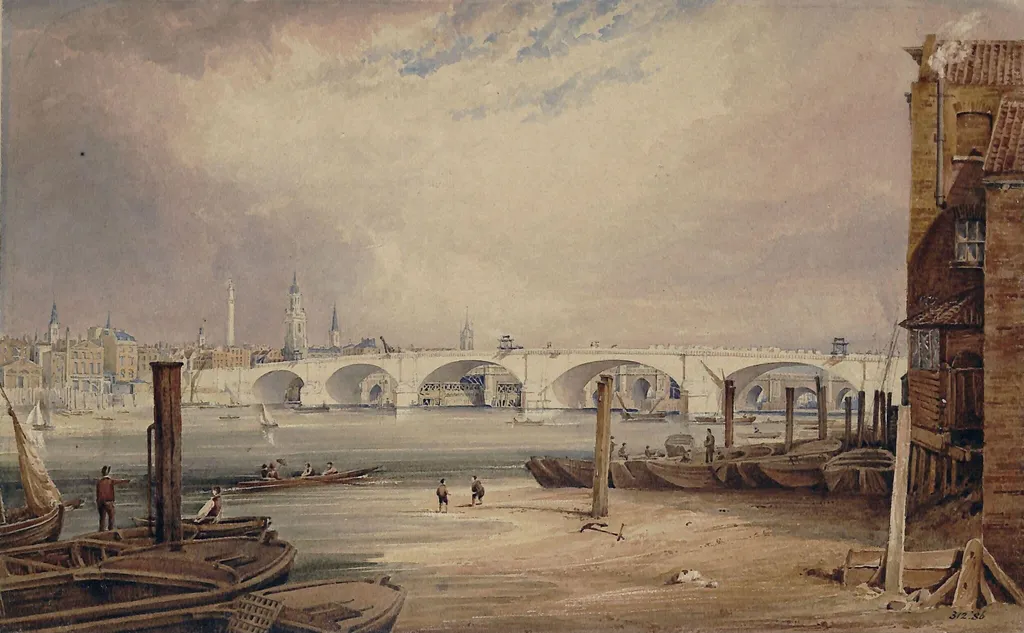
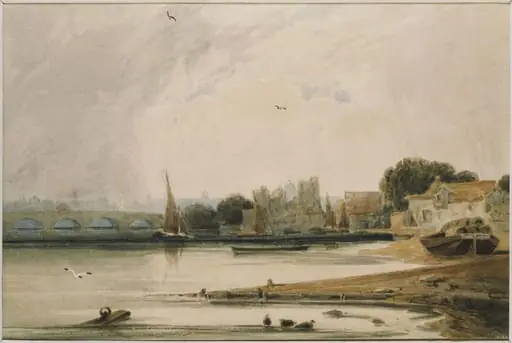
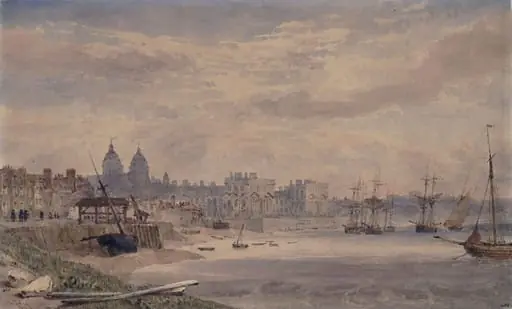
Old and New London Bridge, from the Surrey shore is a watercolor work on paper by the British Romanticist artist Unknown. It dates from 1831 and is held in the collection of the Victoria and Albert Museum. This watercolour, created in 1831, portrays London Bridge as seen from the southern bank of the Thames.
About this work
Overview
This watercolour, created in 1831, portrays London Bridge as seen from the southern bank of the Thames. It captures the coexistence of the medieval bridge still in use and the newer structure under construction, offering a visual record of urban transformation during a period of rapid modernization in the city.
Subject & Meaning
The painting juxtaposes the dense, arched stonework of the old bridge with the skeletal framework of its replacement. This contrast symbolizes the tension between tradition and progress in early 19th-century London. The quiet activity along the shore—small boats, solitary figures—suggests continuity amid change, grounding the monumental shift in everyday life.
Technique & Style
Executed in watercolour, the work employs delicate washes to render the sky and water with softness, while precise linework defines the architectural forms. The solidity of the bridges and buildings is emphasized through careful shading, contrasting with the airy atmosphere above. The composition balances detail with restraint, avoiding theatricality in favor of observational clarity.
History & Provenance
The painting was made during the final years of the medieval bridge’s use, before its demolition in 1831. It likely served as a documentary record for contemporaries aware of the bridge’s impending replacement. Its survival suggests it was valued as a historical document, though its early ownership remains undocumented.
Context
In the early 1800s, London’s infrastructure was undergoing large-scale renewal. The old bridge, dating from the 12th century, was deemed inadequate for growing traffic. The new bridge, designed by John Rennie, represented engineering advancement. This scene reflects a broader cultural moment when civic identity was being reshaped by public works.
Legacy
The painting endures as a quiet testimony to a pivotal moment in London’s urban history. It preserves the visual character of a bridge that had stood for centuries, offering insight into how contemporaries perceived architectural change—not as spectacle, but as a gradual, observable transition.
Artist & collection

 Domestic Scene
 Giacomo and Cardinal Marco, investing Andrea, Abbot of San Zeno, with his Benefice
 The Nymph of Fontainebleau
 Portrait of a Woman
 Madonna and Child with Saints in the Enclosed Garden
 Venus and Minerva
 Family Group of Four on Sofa
 Wall painting from Room H of the Villa of P. Fannius Synistor at Boscoreale