Artwork
On Happiness, Calligraphy in Seal Script Style (zhuanshu)
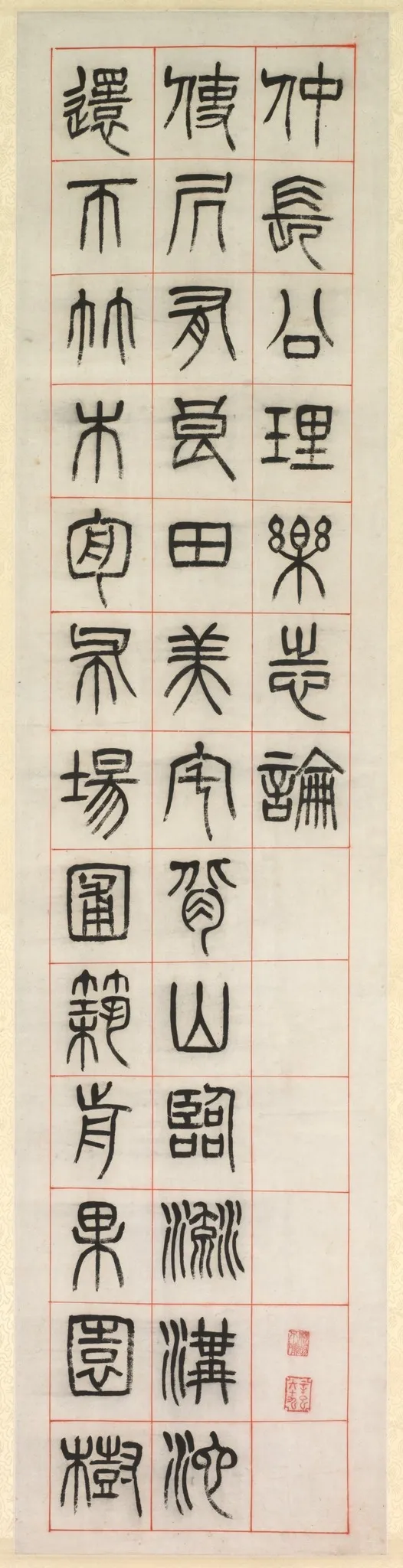
On Happiness, Calligraphy in Seal Script Style (zhuanshu) is an unspecified painting by Unknown. It dates from 1871 and is held in the collection of the Cleveland Museum of Art.
About this work
If you're interested in learning more about Chinese calligraphy, you might want to explore the work of artist Unknown, who created this piece in 1871.
This painting features a grid of 20 Chinese characters, each enclosed within a red square. The characters are written in a dark brown or black ink on a light beige background, with subtle texture visible beneath the ink. The overall effect is one of simplicity and elegance.
Upon closer inspection, the characters appear to be written in a seal script style, which is an ancient form of Chinese calligraphy. The use of this style adds to the painting's sense of history and cultural significance.
If you're interested in learning more about Chinese calligraphy, you might want to explore the work of artist Unknown, who created this piece in 1871.
Overview
On Happiness, Calligraphy in Seal Script Style (zhuanshu) is a painted composition dating from 1871. It consists of twenty individual Chinese characters, each set within a small red square, arranged in a regular grid on a light‑beige surface. The work balances a restrained palette of dark ink and muted background, creating a quiet, orderly visual field.
Subject & Meaning
The characters, rendered in the ancient seal script (zhuanshu), convey the theme of happiness through their literal meanings and the auspicious connotations of the script itself. By presenting each glyph as a discrete unit, the piece invites contemplation of language as both visual form and carrier of cultural wishes.
Technique & Style
Ink applied in a deep brown or black hue is laid onto a textured paper that shows subtle grain beneath the strokes. The seal script, characterized by its rounded, archaic forms, is executed with controlled brushwork, while the surrounding red squares provide a contrasting, geometric framework that emphasizes the calligraphic lines.
History & Provenance
Created in 1871 by an unidentified artist, the painting reflects a period when traditional Chinese calligraphy was often reproduced as decorative art. Its authorship remains unknown, and no documented ownership trail precedes its appearance in contemporary collections.
Context
The work belongs to a broader 19th‑century practice of integrating calligraphy into painted formats, a method that merged literary content with visual aesthetics. The use of seal script links the piece to antiquarian interests of the era, when scholars revived older scripts to evoke historical continuity.
Artist & collection

 Domestic Scene
 Giacomo and Cardinal Marco, investing Andrea, Abbot of San Zeno, with his Benefice
 The Nymph of Fontainebleau
 Portrait of a Woman
 Madonna and Child with Saints in the Enclosed Garden
 Venus and Minerva
 Family Group of Four on Sofa
 Wall painting from Room H of the Villa of P. Fannius Synistor at Boscoreale
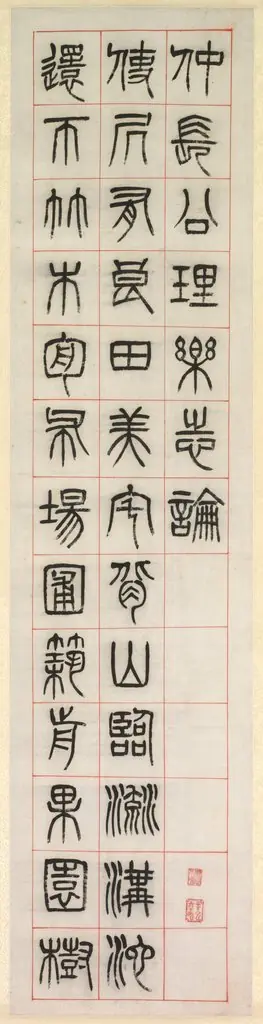 On Happiness, Calligraphy in Seal Script Style (zhuanshu)
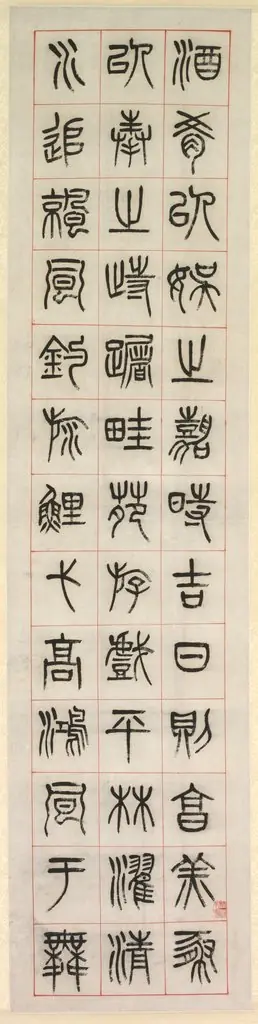 On Happiness, Calligraphy in Seal Script Style (zhuanshu)
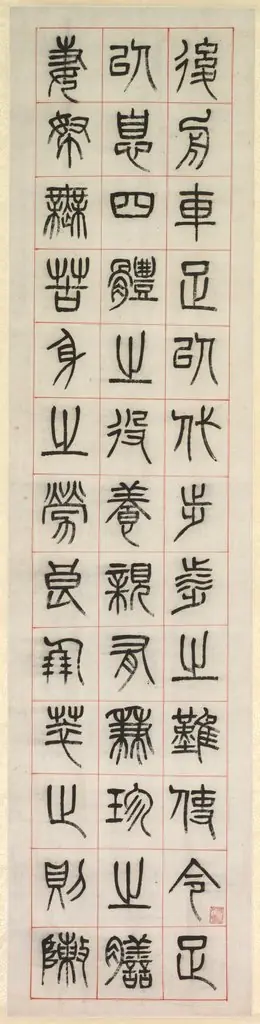 On Happiness, Calligraphy in Seal Script Style (zhuanshu)
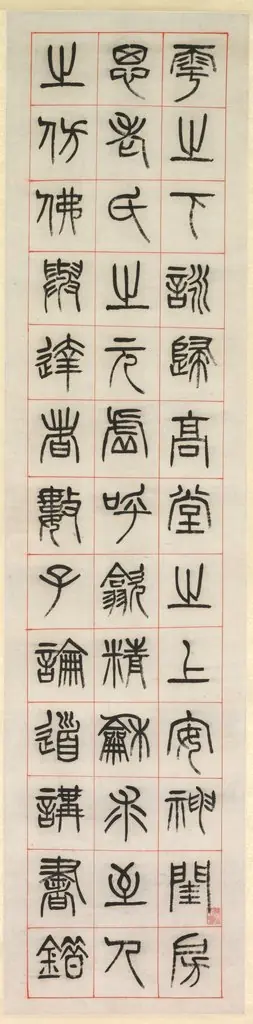 On Happiness, Calligraphy in Seal Script Style (zhuanshu)
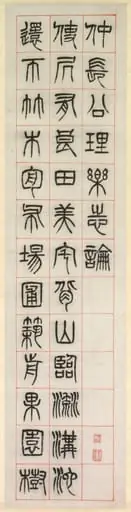 On Happiness, Calligraphy in Seal Script Style (zhuanshu)
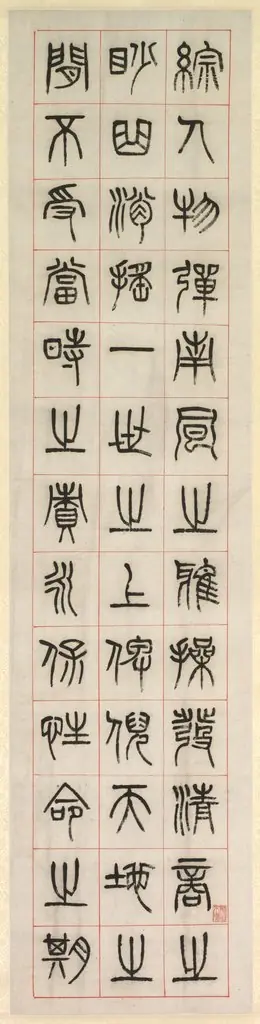 On Happiness, Calligraphy in Seal Script Style (zhuanshu)
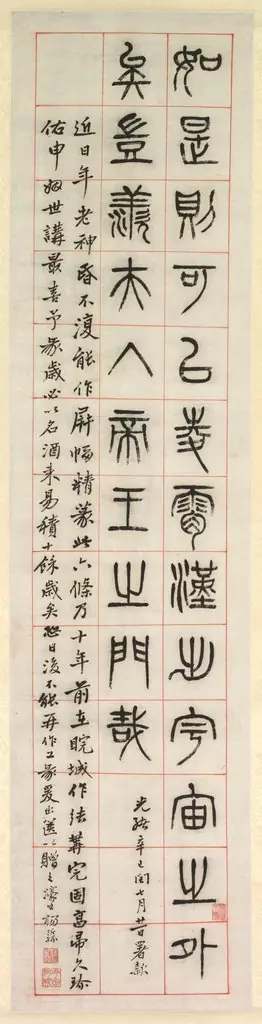 On Happiness, Calligraphy in Seal Script Style (zhuanshu)
 Calligraphy
 Paintings after Ancient Masters: Calligraphy
 Calligraphy (Zen Master's Staff)
 Calligraphy (reverse)