Artwork
One of seven paintings of unidentified Muslim buildings in South India.
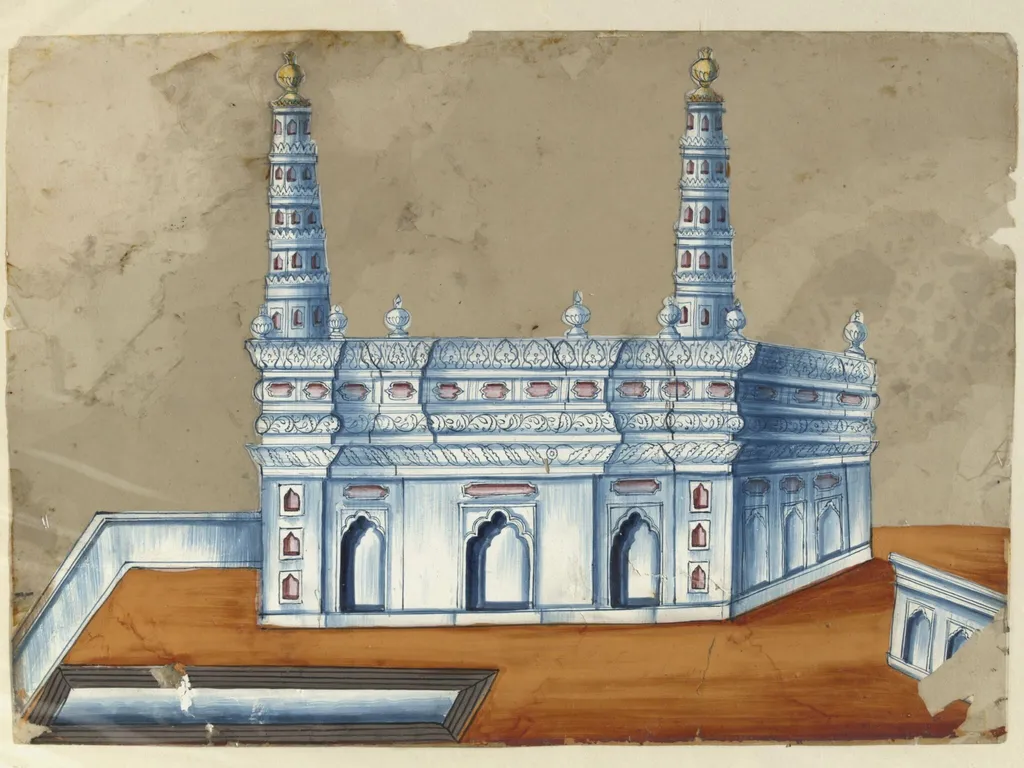
One of seven paintings of unidentified Muslim buildings in South India. is a paint painting by the Impressionist artist Unknown. It dates from 1850 and is held in the collection of the Victoria and Albert Museum. This painting is one of seven known works depicting unidentified Islamic-era structures in South India.
About this work
Overview
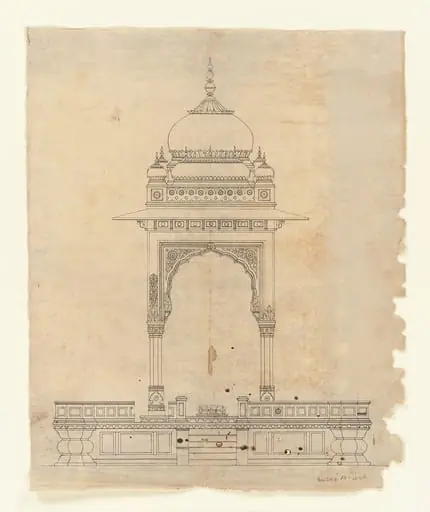
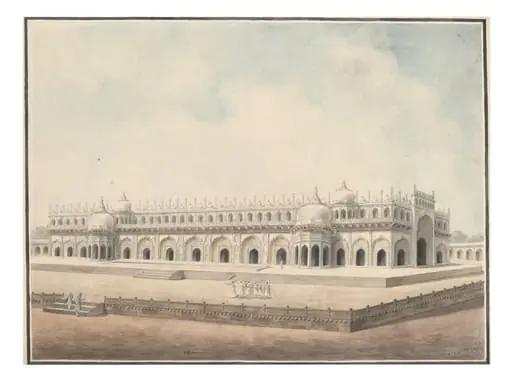
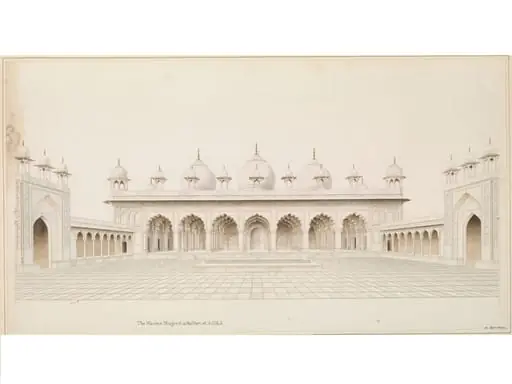
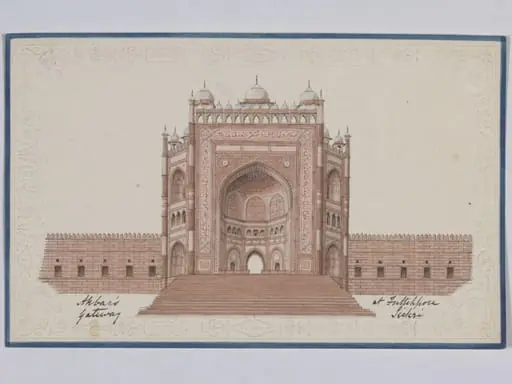
This painting is one of seven known works depicting unidentified Islamic-era structures in South India. It presents a single architectural composition without contextualizing landscape or figures, emphasizing form over narrative. The subject remains unlocated, and no inscriptions or signatures identify the artist or origin, leaving its purpose and commission open to interpretation.
Subject & Meaning
The structure portrayed likely represents a mosque or religious complex, given its twin minarets, arched openings, and courtyard with a central pool.
The structure portrayed likely represents a mosque or religious complex, given its twin minarets, arched openings, and courtyard with a central pool. The absence of human activity or decorative motifs suggests a focus on architectural presence rather than religious narrative. Its isolation against a blank ground may imply an idealized or symbolic representation, possibly intended as a record of form rather than place.
Technique & Style
Rendered in precise lines and flat areas of blue and white, the painting favors clarity over atmospheric depth. Architectural details—roof finials, window tracery, and courtyard paving—are rendered with methodical care. The background is left unmodeled, directing attention to the building’s geometry. The palette and composition reflect a decorative sensibility, possibly influenced by local manuscript traditions or European topographical drawing.
History & Provenance
The painting’s origin is undocumented, but it likely dates to the late 18th or early 19th century, a period when British colonial officials and artists documented South Indian architecture. It may have been produced for a European audience interested in regional structures. Its survival as part of a small, related group suggests it was once part of a curated collection, though its early ownership remains unknown.
Context
These seven works emerged during a time when European patrons sought visual records of Indian architecture, often through local artists trained in hybrid styles. While similar depictions exist in British collections, this group stands out for its uniformity in scale, palette, and focus on structure over context. They reflect a transitional moment in Indian art, where indigenous techniques met colonial documentation needs.
Legacy
The paintings serve as rare visual archives of South Indian Islamic architecture that may no longer exist or have been altered. Their restrained aesthetic and lack of overt cultural commentary make them valuable for architectural historians studying regional forms. Though not widely exhibited, they contribute to broader understandings of how colonial-era visual culture engaged with indigenous structures.
Artist & collection

 Domestic Scene
 Giacomo and Cardinal Marco, investing Andrea, Abbot of San Zeno, with his Benefice
 The Nymph of Fontainebleau
 Portrait of a Woman
 Madonna and Child with Saints in the Enclosed Garden
 Venus and Minerva
 Family Group of Four on Sofa
 Wall painting from Room H of the Villa of P. Fannius Synistor at Boscoreale
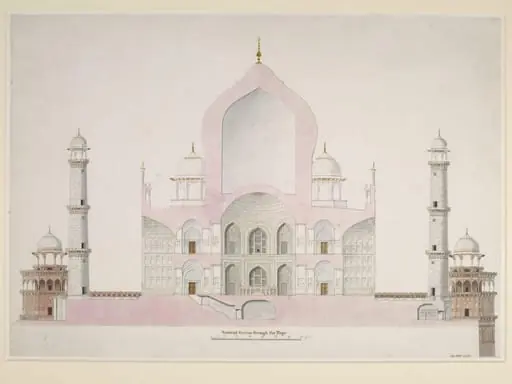 Vertical Section through the Tage
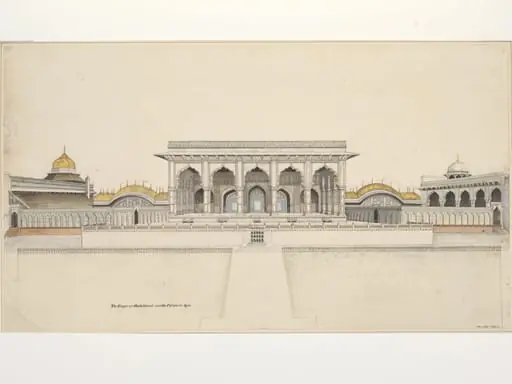 Elevation of the facade of the Khas Mahal, private apartments, Agra Fort, with the adjoining golden pavilions
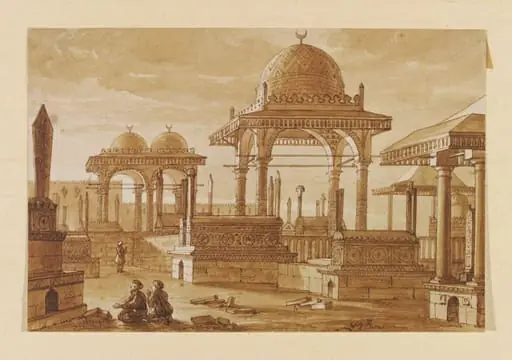 Part of the City of Tombs at Cairo
 Untitled
 The Imambara, Lucknow
 Elevation of the Moti Masjid (Pearl Mosque), Agra
 The Buland Darwaza of the Jami Masjid, Fatehpur Sikri