Artwork
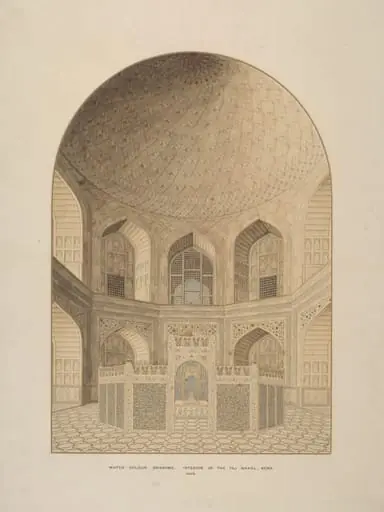
Vertical Section through the Tage
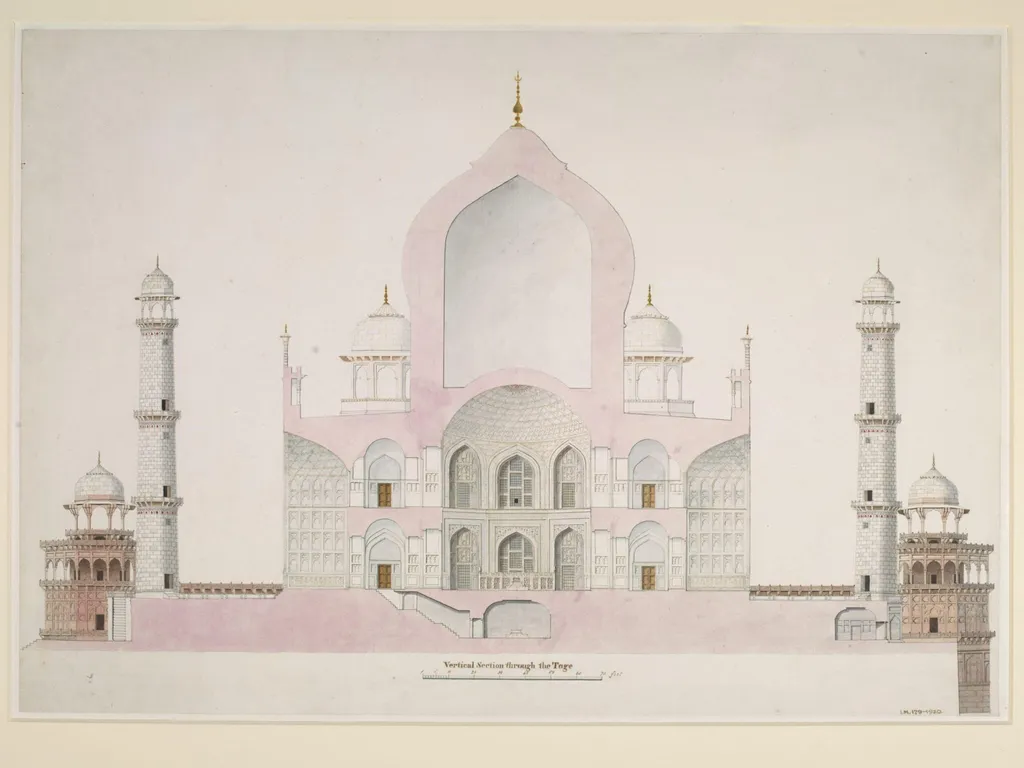
Vertical Section through the Tage is a drawing by the Romanticist artist Unknown. It dates from 1819 and is held in the collection of the Victoria and Albert Museum. The work is a hand‑drawn cross‑section of the Taj Mahal, illustrating the monument’s interior layout.
About this work
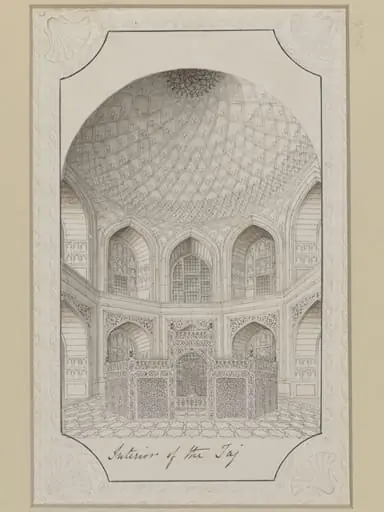
This drawing shows a cutaway view of the Taj Mahal. You see two floors of rooms wrapped around a central chamber. Inside that room stand two empty tombs.
A Delhi or Agra artist made this for a British official between 1816 and 1822. It’s not just a picture—it’s a slice through the building, like an exploded diagram.
Look up the Victoria and Albert Museum to see it in person.
Overview
The work is a hand‑drawn cross‑section of the Taj Mahal, illustrating the monument’s interior layout. Rendered on paper, it presents a cutaway view that reveals two stories of surrounding chambers encircling a central burial chamber, which contains the empty cenotaphs of Mumtaz Mahal and Shah Jahan.
Subject & Meaning
The drawing visualises the mausoleum’s architectural program: a peripheral ring of eight rooms on each level that frame the core space where the imperial couple’s tombs rest. By exposing the interior, the image clarifies the relationship between the outer galleries and the sanctified inner chamber.
Technique & Style
Executed by an Indian artist from Delhi or Agra, the drawing employs precise line work and shading to convey depth and structural detail. The style reflects a practical, technical approach rather than decorative embellishment, functioning as an early architectural illustration akin to an exploded diagram.
History & Provenance
Commissioned for the British Superintendent of Public Buildings in India, the drawing was produced between 1816 and 1822. It entered the collection of the Victoria and Albert Museum, where it remains accessible for study.
Context
The Taj Mahal, built between 1632 and 1643 on Shah Jahan’s orders after Mumtaz Mahal’s death, stands as a prime example of Mughal funerary architecture. This early 19th‑century illustration offers a rare contemporary perspective on the monument’s interior configuration, predating modern archaeological surveys.
Artist & collection

 Domestic Scene
 Giacomo and Cardinal Marco, investing Andrea, Abbot of San Zeno, with his Benefice
 The Nymph of Fontainebleau
 Portrait of a Woman
 Madonna and Child with Saints in the Enclosed Garden
 Venus and Minerva
 Family Group of Four on Sofa
 Wall painting from Room H of the Villa of P. Fannius Synistor at Boscoreale