Artwork
Panorama dalla Cupola di S. Pietro, Rome
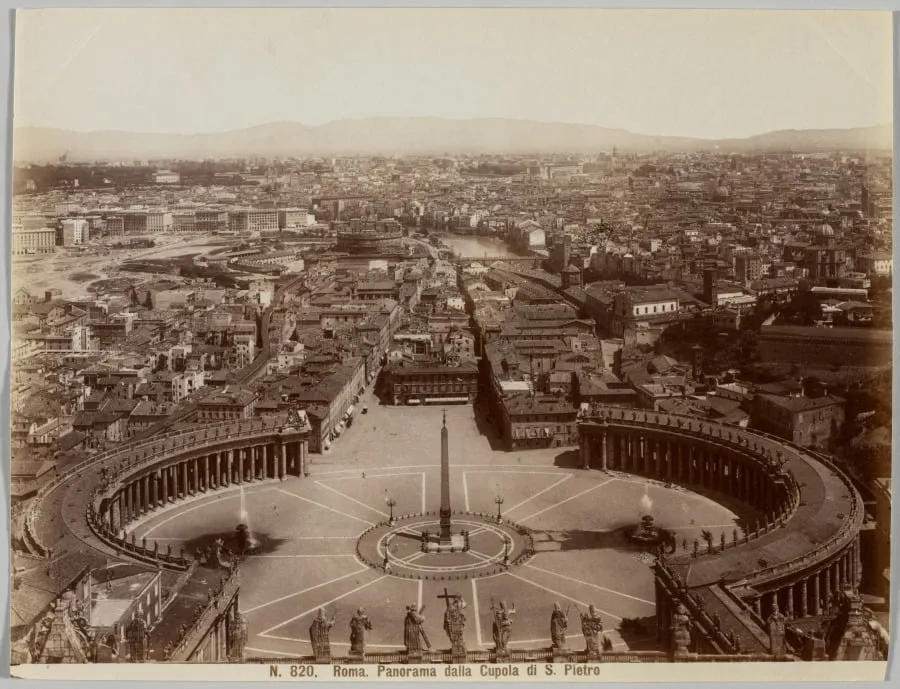
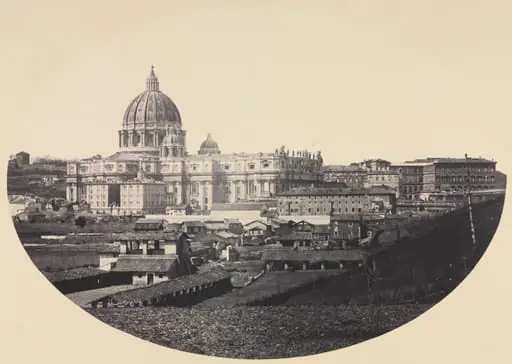
Panorama dalla Cupola di S. Pietro, Rome is a photography by the Impressionist artist Unknown. It dates from 1890 and is held in the collection of the Cleveland Museum of Art. The black‑and‑white photograph titled “Panorama dalla Cupola di S.
About this work
Overview
The black‑and‑white photograph titled “Panorama dalla Cupola di S. Pietro, Rome” captures a sweeping view of Rome’s central square as seen from an elevated position, likely the dome of St. Peter’s Basilica. The image frames a vast, open piazza dominated by a towering obelisk, surrounded by fountains, statues, and a dense skyline of domed roofs and classical façades.
Subject & Meaning
The composition emphasizes the monumental scale of the square, a space historically used for public ceremonies and gatherings. The central obelisk, a relic of ancient Egypt, anchors the scene, while the surrounding fountains and statues underscore the city’s layered artistic heritage.
Technique & Style
Executed in monochrome, the photograph relies on contrast and tonal gradations to convey depth, with the hazy atmosphere softening architectural details. The high‑angle perspective creates a sense of spatial vastness, allowing the viewer to trace the continuity of the urban fabric toward the horizon.
History & Provenance
The work is part of the collection of the Cleveland Museum of Art. Its acquisition details are not specified, but the museum’s holdings include a range of historic and contemporary photographic works, situating this image within a broader narrative of visual documentation of European landmarks.
Context
Taken from the dome of St. Peter’s, the photograph offers a rare aerial viewpoint of the Vatican’s surrounding environment, juxtaposing the religious epicenter with the secular urban landscape of Rome. The image reflects early 20th‑century interests in panoramic photography as a means of capturing cityscapes.
Legacy
As a documentary record, the photograph provides scholars with visual evidence of Rome’s architectural layout and public space usage during the period of its creation, contributing to studies of urban development and the evolution of photographic techniques.
Artist & collection

 Domestic Scene
 Giacomo and Cardinal Marco, investing Andrea, Abbot of San Zeno, with his Benefice
 The Nymph of Fontainebleau
 Portrait of a Woman
 Madonna and Child with Saints in the Enclosed Garden
 Venus and Minerva
 Family Group of Four on Sofa
 Wall painting from Room H of the Villa of P. Fannius Synistor at Boscoreale