Artwork
Patamanjari Ragini
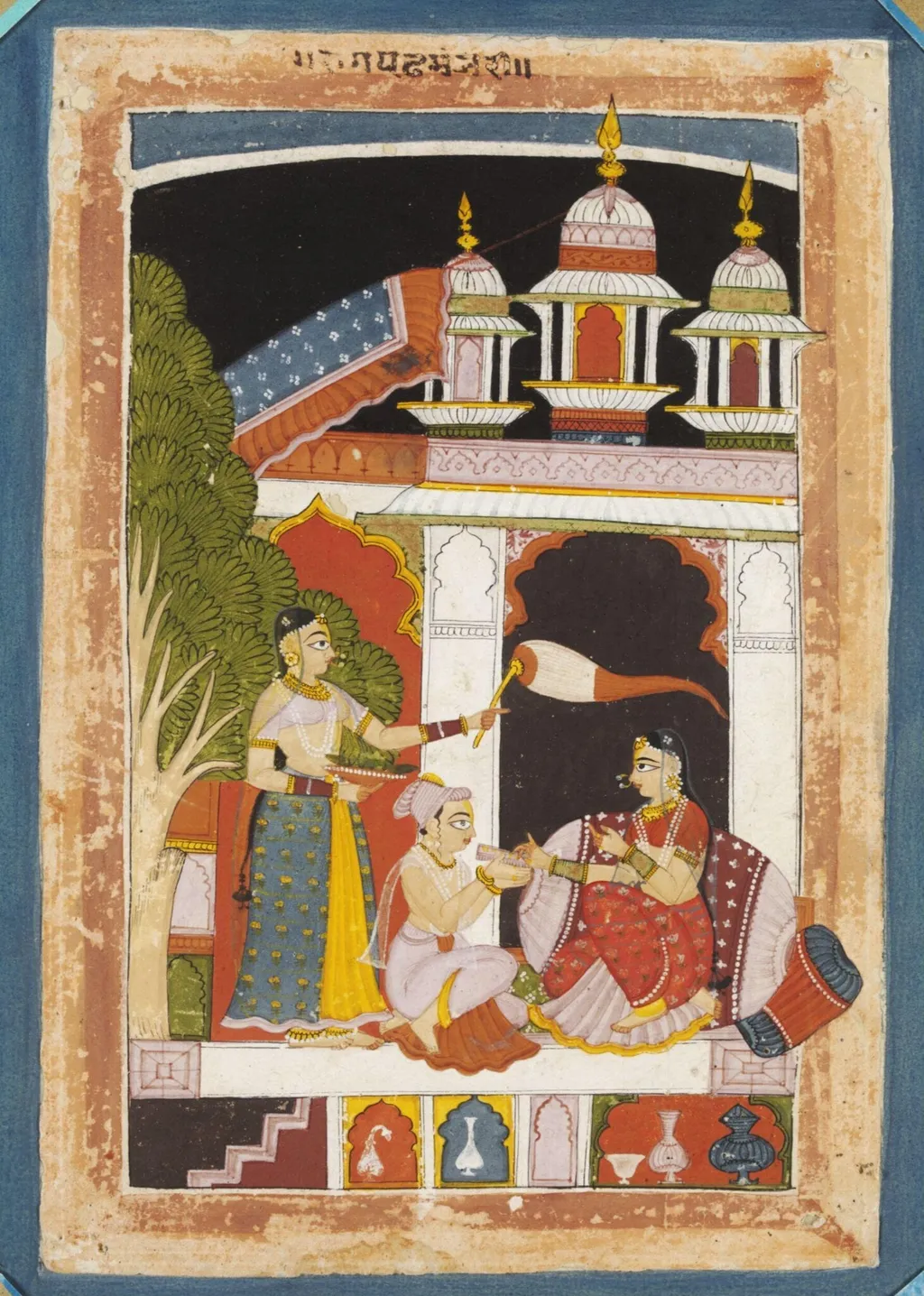
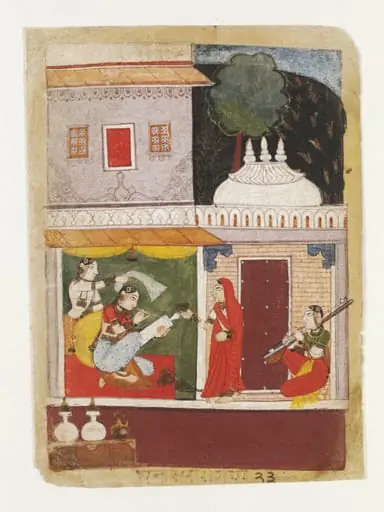
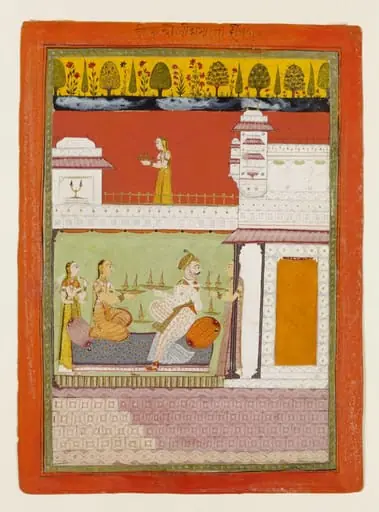
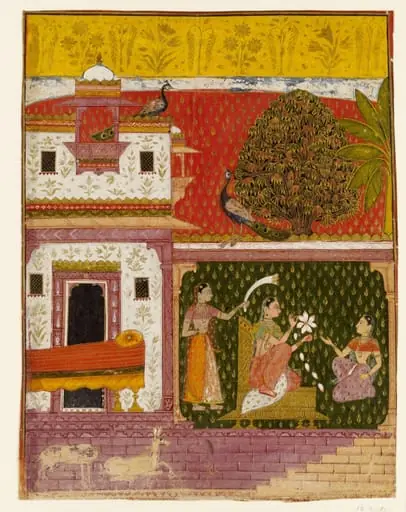
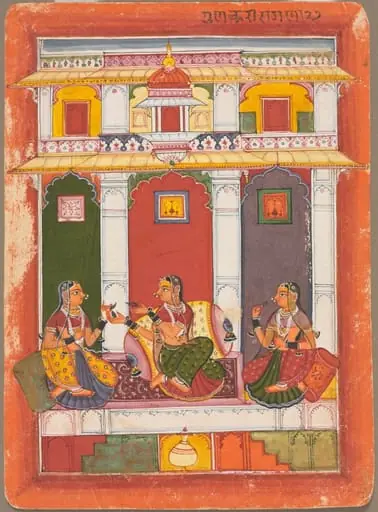
Patamanjari Ragini is a paint painting by the Mughal Painting artist Unknown. It dates from 1650 and is held in the collection of the Victoria and Albert Museum.
About this work
Overview
Executed with precision, it captures a quiet, intimate moment within an architectural setting, blending narrative and musical symbolism.
This opaque watercolor on paper, dated to approximately 1650, illustrates the musical mode Patamanjari Ragini, part of a larger tradition of Rajput miniature painting. Executed with precision, it captures a quiet, intimate moment within an architectural setting, blending narrative and musical symbolism. The composition centers on three figures arranged in a balanced, frontal grouping, typical of the Pahari school's aesthetic.
Subject & Meaning
The scene portrays a woman seated in contemplation, attended by a male servant offering sweetmeats and betel leaves, while a female figure stands nearby holding a fan. The absent lover, implied by the ragini’s thematic structure, evokes longing. The ritual of offering and the stillness of the seated woman suggest emotional restraint, aligning the visual with the melancholic mood associated with this raga in Indian classical music.
Technique & Style
The painting employs bold, flat areas of color—deep reds, rich blues, and gold leaf—outlined in fine black ink to define forms. Details in jewelry and fabric patterns are rendered with meticulous brushwork, while the background hints at a distant palace skyline with minimal depth. The lack of shading and the stylized figures reflect the conventions of early Rajput painting, prioritizing symbolic clarity over naturalism.
History & Provenance
Created in the hill kingdoms of northern India, likely in the Kangra or Guler region, this work was part of a manuscript series illustrating raginis—musical modes personified as female figures. Such albums were commissioned by royal patrons for private contemplation. Its survival suggests it was carefully preserved, possibly within a court collection before entering modern institutional holdings.
Context
This painting belongs to a genre that fused poetry, music, and visual art in early modern India. Ragamala paintings translated abstract musical modes into visual narratives, often depicting emotional states through human figures and settings. The Patamanjari Ragini, associated with separation and yearning, was rendered in this format to evoke a meditative response, linking sensory experience with spiritual sentiment.
Legacy
Works like this contributed to the enduring legacy of Indian miniature painting, influencing later regional styles and inspiring modern collectors and scholars. They remain key references for understanding how music and emotion were encoded in visual form. Today, such paintings are studied for their cultural synthesis and technical refinement, preserved in museums as artifacts of a sophisticated artistic tradition.
Artist & collection

 Domestic Scene
 Giacomo and Cardinal Marco, investing Andrea, Abbot of San Zeno, with his Benefice
 The Nymph of Fontainebleau
 Portrait of a Woman
 Madonna and Child with Saints in the Enclosed Garden
 Venus and Minerva
 Family Group of Four on Sofa
 Wall painting from Room H of the Villa of P. Fannius Synistor at Boscoreale