Artwork
Prăznicar – Botezul lui IS HS
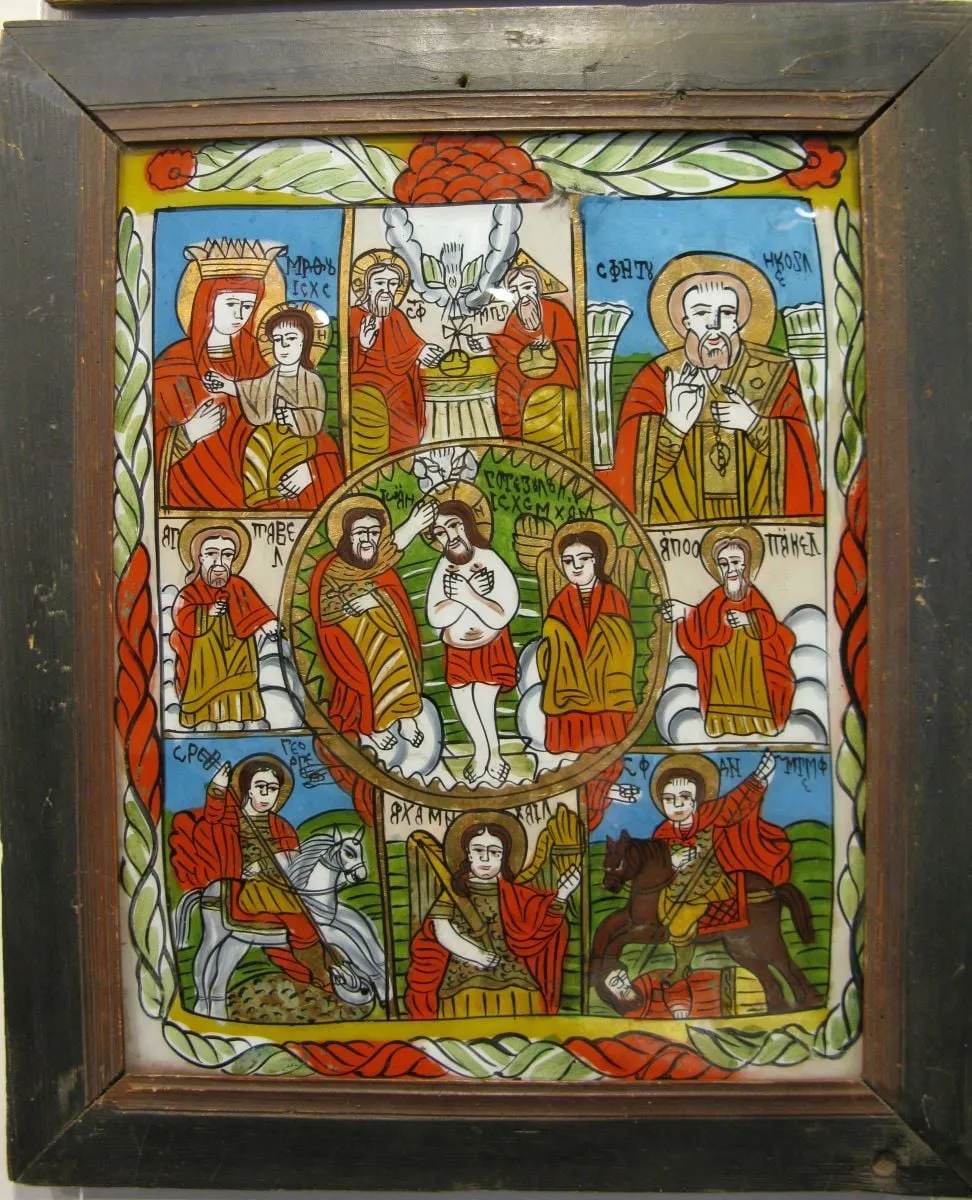
Prăznicar – Botezul lui IS HS is a drawing by Unknown. It dates from 1850 and is held in the collection of the National Museum of Art of Romania.
About this work
Overview
Surrounding this focal point are a number of secondary figures—some on horseback, others on foot—who observe the central action.
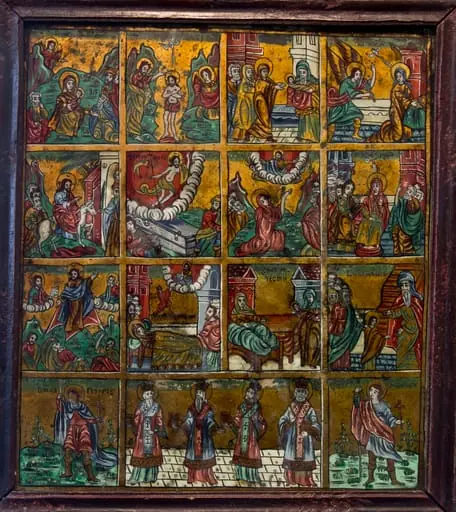
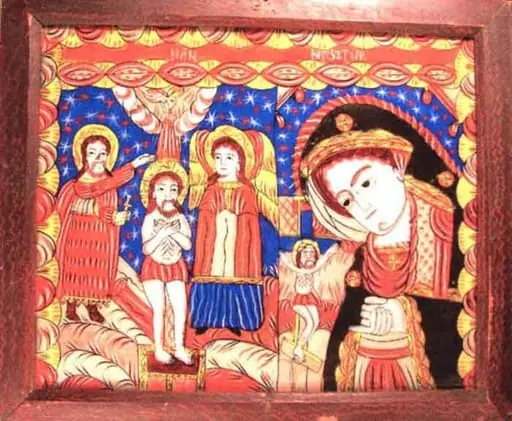
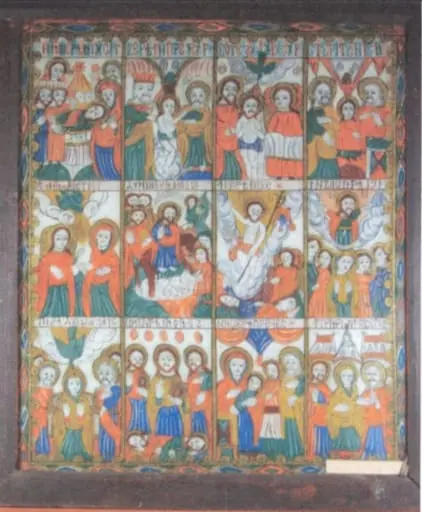
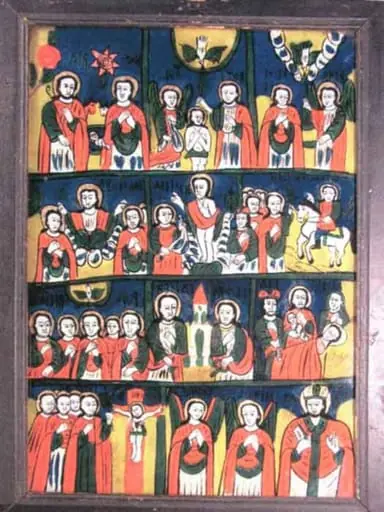
The work, titled *Prăznicar – Botezul lui IS HS*, presents a compact composition dominated by vivid, flat areas of color. At its core a central figure stands within a circular element interpreted as water, hands raised upward. Surrounding this focal point are a number of secondary figures—some on horseback, others on foot—who observe the central action. Labels placed in the corners identify the participants.
Subject & Meaning
The scene is commonly read as a baptismal rite: the central figure appears to be receiving the sacrament, while the encircling water motif reinforces the ritual context. The presence of gold halos above several characters signals their sanctified status, aligning the image with traditional Christian iconography of holy persons undergoing initiation.
Technique & Style
The artist employs a palette of saturated hues—prominent reds, deep blues, and luminous golds—applied in broad, unmodulated planes that give the picture a graphic, almost decorative quality. Forms are rendered with minimal modeling, emphasizing outline and color over three‑dimensional illusion. The overall effect recalls medieval manuscript illumination and later folk‑art traditions that favor flatness and symbolic clarity.
Context
The use of a round central element, or roundel, to frame a pivotal action connects this piece to a broader visual convention found in religious art, where circular motifs often denote sacred space or divine presence. Such compositional devices appear in frescoes, panel paintings, and illuminated manuscripts across Eastern European Christian traditions.
Legacy
While specific details of the work’s creation and subsequent ownership remain undocumented, its visual language contributes to the continuity of iconographic practices that blend narrative clarity with stylized abstraction. The painting serves as a reference point for scholars examining the persistence of flat, color‑driven representation in later devotional art.
Artist & collection

 Domestic Scene
 Giacomo and Cardinal Marco, investing Andrea, Abbot of San Zeno, with his Benefice
 The Nymph of Fontainebleau
 Portrait of a Woman
 Madonna and Child with Saints in the Enclosed Garden
 Venus and Minerva
 Family Group of Four on Sofa
 Wall painting from Room H of the Villa of P. Fannius Synistor at Boscoreale