Artwork
Maica Domnului Îndurerată (Botezul Domnului)
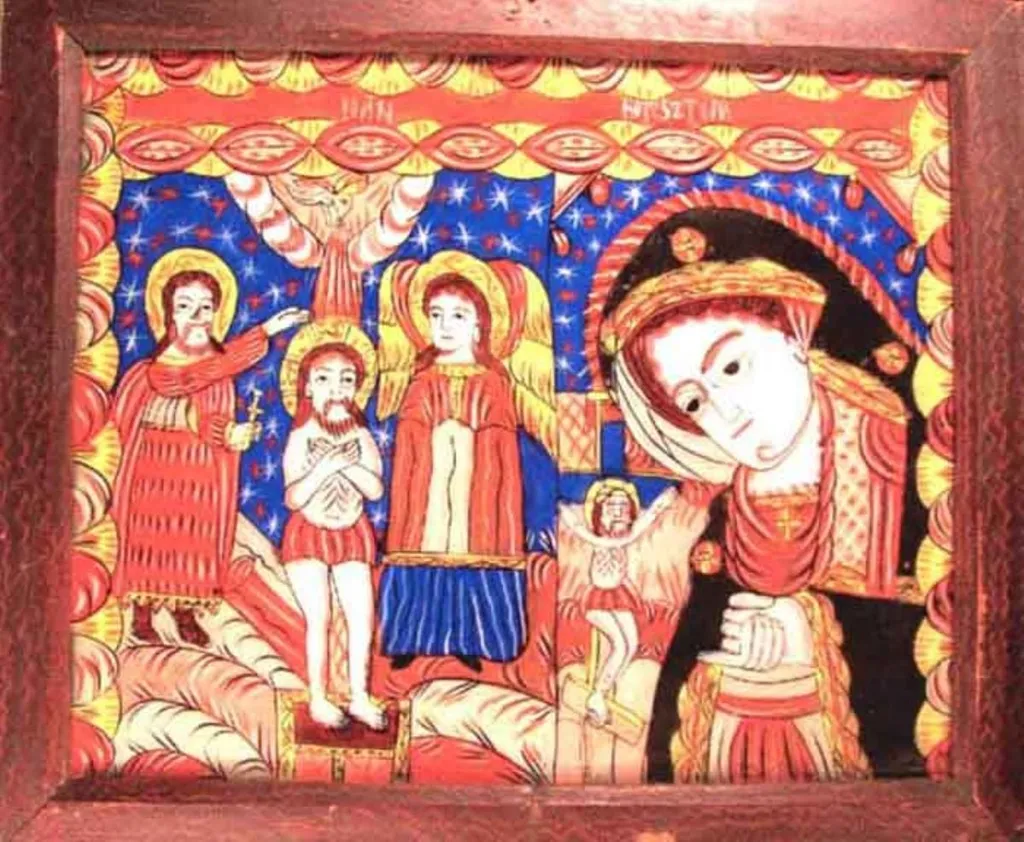
Maica Domnului Îndurerată (Botezul Domnului) is a drawing by Unknown. It dates from 1850 and is held in the collection of the Romanian Peasant Museum.
About this work
Overview
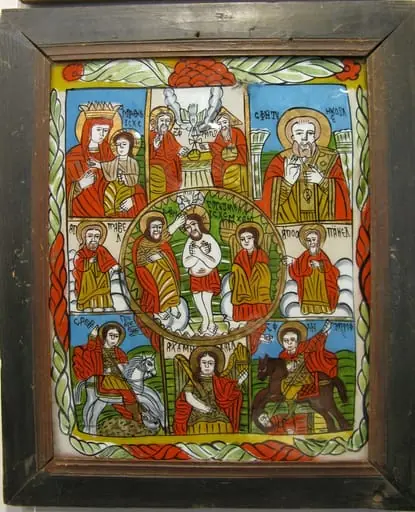
Maica Domnului Îndurerată (Botezul Domnului) is a religious painting depicting a sacred scene with five figures set against a vibrant gold and blue background, characterized by the use of bright colors and symbolic elements.
Subject & Meaning
Above, a winged, glowing figure in a starry sky (likely an angel or the Holy Spirit) oversees the scene.
The painting illustrates a biblical event, likely the Baptism of the Lord, given the title. Figures include two standing men in red (possibly saints or biblical figures, with one gesturing upwards, perhaps indicating divine presence), a central woman in blue and red (potentially the Virgin Mary due to her central placement and attire), a seated woman in red holding a baby (possibly another female figure from the narrative, with the baby's identity dependent on the specific biblical moment depicted), and a kneeling child. Above, a winged, glowing figure in a starry sky (likely an angel or the Holy Spirit) oversees the scene.
Technique & Style
The work features a distinctive use of bright, vivid colors against a gold and blue backdrop, creating a sense of depth and solemnity. The incorporation of a gold border adorned with festoons (repeating scroll or ribbon-like patterns) at the top adds a layer of traditional religious iconography, framing the holy scene in a manner common to religious art.
Context
The use of festoons in the gold border reflects a common practice in religious art to frame sacred scenes with ornate, symbolic elements, suggesting the work's adherence to traditional religious visual language.
Artist & collection

 Domestic Scene
 Giacomo and Cardinal Marco, investing Andrea, Abbot of San Zeno, with his Benefice
 The Nymph of Fontainebleau
 Portrait of a Woman
 Madonna and Child with Saints in the Enclosed Garden
 Venus and Minerva
 Family Group of Four on Sofa
 Wall painting from Room H of the Villa of P. Fannius Synistor at Boscoreale