Artwork
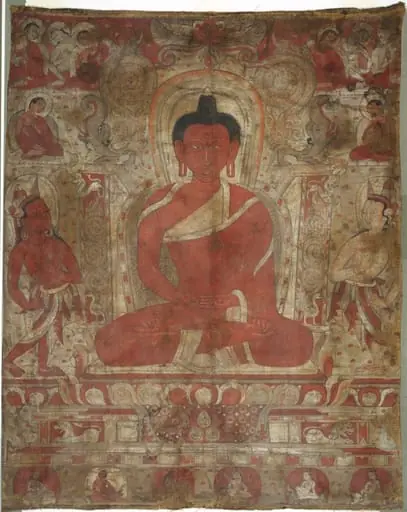
Preaching Amitabha with Avalokiteshvara and Manjushri, folio 186 (verso), from a Manuscript of the Perfection of Wisdom in Eight Thousand Lines (Ashtasahasrika Prajnaparamita-sutra)

Preaching Amitabha with Avalokiteshvara and Manjushri, folio 186 (verso), from a Manuscript of the Perfection of Wisdom in Eight Thousand Lines (Ashtasahasrika Prajnaparamita-sutra) is an unspecified painting by Unknown. It dates from 14 and is held in the collection of the Cleveland Museum of Art.
About this work
You see a red Buddha sitting under a tree, flanked by two colorful holy figures and a pair of geese perched above.
You see a red Buddha sitting under a tree, flanked by two colorful holy figures and a pair of geese perched above.
This tiny painting was one page in a 188-page book copied by hand in 1119. The scribe worked in India, but the artists were from Nepal, blending two traditions on one small sheet.
To see more work from the same place, look up *eastern india, bihar, vikramashila monastery. painting: nepal, kathmandu*.
Overview
This miniature painting, dated 1119, is folio 186 (verso) from a handwritten manuscript of the Ashtasahasrika Prajnaparamita-sutra, a key Buddhist text. The small artwork depicts a serene scene with the Buddha Amitabha at its center.
Subject & Meaning
The composition features the red-hued Buddha Amitabha seated on a throne under a tree, symbolizing his spiritual realm. Flanking him are two bodhisattvas (one white, one red), representing compassion and wisdom. Two geese, perched above, serve as Amitabha’s emblematic animals, signifying purity and devotion.
Technique & Style
The painting showcases a blend of artistic traditions. While the manuscript was calligraphed by a scribe in northeastern India (likely at Vikramashila Monastery in Bihar), the artwork itself is attributed to Nepalese artists from Kathmandu, evident in the distinctive coloring and figure styles.
History & Provenance
Commissioned by a Nepalese monk, this manuscript was created in 1119 at an Indian monastery. The collaboration between Indian scribes and Nepalese painters highlights the cross-cultural exchange prevalent during this period.
Context
This folio is part of a larger 188-folio manuscript, illustrating the religious and literary significance of the Prajnaparamita-sutras in medieval Buddhist practice. The miniature’s small scale belies its importance as part of an extensive, meticulously crafted religious text.
Artist & collection

 Domestic Scene
 Giacomo and Cardinal Marco, investing Andrea, Abbot of San Zeno, with his Benefice
 The Nymph of Fontainebleau
 Portrait of a Woman
 Madonna and Child with Saints in the Enclosed Garden
 Venus and Minerva
 Family Group of Four on Sofa
 Wall painting from Room H of the Villa of P. Fannius Synistor at Boscoreale
 Prajnaparamita flanked by two bodhisattvas, folio 187 (recto), from a Manuscript of the Perfection of Wisdom in Eight Thousand Lines (Ashtasahasrika Prajnaparamita-sutra)
 Colophon, folio 188 (recto), from a Manuscript of the Perfection of Wisdom in Eight Thousand Lines (Ashtasahasrika Prajnaparamita-sutra)
 Seated Amitabha with Attendants
 Prajnaparamita flanked by two female figures, folio 1 (verso), from a Manuscript of the Perfection of Wisdom in Eight Thousand Lines (Ashtasahasrika Prajnaparamita-sutra)
 Prajnaparamita flanked by two female figures, folio 1 (verso), from a Manuscript of the Perfection of Wisdom in Eight Thousand Lines (Ashtasahasrika Prajnaparamita-sutra)
 Text, Folio 5 (recto), from a Manuscript of the Perfection of Wisdom in Eight Thousand Lines (Ashtasahasrika Prajnaparamita-sutra)