Artwork
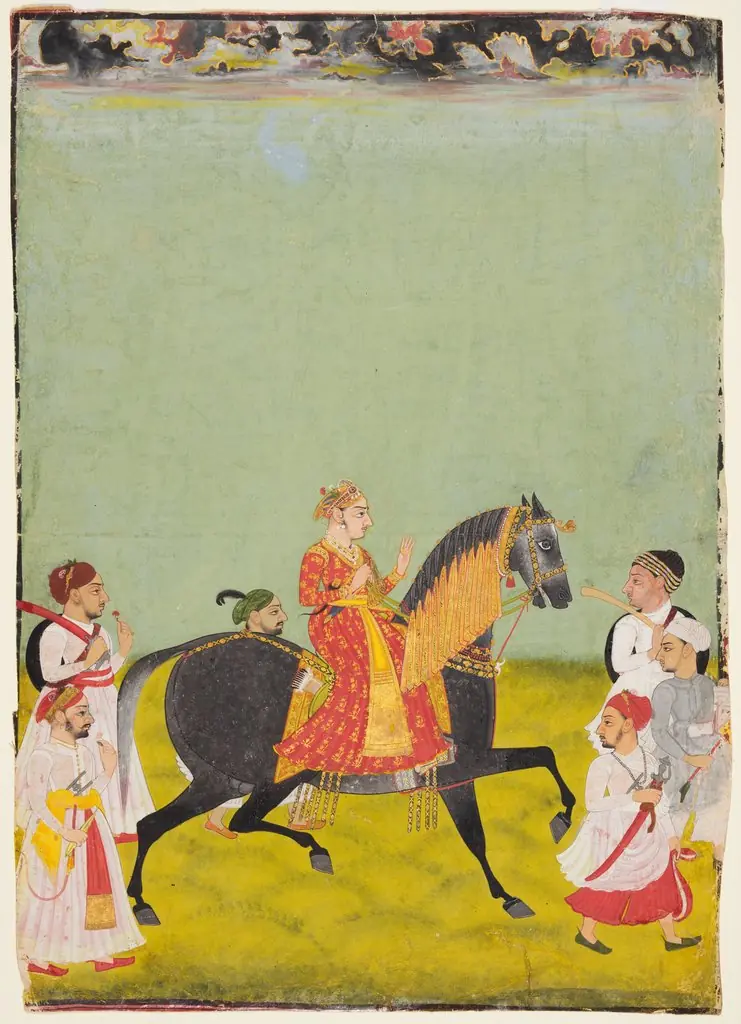
Prince Mathu Singh of Jatoli on a Blue Horse Riding to Udaipur
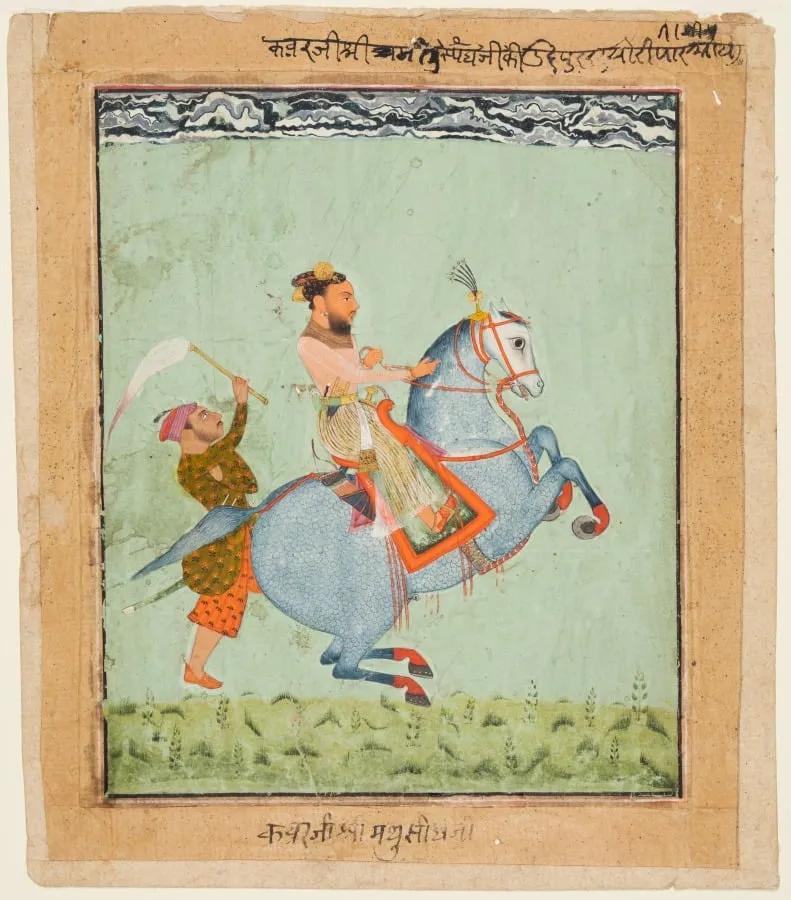
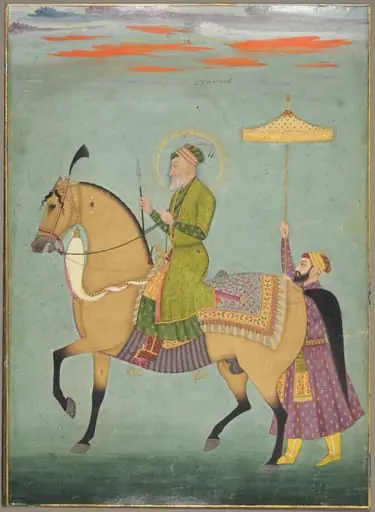
Prince Mathu Singh of Jatoli on a Blue Horse Riding to Udaipur is an unspecified painting by the Baroque artist Unknown. It dates from 1720 and is held in the collection of the Cleveland Museum of Art. This painting records the departure of Prince Mathu Singh of Jatoli on a journey to Udaipur, the capital of the Mewar Kingdom.
About this work
Overview
This painting records the departure of Prince Mathu Singh of Jatoli on a journey to Udaipur, the capital of the Mewar Kingdom.
This painting records the departure of Prince Mathu Singh of Jatoli on a journey to Udaipur, the capital of the Mewar Kingdom. The scene captures the moment he begins a nearly 600-kilometer ride, a significant act of political and personal transition. The composition focuses on the prince and his rearing blue horse, framed by a single attendant, emphasizing the quiet gravity of the occasion rather than grand spectacle.
Subject & Meaning
Prince Mathu Singh’s journey symbolizes the assertion of his lineage and the formal submission of his small principality to the authority of Mewar. The rearing horse marks the commencement of the trip, not its climax, underscoring the journey’s importance as a rite of passage. The fly-whisk held by the attendant is a subtle emblem of royal dignity, signaling status without overt display, consistent with Rajput courtly restraint.
Technique & Style
Rendered in watercolor and opaque pigments, the painting employs fine brushwork to convey the translucency of the prince’s muslin garment and the muscular tension of the horse. The blue horse, rendered with unnatural but deliberate color, stands out against a minimal background, directing focus to the figures. The lack of landscape detail reinforces the moment’s intimacy and symbolic weight over geographic realism.
History & Provenance
The painting was likely commissioned to commemorate Prince Mathu Singh’s formal visit to the Mewar court, possibly to secure alliance or recognition. It originated in the eastern Rajasthan region, likely within the Jatoli court’s artistic circle, and entered later collections through royal lineage or diplomatic exchange. Its survival reflects the value placed on documenting such political movements among minor Rajput houses.
Context
In 18th-century Rajasthan, minor princely states like Jatoli maintained autonomy while navigating the dominance of larger powers like Mewar. Travel between courts was both ceremonial and strategic, reinforcing ties through personal presence. This painting fits a broader tradition of Rajput portraiture that valued symbolic moments—departures, arrivals, and rituals—over narrative storytelling.
Legacy
The work remains a rare visual record of a minor Rajput prince’s political engagement, offering insight into the quiet diplomacy of smaller courts. Its restrained composition and symbolic details distinguish it from more flamboyant court paintings, highlighting how status and intention were conveyed through subtlety. It contributes to understanding the diversity of Rajput artistic expression beyond major centers.
Artist & collection

 Domestic Scene
 Giacomo and Cardinal Marco, investing Andrea, Abbot of San Zeno, with his Benefice
 The Nymph of Fontainebleau
 Portrait of a Woman
 Madonna and Child with Saints in the Enclosed Garden
 Venus and Minerva
 Family Group of Four on Sofa
 Wall painting from Room H of the Villa of P. Fannius Synistor at Boscoreale
 Prince Mathu Singh of Jatoli on a Blue Horse Riding to Udaipur
 Maharaja Sawai Jai Singh
 Raja Dhian Singh
 Equestrian Portrait of Maharana Raj Singh II of Mewar (r. 1755–62)
 Maharana Bhim Singh in Procession
 Equestrian Portrait of Maharana Raj Singh II of Mewar (r. 1755–62)
 Amir Khan
 The Emperor Alamgir (reigned 1658–1707) on Horseback