Artwork
The Emperor Alamgir (reigned 1658–1707) on Horseback
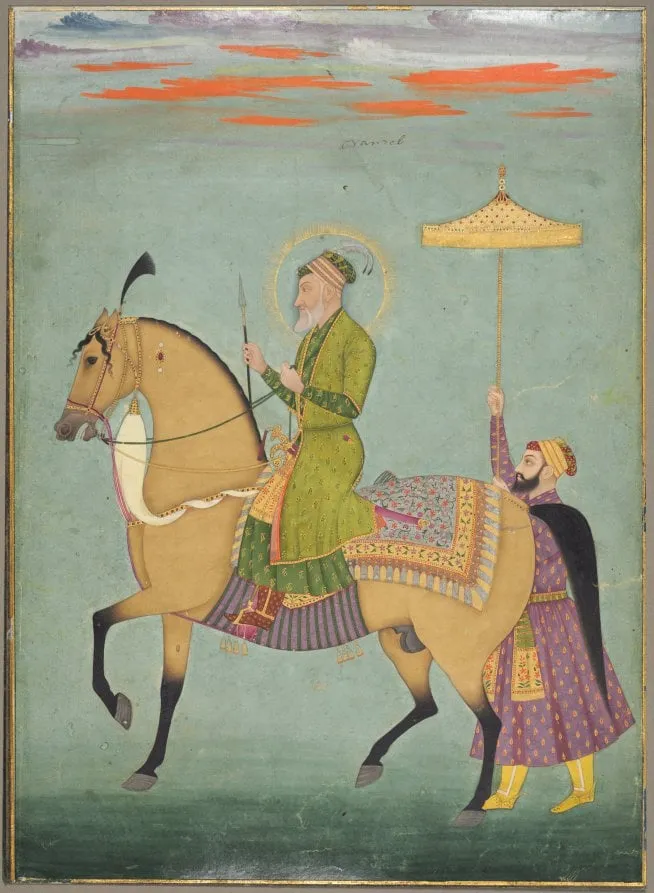
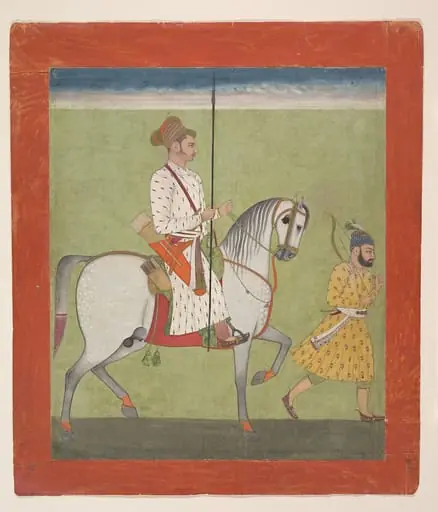
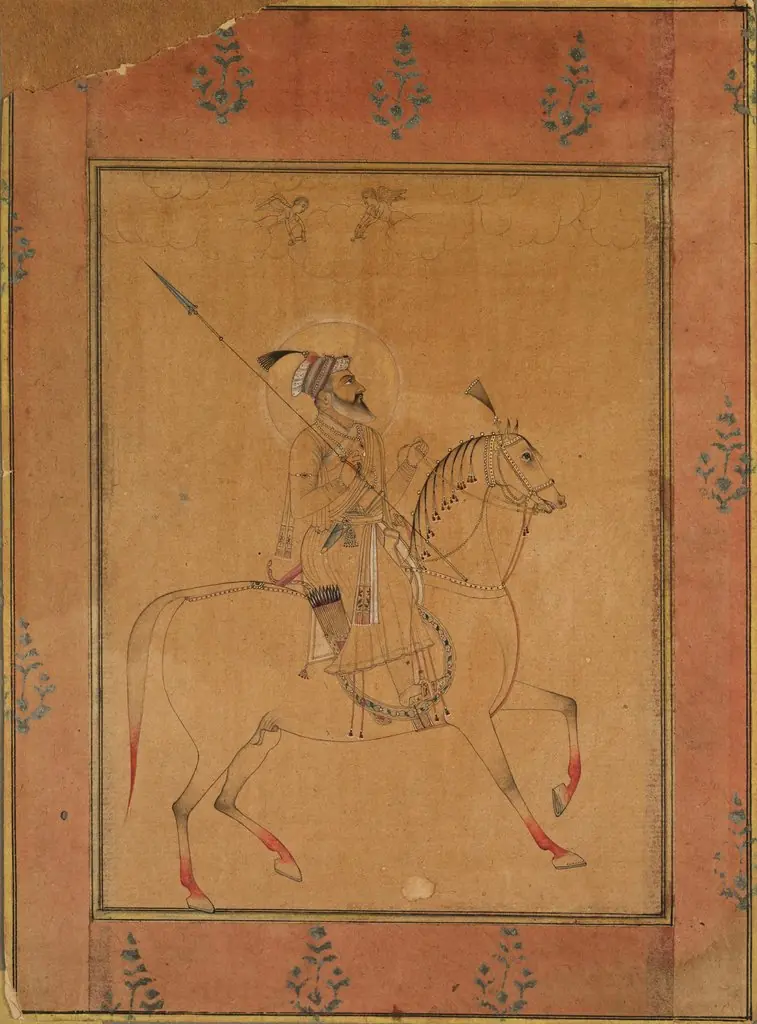
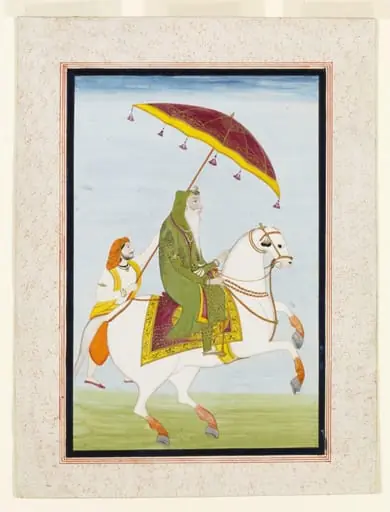
The Emperor Alamgir (reigned 1658–1707) on Horseback is an unspecified painting by the Baroque artist Unknown. It dates from 1700 and is held in the collection of the Cleveland Museum of Art. This equestrian portrait depicts Emperor Alamgir I, the sixth ruler of the Mughal dynasty, mounted on a finely adorned white horse.
About this work
You see a Mughal emperor on a prancing white horse, spear in hand, while a servant holds a parasol above his head.
You see a Mughal emperor on a prancing white horse, spear in hand, while a servant holds a parasol above his head.
This painting mixes Indian royal symbols with European-style horse portraits. The parasol—a sign of kingship for centuries—shows how Mughal rulers borrowed ideas from both East and West. The artist likely worked from prints sent as gifts to the court.
If you like this, look up more about the subject: mughal dynasty (1526-1756).
Overview
This equestrian portrait depicts Emperor Alamgir I, the sixth ruler of the Mughal dynasty, mounted on a finely adorned white horse. The composition reflects a fusion of European artistic influences—introduced through printed images gifted to the Mughal court—and traditional Indian iconography. The emperor is shown in dynamic readiness, embodying both martial authority and imperial dignity, with visual cues drawn from both Western portraiture and South Asian royal symbolism.
Subject & Meaning
Alamgir is portrayed as a warrior-king, spear poised and sword at hand, suggesting preparedness for campaign. Above him, a servant holds a ceremonial parasol, an ancient Indian symbol of sovereignty that predates Mughal rule. The pairing of European-style horsemanship with this enduring emblem signals the emperor’s dual identity: a conqueror shaped by global exchange yet rooted in indigenous traditions of kingship.
Technique & Style
The painting adapts European compositional conventions—such as the dynamic pose of the horse and naturalistic rendering of anatomy—while retaining the meticulous detail and flat decorative elements characteristic of Mughal miniatures. The horse’s trappings and the attendant’s attire are rendered with fine brushwork, and the background remains sparse, focusing attention on the figures. The artist likely based the image on imported engravings, reinterpreting them through local aesthetic sensibilities.
History & Provenance
Created during Alamgir’s long reign (1658–1707), the painting reflects the imperial court’s engagement with European visual culture, particularly through gifts of prints from Jesuit missionaries and diplomatic envoys. It was likely produced in a royal atelier, where artists synthesized foreign models with indigenous traditions. The work served as a visual assertion of imperial power, circulated among courtiers and foreign dignitaries to reinforce the emperor’s authority.
Context
Alamgir’s reign was defined by military expansion, especially into the Deccan region, which brought the Mughal Empire to its largest territorial extent. The portrait aligns with this era of aggressive consolidation, using imagery to project strength and legitimacy. The blending of European and Indian motifs mirrors the broader cultural syncretism of the Mughal court, where Persian, Indian, and Western elements coexisted in art, architecture, and governance.
Legacy
This portrait exemplifies how Mughal artists selectively adopted foreign techniques without abandoning local symbolic systems. It stands as a testament to the dynasty’s cosmopolitan character and its ability to transform external influences into distinctly imperial expressions. Later Mughal and regional courts continued to reference such compositions, embedding the fusion of East and West into the visual language of South Asian royalty.
Artist & collection

 Domestic Scene
 Giacomo and Cardinal Marco, investing Andrea, Abbot of San Zeno, with his Benefice
 The Nymph of Fontainebleau
 Portrait of a Woman
 Madonna and Child with Saints in the Enclosed Garden
 Venus and Minerva
 Family Group of Four on Sofa
 Wall painting from Room H of the Villa of P. Fannius Synistor at Boscoreale