Artwork
Rama
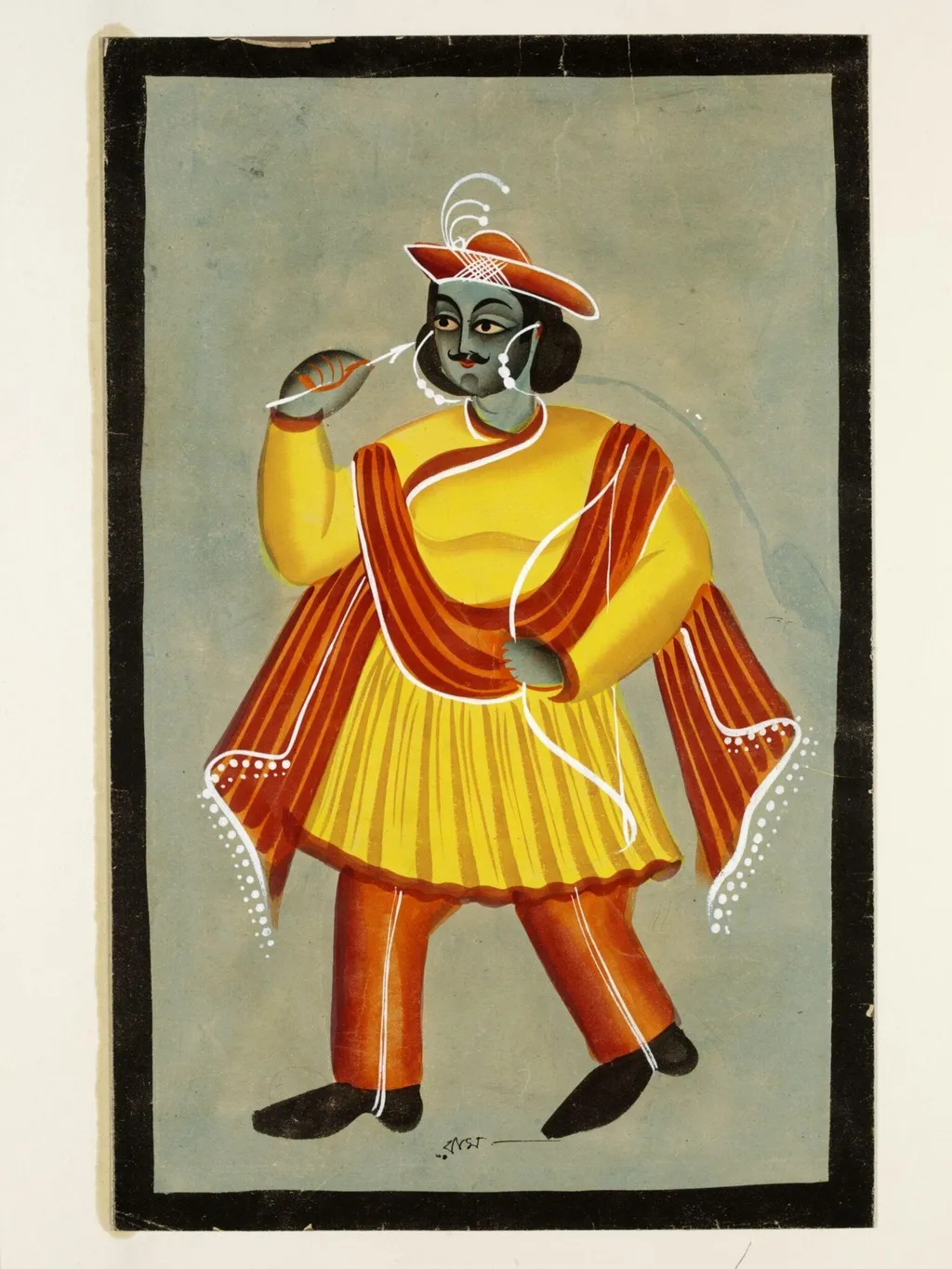
Rama is a paint painting by the Impressionist artist Unknown. It dates from 1885 and is held in the collection of the Victoria and Albert Museum.
About this work
Overview
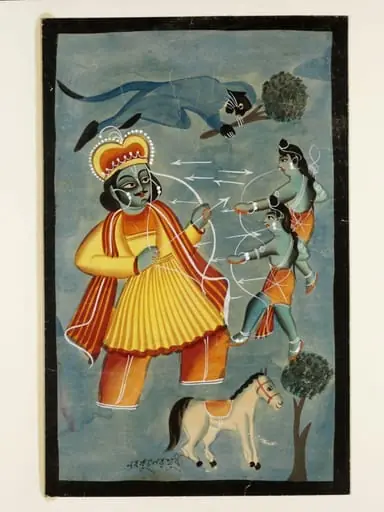
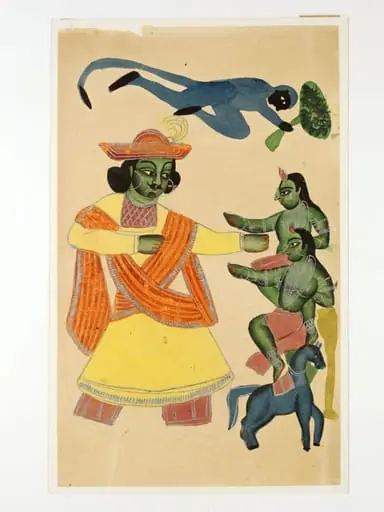
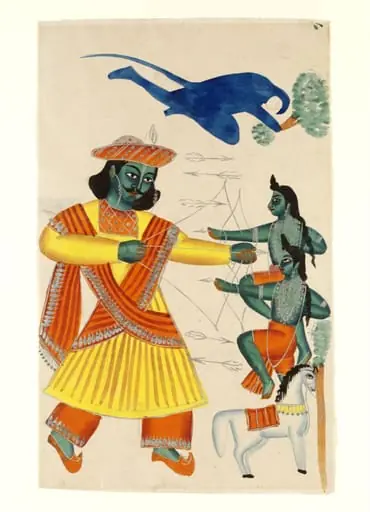
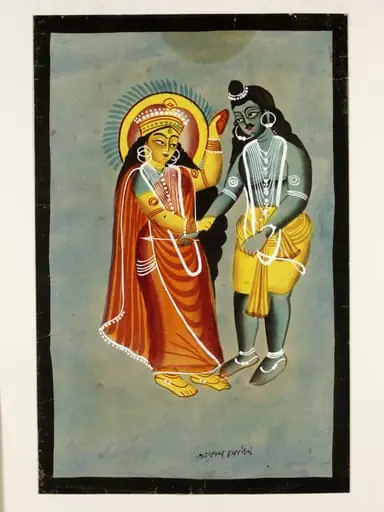
Created in 1885, this opaque watercolor on paper portrays Rama, the seventh incarnation of the Hindu god Vishnu. The composition centers on a dark‑skinned figure dressed in vivid yellow and red garments, a red headpiece, and black footwear, set against a plain gray backdrop.
Subject & Meaning
Rama is a central hero of the Indian epic Ramayana, embodying ideals of duty, righteousness and devotion. The painting captures him holding a curved implement—likely a bow or sword—in one hand and a smaller object, perhaps a symbolic token, in the other, underscoring his role as a warrior‑prince and divine protector.
Technique & Style
The work employs an opaque watercolor technique that yields flat, saturated areas of color with minimal modeling. Clean outlines define the figure, while white accents trace the edges of the clothing and facial features. The overall effect is graphic and stylized, emphasizing bold hues over three‑dimensional modeling.
History & Provenance
The piece entered the collection in 1894 through the purchase from Miss M. Steele, whose mother, a Sanskrit scholar at Cambridge, had likely acquired the painting during her time in India. The artwork thus reflects both a personal scholarly interest in Indian culture and the broader Victorian fascination with Oriental subjects.
Artist & collection

 Domestic Scene
 Giacomo and Cardinal Marco, investing Andrea, Abbot of San Zeno, with his Benefice
 The Nymph of Fontainebleau
 Portrait of a Woman
 Madonna and Child with Saints in the Enclosed Garden
 Venus and Minerva
 Family Group of Four on Sofa
 Wall painting from Room H of the Villa of P. Fannius Synistor at Boscoreale