Artwork
Rama, Lakshma and Gaya
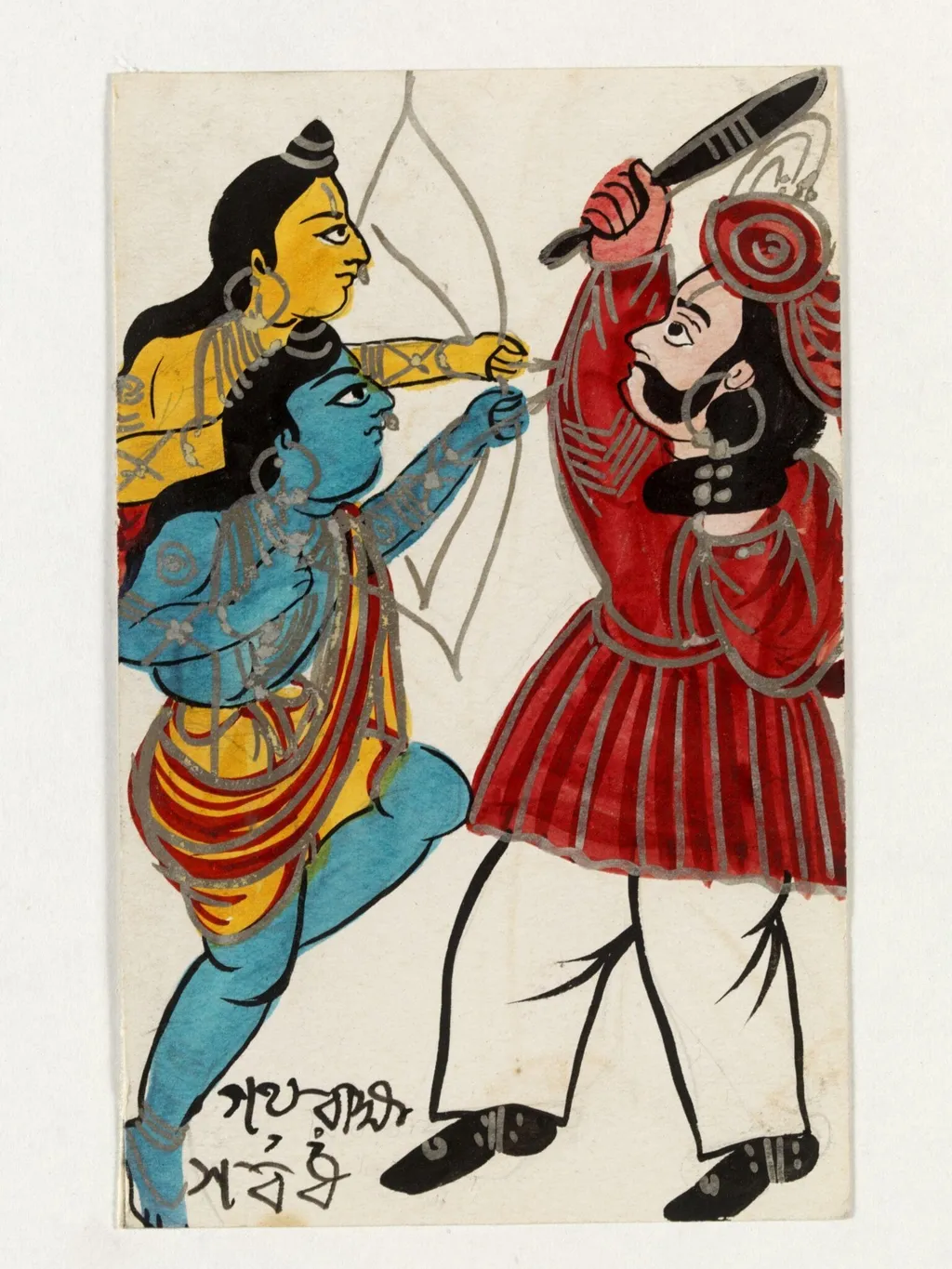
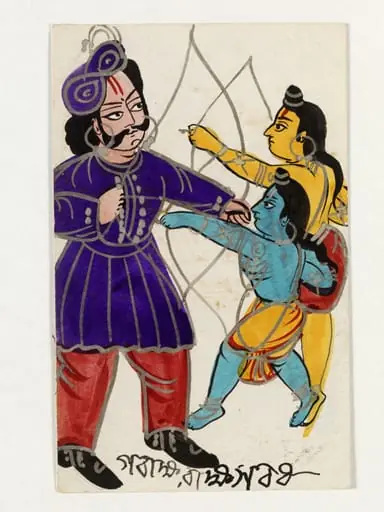
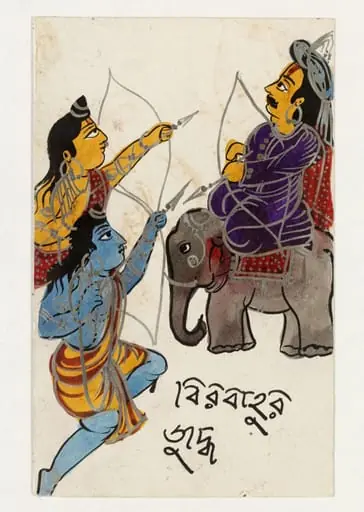
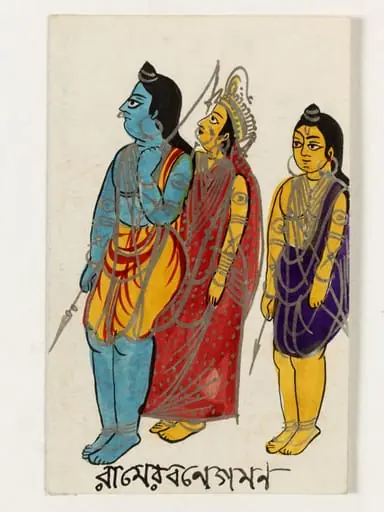
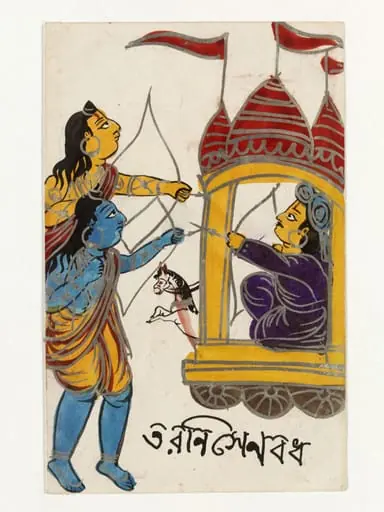
Rama, Lakshma and Gaya is a paint painting by the Impressionist artist Unknown. It dates from 1890 and is held in the collection of the Victoria and Albert Museum. This 1890 watercolor and tin alloy painting on paper originates from the Kalighat school in Calcutta.
About this work
Overview
This 1890 watercolor and tin alloy painting on paper originates from the Kalighat school in Calcutta.
This 1890 watercolor and tin alloy painting on paper originates from the Kalighat school in Calcutta. It depicts a moment from the Ramayana involving Rama, Lakshmana, and the demoness Gaya. The work is part of a broader tradition of Bengali folk-art production that responded to urbanization and colonial influence, offering accessible religious imagery to a growing middle class through inexpensive, mass-produced formats.
Subject & Meaning
The scene illustrates Rama and Lakshmana confronting Gaya, a demoness who had taken human form. Rama, armed with bow and arrow, stands poised to strike, while Lakshmana supports him. Gaya, depicted in red robes with sword and shield, represents the forces of chaos. The composition captures a decisive moment in the myth, emphasizing dharma’s triumph without overt violence, reflecting the narrative’s moral clarity central to Hindu epics.
Technique & Style
Executed in bold, flat colors with minimal detail, the painting exemplifies Kalighat’s signature style: unmodulated hues, strong outlines, and absence of shading. Figures are rendered with simplified anatomy and stylized costumes, their patterns suggested rather than detailed. Tin alloy was used to add metallic sheen to ornaments and weapons, enhancing visual impact while keeping production efficient for the market-driven workshop system of the time.
History & Provenance
Created in Calcutta during the late 19th century, the painting emerged from artist communities near the Kalighat temple, who adapted traditional iconography for urban patrons. These works were sold as devotional objects or souvenirs, often to British collectors and local middle-class households. Its survival reflects its role in a thriving, commercially oriented art economy that persisted despite colonial cultural shifts.
Context
Amid British colonial rule, Kalighat artists reinterpreted Hindu myths for a changing society. The style evolved from temple scroll paintings into portable, affordable art, responding to new audiences and materials. This painting’s fusion of mythological narrative with contemporary visual language illustrates how traditional themes were sustained through adaptation, not preservation, in a rapidly modernizing city.
Legacy
Kalighat paintings like this one influenced later Indian modernist movements by demonstrating how folk aesthetics could carry complex narratives. Though initially dismissed as commercial art, they are now recognized for their expressive economy and cultural resilience. Collections in institutions such as the Victoria and Albert Museum preserve these works as vital records of 19th-century Bengali visual culture.
Artist & collection

 Domestic Scene
 Giacomo and Cardinal Marco, investing Andrea, Abbot of San Zeno, with his Benefice
 The Nymph of Fontainebleau
 Portrait of a Woman
 Madonna and Child with Saints in the Enclosed Garden
 Venus and Minerva
 Family Group of Four on Sofa
 Wall painting from Room H of the Villa of P. Fannius Synistor at Boscoreale