Artwork
Rama, Sita and Lakshmana
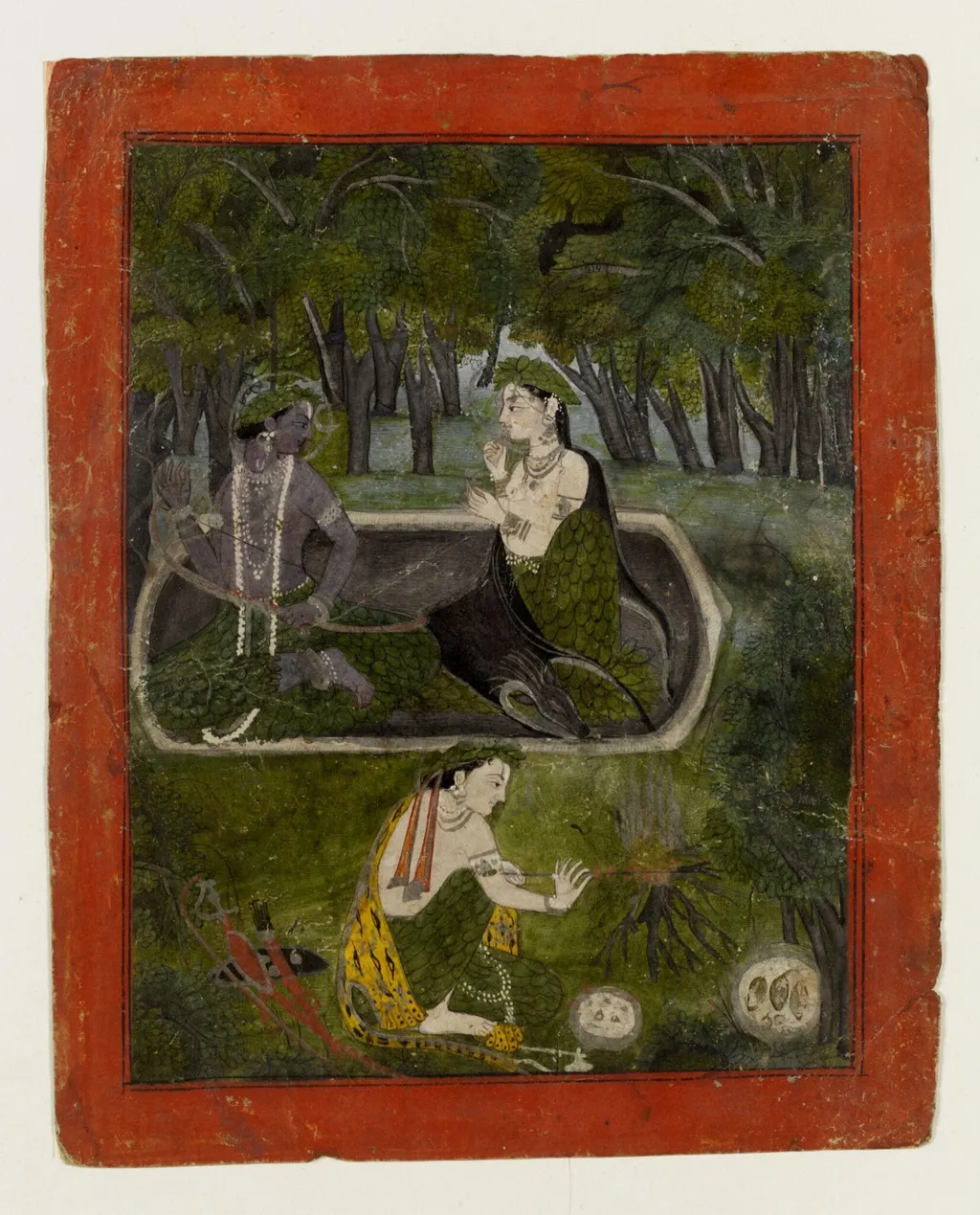
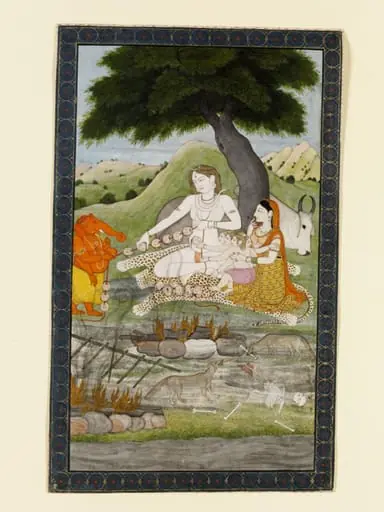
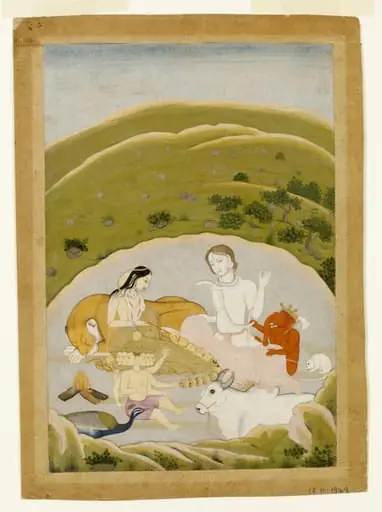
Rama, Sita and Lakshmana is a paint painting by the Romanticist artist Unknown. It dates from 1820 and is held in the collection of the Victoria and Albert Museum. This early 19th-century painting, executed in opaque watercolor on paper, portrays three central figures from Hindu epic tradition.
About this work
Overview
This early 19th-century painting, executed in opaque watercolor on paper, portrays three central figures from Hindu epic tradition. The scene unfolds in a forested environment, where Rama and Sita recline on a deerskin mat while Lakshmana tends to a nearby fire. The composition balances human interaction with natural elements, rendered in vibrant yet softened hues that suggest age.
Subject & Meaning
The work depicts a moment from the Ramayana, focusing on Rama, his consort Sita, and his brother Lakshmana during their exile.
The work depicts a moment from the Ramayana, focusing on Rama, his consort Sita, and his brother Lakshmana during their exile. Their placement within a tranquil forest setting underscores themes of duty, devotion, and separation. The figures’ postures—Rama seated in conversation, Sita at ease, and Lakshmana in attentive service—reflect hierarchical and emotional relationships central to the narrative.
Technique & Style
The artist employs opaque watercolor, a medium common in Indian miniature painting, to achieve rich, flat color fields. Delicate linework defines the figures and foliage, while the red-bordered frame directs attention inward. Though the palette retains brightness, time has muted some pigments, particularly the framing edges. The style merges narrative clarity with decorative precision, avoiding Western perspectival depth.
History & Provenance
Dated to approximately 1820, the painting originates from a period of active patronage under regional Indian courts. Its exact origin remains unconfirmed, though stylistic elements align with Rajasthani or Pahari traditions. The work likely entered Western collections in the 19th or early 20th century, reflecting broader colonial-era interest in South Asian art. Documentation of its early ownership is fragmentary.
Context
The painting emerges from a cultural milieu where visual retellings of the Ramayana served both devotional and aesthetic purposes. During the early 1800s, Indian artists frequently collaborated with local rulers to produce works that reinforced religious and political identity. The forest setting, a recurring motif, evokes the exile narrative while resonating with contemporary romanticized views of nature.
Legacy
This work exemplifies the enduring appeal of Ramayana imagery in Indian art, bridging sacred text and visual storytelling. Its inclusion in later exhibitions and collections has contributed to the preservation of pre-colonial artistic practices. While not singular in its iconography, the painting offers insight into the stylistic conventions and thematic preoccupations of its era.
Artist & collection

 Domestic Scene
 Giacomo and Cardinal Marco, investing Andrea, Abbot of San Zeno, with his Benefice
 The Nymph of Fontainebleau
 Portrait of a Woman
 Madonna and Child with Saints in the Enclosed Garden
 Venus and Minerva
 Family Group of Four on Sofa
 Wall painting from Room H of the Villa of P. Fannius Synistor at Boscoreale