Artwork
Romeo and Juliet
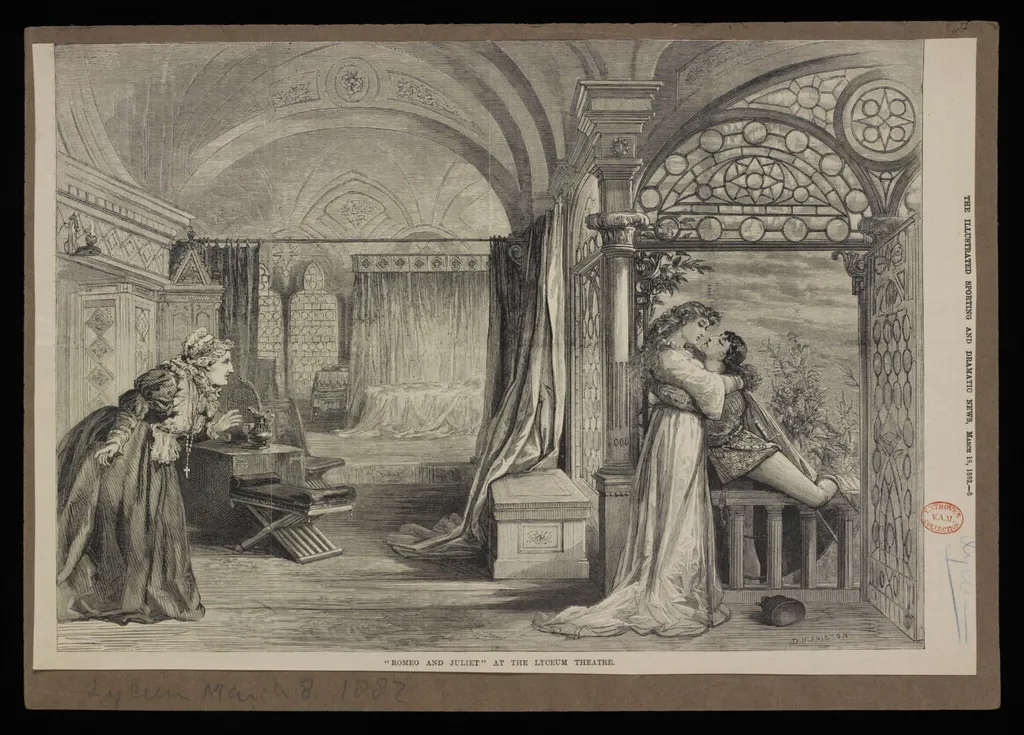
Romeo and Juliet is a print by the Impressionist artist Unknown. It dates from 1882 and is held in the collection of the Victoria and Albert Museum.
About this work
This print shows a scene from Romeo and Juliet.
The production was at the Lyceum Theatre in 1882. It featured Henry Irving as Romeo and Ellen Terry as Juliet.
This scene was printed in The Illustrated Sporting and Dramatic News, giving us a glimpse of theater history, similar to what you can see at the museum: Victoria and Albert Museum.
Overview
The image is a printed illustration of the balcony episode from Shakespeare’s Romeo and Juliet, as staged at London’s Lyceum Theatre in March 1882. It was reproduced in the March 18, 1882 issue of The Illustrated Sporting and Dramatic News, offering a contemporary visual record of the production’s staging and principal performers.
Subject & Meaning
The print captures the iconic moment when Romeo and Juliet declare their love from opposite balconies, a focal point of the tragedy’s romantic narrative. By depicting the actors in costume, the illustration emphasizes the emotional intensity and theatricality that the Lyceum’s audience would have experienced.
Technique & Style
Executed as a black‑and‑white print, the image employs line work and shading to delineate figures, architecture, and stage lighting. The composition centers the two protagonists while including secondary characters such as the Nurse, allowing viewers to discern costume details and set design typical of late‑Victorian theatre.
History & Provenance
The production formed part of Henry Irving’s actor‑manager tenure at the Lyceum, during which he frequently partnered with leading lady Ellen Terry.
The production formed part of Henry Irving’s actor‑manager tenure at the Lyceum, during which he frequently partnered with leading lady Ellen Terry. Alongside Irving as Romeo and Terry as Juliet, the cast featured William Terriss as Mercutio, with incidental music composed by Sir Julius Benedict. The printed illustration was circulated in a popular periodical of the era, preserving a snapshot of the performance.
Context
Irving’s Lyceum seasons were renowned for their lavish productions and star pairings, contributing to the revival of Shakespeare on the Victorian stage. The 1882 staging of Romeo and Juliet exemplified this trend, combining high‑profile actors, original musical accompaniment, and elaborate scenery to attract a broad audience.
Legacy
The illustration remains a valuable documentary source for scholars of 19th‑century theatre, illustrating performance practice, costuming, and set design of the period. Its preservation in museum collections, such as the Victoria and Albert Museum, underscores its role in chronicling the visual culture of historic theatrical productions.
Artist & collection

 Domestic Scene
 Giacomo and Cardinal Marco, investing Andrea, Abbot of San Zeno, with his Benefice
 The Nymph of Fontainebleau
 Portrait of a Woman
 Madonna and Child with Saints in the Enclosed Garden
 Venus and Minerva
 Family Group of Four on Sofa
 Wall painting from Room H of the Villa of P. Fannius Synistor at Boscoreale