Artwork
Sf. Ioan Botezătorul și Sf.Nicolae
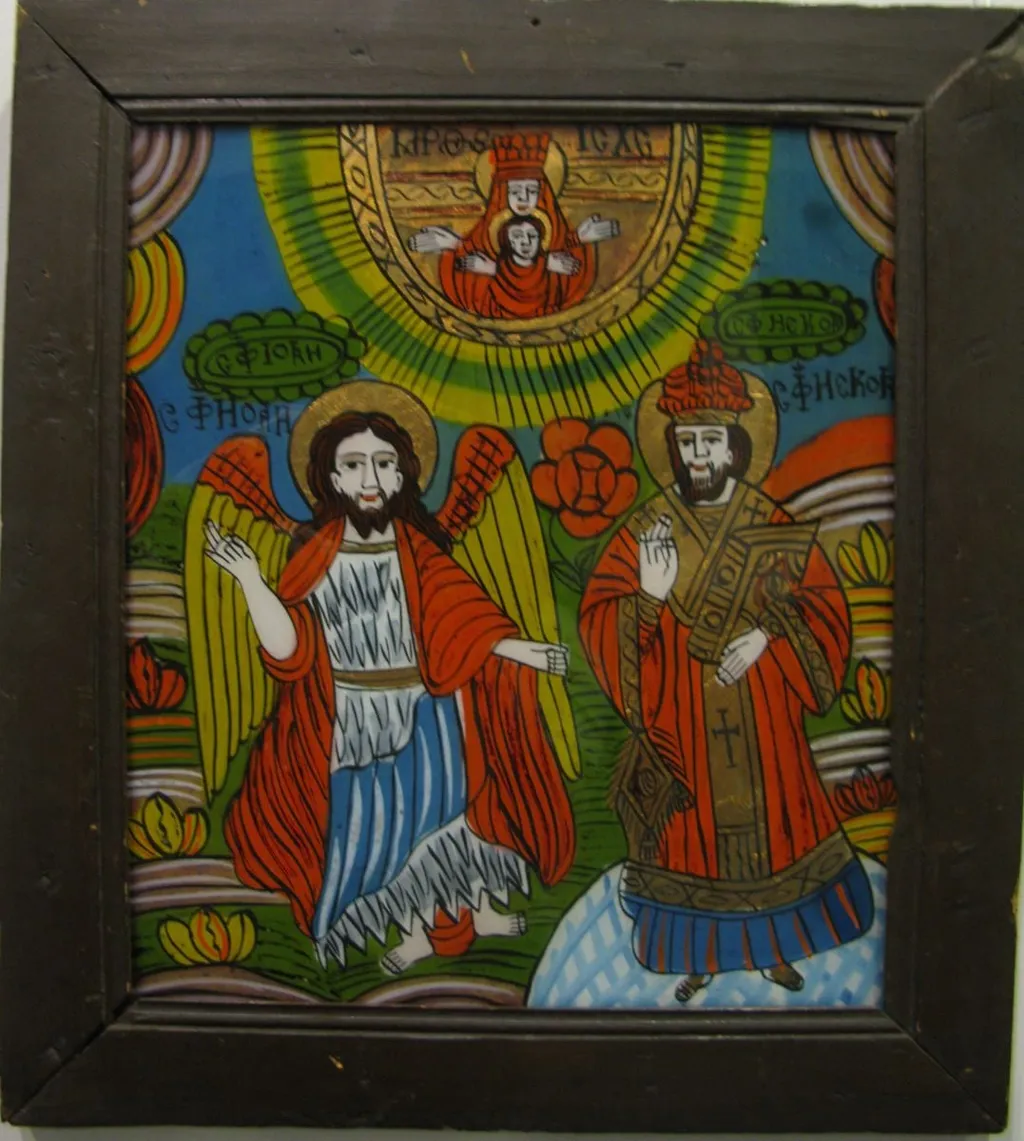
Sf. Ioan Botezătorul și Sf.Nicolae is a drawing by Unknown. It dates from 1850 and is held in the collection of the National Museum of Art of Romania. This religious panel depicts two saints side by side against a luminous celestial background.
About this work
Overview
This religious panel depicts two saints side by side against a luminous celestial background. The figures are rendered in flat, saturated hues with minimal modeling, emphasizing symbolic presence over naturalism. A circular halo above them contains three smaller figures, suggesting divine authority. Inscriptions in an archaic script frame the composition, reinforcing its liturgical function.
Subject & Meaning
Together, they serve as intercessors, their placement within a heavenly sphere affirming their spiritual mediation.
The left figure, bearded and holding a staff with red blossoms, is Saint John the Baptist, identified by his ascetic attributes and the staff’s floral tip, a symbol of his prophetic role. The right figure, crowned and clad in blue and gold, represents Saint Nicholas, patron of the faithful. Together, they serve as intercessors, their placement within a heavenly sphere affirming their spiritual mediation.
Technique & Style
The artist employs bold, unmodulated colors and simplified forms, typical of late medieval iconography. Cross-hatching adds subtle texture to the robes, suggesting fabric without depth. The glowing circle behind the saints is rendered with flat gold and blue, contrasting with the green-tinted clouds. The inscriptions encircling the scene are executed in a stylized, archaic script, enhancing the sacred atmosphere.
History & Provenance
The painting likely originated in a Byzantine-influenced Orthodox context, possibly from the Balkans or Romania, during the 15th or early 16th century. Its format and iconography align with portable devotional panels used in private or monastic settings. No documented provenance is available, but its stylistic features suggest regional workshop production rather than a major center.
Context
In Eastern Christian tradition, paired saint icons like this served both devotional and didactic purposes, often displayed in homes or chapels. The inclusion of a celestial triad—possibly the Trinity or angelic figures—within the halo reflects theological emphasis on divine presence. The use of inscriptions and symbolic attributes followed established iconographic conventions to ensure immediate recognition by the faithful.
Legacy
This work exemplifies the enduring visual language of Orthodox icon painting, where symbolism outweighs realism. Its preservation offers insight into regional devotional practices and the transmission of Byzantine artistic norms in peripheral areas. Though not widely known outside local collections, it remains a representative example of pre-modern religious panel painting in Eastern Europe.
Artist & collection

 Domestic Scene
 Giacomo and Cardinal Marco, investing Andrea, Abbot of San Zeno, with his Benefice
 The Nymph of Fontainebleau
 Portrait of a Woman
 Madonna and Child with Saints in the Enclosed Garden
 Venus and Minerva
 Family Group of Four on Sofa
 Wall painting from Room H of the Villa of P. Fannius Synistor at Boscoreale
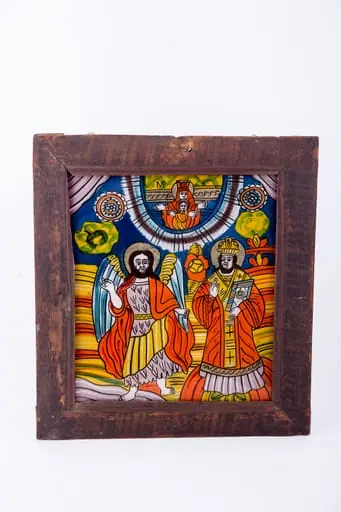 Icoana îi reprezintă pe Sfântul Ioan Botezătorul și Înaintemergătorul Mântuitorului Iisus Hristos și pe Sfântul Mare Ierarh Vasile cel Mare. Cel dintâi este simbolul pocăinței și cel de-al doilea este asprimea dezlegărilor. Sfântul Ioan Botezătorul este îmbrăcat cu o mantie roșie vermillon și ocru și un himation gri-brun sau o haină din păr de cămilă. Este desculț și are aripi de înger. Sfântul Mare Ierarh Vasile cel Mare este îmbrăcat în veșminte liturgice de arhiereu, cu mantie roșie vermillon, sacos alb-gri, epitrahil-patrafir galben, mithră mitopolitană și ține în mâna stânga Sfânta Evanghelie închisă și cu mâna dreaptă binecuvintează. În registrul superior, într-un semicerc de raze, asemenea unei mandorle de nouri, ca într-o deschidere de Ceruri, este Maica Domnului cu Pruncul Iisus Hristos în brațe, amândoi arătând Calea, ocrotind, păzind și binecuvântând. Maica Domnului este Orantă, adică rugătoare. Fondul icoanei este albastru ceruleum, pe care sunt câteva flori mari galben-verzi și doi aștri decorativi. Soarele, luna, stelele și florile adeseori se suprapun simbolic și semantic în icoanele din Țara Oltului. Cromatica este armonioasă, luminoasă și vie: roșu vermillon, galben, ocru, verde, albastru ceruleuum, alb, negru.
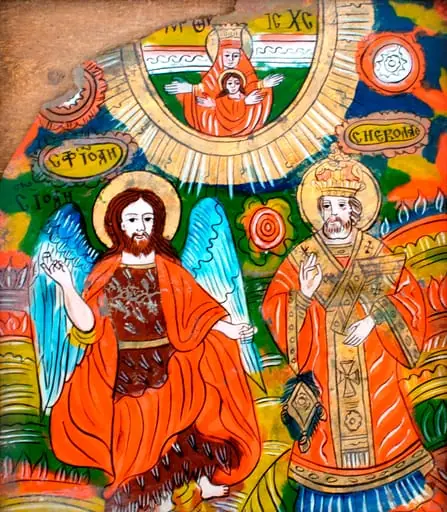 Asociere mai rar întâlnită, probabil comandată special. Icoana îi reprezintă pe în prim plan Sfinții Ioan Botezătorul și Sfântul Nicolae(1/1), deasupra lor Maica Domnului Platytera într-un medalion aurit,înconjurat de raze. Maica are coroană împărătească și îl ține pe Isus copil în poală, ambii avînd brațele desfăcute. Sfântul Ioan este în ipostaza îngerească, înaripat, desculț, binecuvântând cu dreapta, înveșmântat cu haina de păr de cămilă, deasupra mantie roșie. Sfântul Nicolae este prezentat în ipostaza de mare ierarh, cu însemnele episcopale(mitră pe cap, sacos, epitrahil decorat cu cruci și motive florale, bedernița cu franjuri și motive geometrice) Relief stilizat, alternanță de benzi ondulate multicolore, și registre cu elemente fitomorfe. Inscripțiile în chenare, numele sfântului Ioan dublat în afara chenarului. Câmp albastru ultramarin, decorat cu pete de culoare și motive astrale stilizate. Medalionul este împărțit în două zone de culoare(galben și verde) printr-o bandă albă cu motiv spiralat(funia răsucită). Cromatica este foarte variată:alb, albastru, verde, roșu, galben, ocru,culori intense. Icoana are colțul stâng lipsă.
 Sfânbrad
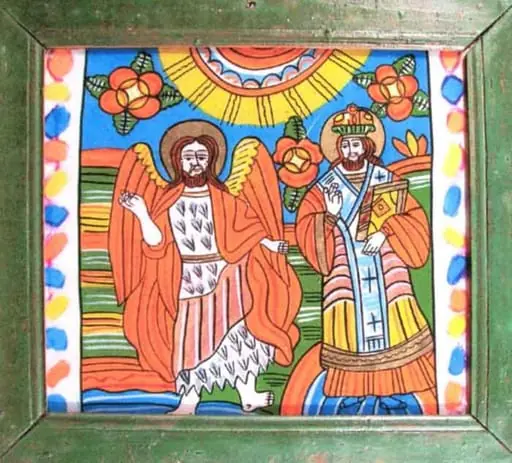 Iisus Împărat și Sfântul Ioan Botezătorul
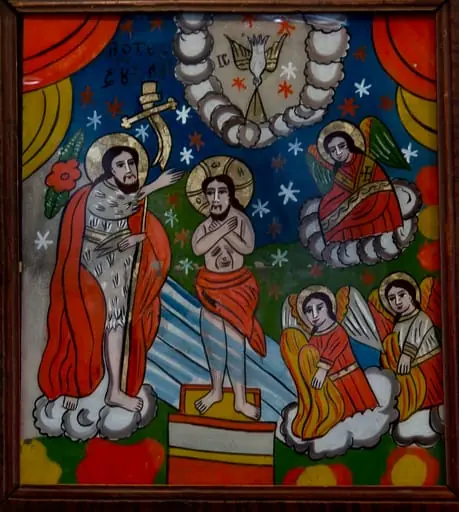 Botzezul lui IS HS
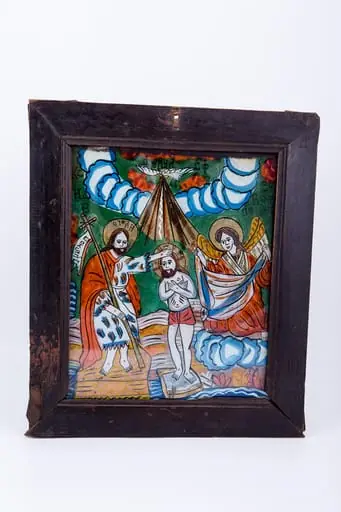 Domnul Iisus Hristos primește Botezul, în râul Iordanului, din partea Sfântului Mare Prooroc și Înaintemergător Ioan Botezătorul, care se află în dreapta Mântuitorului. Mântuitorul este înfășurat cu o pânză de culoare roșie împrejurul șoldurilor și a coapselor. În stânga Lui, este un înger evlavios, care Îl așteaptă cu un ștergar alb-roșu-albastru gata să înveșmânteze Trupul Domnului. Sfântul Ioan Botezătorul este îmbrăcat cu o mantie roșie și un himation alb-brun sau o haină din păr de cămilă. Cerurile de culoare verde, asemenea Duhului Sfânt, sunt deschise și izvorăște o rază de lumină, pe care se pogoară porumbelul, simbolul Sfântului Duh, pe creștetul Mântuitorului. Mandorla de nouri rotunzi, care permite deschiderea Cerurilor au o alternanță cromatică de alb și albastru bleu-ciel. Cromatica este specifică Țării Oltului: auriu, roșu vermillon, verde spanac-avocado, albastru bleu-ciel, bej, gri, ocru, brun-nisipiu, alb, negru. Inscripția din româno-chirilică se traduce Botezul Lui IC XC Iisus Hristos Sfântul Duh Ioan.
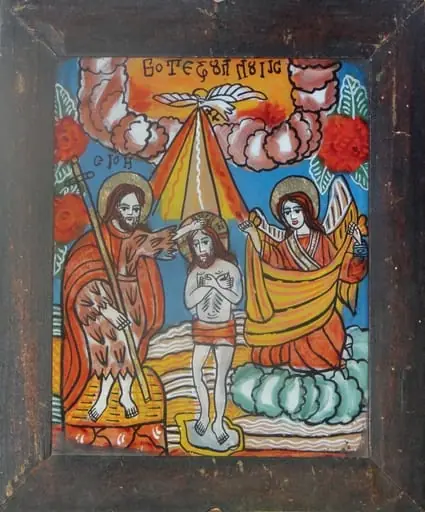 Botezul Domnului
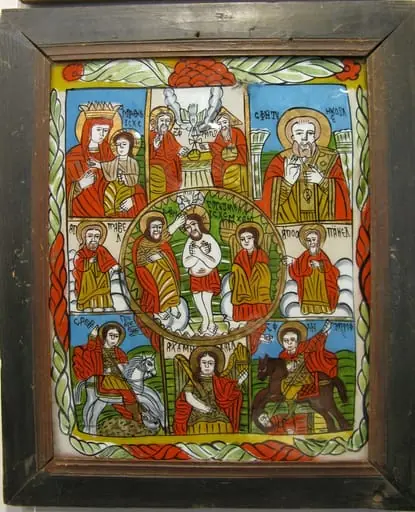 Prăznicar – Botezul lui IS HS
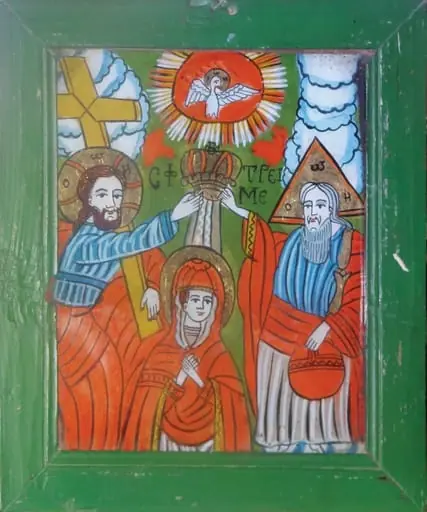 Încoronarea Fecioarei
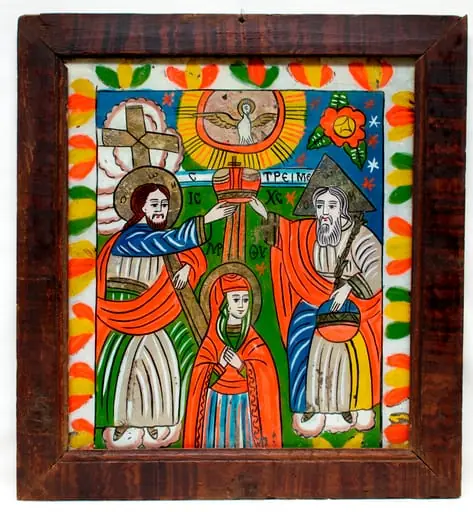
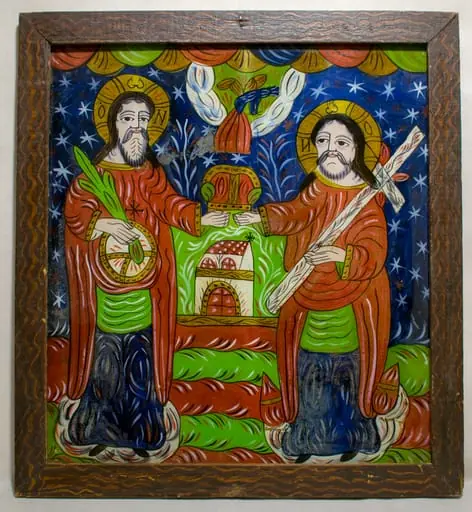 Icoana reprezintă Sfânta Treime prin cele trei ipostasuri ale aceleiași Persoane: Dumnezeu Tatăl, Isus Hristos - Fiul și Sfântul Duh, în formă de porumbel.Tratarea temei este asemănătoare cu Încoronarea Fecioarei, una dintre caracteristicile picturii de factură populară din Țara Oltului, în special a membrilor familiei Tămaș, fiind inocența cu care combină temele sau le redau într-o formă incompletă. Dumnezeu Tatăl și Isus Hristos redați în prim plan. Ei susțin cu câte o mână coroana împărătească cu care încununează Biserica, redată simbolic și miniatural în centrul picturii. Deasupra acesteia, dintr-un nor se revarsă Harul Sfântului Duh, redat sub formă de porumbel, dar nu alb. Reprezentarea primelor două ipostasuri este aproape identică, Canonic, în iconografia bizantină, Dumnezeu Tatăl, al cărui chip nimeni nu l-a văzut, este redat printr-o mână ieșind dintr-un nor. Icoana preia reprezentarea consacrată de biserica catolică. Dintre elementele semnificative care diferențiază pe Dumnezeu Tatăl de Fiul se numără crucea Calvarului pe care Hristos o ține pe umărul stâng în timp ce Tatăl ține globul pământesc și un sceptru de formă vegetală.Nimbul cruciger apare în formă rotundă la ambele persoane. Partea de sus a icoanei este ocupată de o draperie de nori. Câmpul albastru ultramarin este ornamentat cu o mulțime de stele albe. Specifică pentru Țara Oltului este adăugarea de linii, puncte, arabescuri, din rațiuni pur decorative din necesitatea umplerii spațiului rezultat prin mărirea dimensiunilor icoanei. Cromatica este variată, culorile intense: verde, grena, albastru, alb, galben, roșu, auriu. Rama este decorată cu șiruri paralele de unda apei, dispuse longitudinal.