Artwork
Sfânbrad
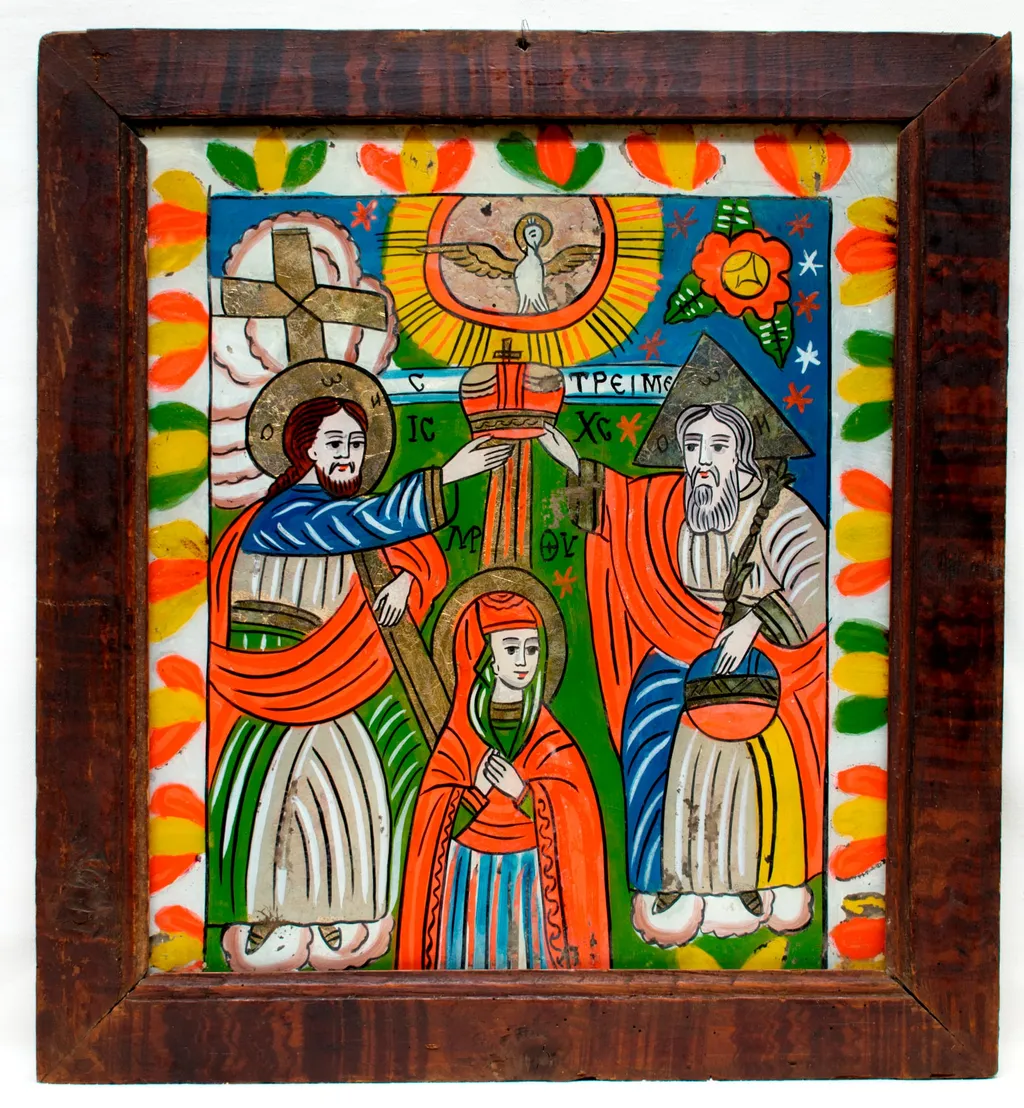
Sfânbrad is a drawing by Unknown. It dates from 1850 and is held in the collection of the "Dimitrie Gusti" National Village Museum. This drawing depicts three figures arranged in a linear composition, each holding symbolic objects.
About this work
Overview
The use of vivid colors and strong outlines creates a flattened, non-naturalistic space, emphasizing symbolic meaning over spatial realism.
This drawing depicts three figures arranged in a linear composition, each holding symbolic objects. Above them, a dove emerges from a radiant sunburst, surrounded by stars and floral motifs. The use of vivid colors and strong outlines creates a flattened, non-naturalistic space, emphasizing symbolic meaning over spatial realism. Inscriptions on the staff and cross suggest encoded religious or ritual significance, common in devotional imagery of certain traditions.
Subject & Meaning
The figures likely represent sacred or authoritative roles within a religious context. The left figure, bearing a cross and globus cruciger, may symbolize divine authority or rulership. The central figure, smaller and holding a scroll, could signify wisdom or scripture. The bearded figure on the right, with a staff and hat, may denote a prophet or elder. The dove and sunburst above suggest divine presence or the Holy Spirit, reinforcing a theological narrative.
Technique & Style
The drawing employs bold, unmodulated outlines and flat areas of bright color, rejecting perspective and shading. This stylistic choice aligns with symbolic or liturgical art traditions that prioritize clarity and spiritual resonance over naturalism. The decorative elements—stars, flowers, and radiating lines—enhance the otherworldly atmosphere, directing focus to the figures and their emblems rather than physical realism.
History & Provenance
The work’s origin is undocumented, but its iconography resembles devotional objects from medieval or early modern Eastern Christian traditions. Similar compositions appear in liturgical manuscripts or portable cult items used in private or communal worship. The abbreviations on the staff and cross may correspond to liturgical texts or theological formulas, suggesting a function tied to ritual practice rather than purely aesthetic expression.
Context
In religious communities where literacy was limited, visual symbols served as tools for teaching doctrine and reinforcing belief. Objects like this drawing may have been displayed during ceremonies or carried in processions, functioning as focal points for prayer or veneration. The presence of celestial motifs and sacred attributes aligns with broader patterns in sacred art meant to convey divine order and spiritual hierarchy.
Legacy
Though not widely known outside niche scholarly circles, this work reflects enduring traditions in symbolic religious imagery. Its visual language—flat planes, coded inscriptions, and celestial signs—echoes practices that persisted across centuries in regional devotional cultures. Such artifacts contribute to understanding how faith was visually encoded and transmitted, especially in communities where written texts were less accessible.
Artist & collection
Museum
"Dimitrie Gusti" National Village Museum
Continue through works from the same source collection.
 Domestic Scene
 Giacomo and Cardinal Marco, investing Andrea, Abbot of San Zeno, with his Benefice
 The Nymph of Fontainebleau
 Portrait of a Woman
 Madonna and Child with Saints in the Enclosed Garden
 Venus and Minerva
 Family Group of Four on Sofa
 Wall painting from Room H of the Villa of P. Fannius Synistor at Boscoreale
 Icoană „Masa raiului”
 Icoaauri
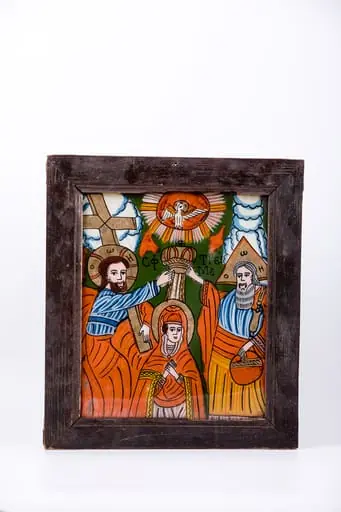 Icoana reprezintă Sfânta Treime - Sfânta Troiță și Încoronarea Maicii Domnului. Dumnezeu-Tatăl are sceptrul Împărăției Cerurilor și globul pământesc sprijinit pe genunchii părintești și Dumnezeu-Fiul are Crucea pe umărul stâng. Maica Domnului este ridicată în timpul de rugăciune și ascultare, smerenie și primire de bunăvoie. Dumnezeu-Tatăl, Dumnezeu-Fiul și Maica Domnului sunt înveșmântați în roșu vermillon-orange, alb, galben și albastru bleu-ciel. În registrul îndepărtat superior este cerul albastru, Dumnezeu-Fiul ține pe brațul stâng Crucea, iar Maica Domnului are mâinile împreunate în cruce pe piept. Dumnezeu-Tatăl și Dumnezeu-Fiul așează împreună coroana de împărăteasă a Cerurilor pe capul Fecioarei Maria. În registrul superior, printr-o mandorlă de nouri și un disc roșu de raze solare, deschizându-se cerurile, se coboară Sfântul Duh, sub forma unui porumbel, pe un mănunchi de raze de lumină. Maica Domnului este încoronată ca Împărăteasa Cerurilor de către Dumnezeu-Tatăl și Dumnezeu-Fiul. În registrul superior, icoana este încadrată de nori albi-albaștri bleu-ciel. Inscripția din româno-chirilică se traduce Sf Treime. Cromatica este luminoasă și armonioasă: roșu vermillon, orange, albastru bleu-ciel, verde văratic, galben, alb, auriu, negru. Trăsăturile chipurilor sunt rafinat desenate. Fondul icoanei este văzduhul verde-văratic, decorat de mandorle de nouri rotunzi albi-albaștri. Este o icoană de Țara Oltului.
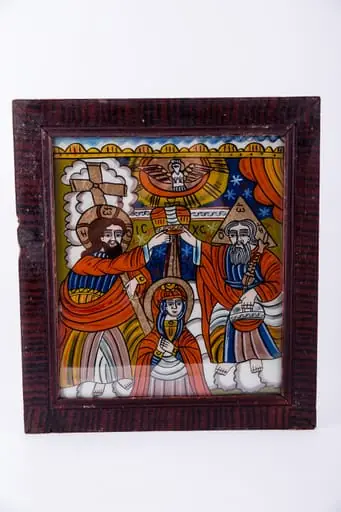 Dumnezeu Tatăl, Fiul Iisus Hristos așează dimpreună coroana de împărăteasă pe capul Maicii Domnului, iar din cerurile deschise se pogoară Sfântul Duh, printr-un porumbel, pe o rază luminoasă de soare. Compoziția se împarte simetric și echilibrat în patru părți, asemenea unei cruci. Fiul - Tatăl; Sfântul Duh - Maica Domnului. Maica Domnului are înălțimea mică a unei fetițe, fiind aleasă dintre oameni. Dumnezeu-Fiul are în mâna dreaptă Crucea, iar Dumnezeu-Tatăl are globul pământesc. Maica Domnului are mâinile împreunate în rugăciune și ascultare, smerenie și primire de bunăvoie. Sunt înveșmântați în roșu vermillon-galben-albastru. În registrul îndepărtat superior este cerul albastru cu stele albe, iar în registrul inferior sunt nori albi, toată narațiunea desfășurându-se în Împărăția Cerurilor, Maica Domnului fiind ridicată de pe pământ - Adormirea Maicii Domnului. În registrul superior, tematica iconografică este încadrată de un segment decorativ, geometrizant, asemenea unor colțișori de dantelărie. Inscripția în chirilică se traduce ICXC MP Iisus Hristos Maica Domnului. Cromatică: roșu vermillon, galben, albastru, alb. Icoana ste din Țara Oltului, Șcheii Brașovului.
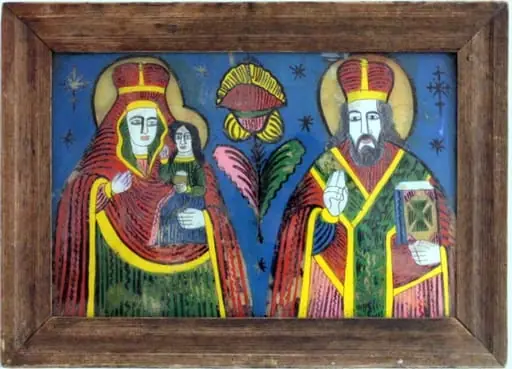 Maica Domnului cu Pruncul și Sf. Nicolae
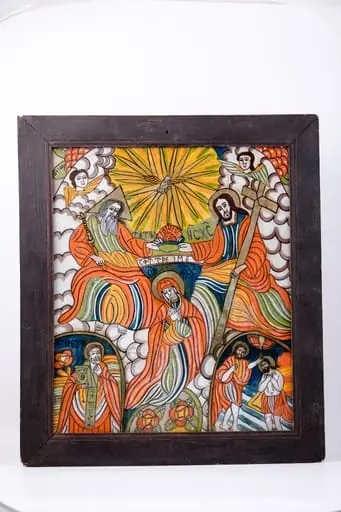 Icoana reprezintă Sfânta Treime și Încoronarea Maicii Domnului central și secundar Botezul Domnului și Sfântul Apostol Petru. Dumnezeu-Tatăl are sceptrul Împărăției Cerurilor, asemenea unui crin de bronz și Dumnezeu-Fiul are Crucea pe umăr. Maica Domnului este ridicată în timpul de rugăciune și ascultare, smerenie și primire de bunăvoie. Dumnezeu-Tatăl, Dumnezeu-Fiul și Maica Domnului sunt înveșmântați în roșu vermillon-orange, alb și albastru bleu-ciel și verde. În registrul îndepărtat superior este cerul albastru, Dumnezeu-Fiul ține pe brațul stâng Crucea, iar Maica Domnului are mâinile împreunate în cruce pe piept. Dumnezeu-Tatăl și Dumnezeu-Fiul așează împreună coroana de împărăteasă a Cerurilor pe capul Fecioarei Maria. În registrul superior, printr-o mandorlă de nouri și un disc de raze solare, deschizându-se cerurile, se coboară Sfântul Duh, sub forma unui porumbel, pe un mănunchi de raze de lumină. Maica Domnului este încoronată ca Împărăteasa Cerurilor de către Dumnezeu-Tatăl și Dumneteu-Fiul. În colțurile superioare stânga-dreapta sunt 2 îngeri serafimi. În registrul inferior, în câte două medalioane ovoidale sunt Botezul Domnului Iisus Hristos și Sfântul Apostol Petru, având Cheile Împărăției Cerurilor. Sunt două tematici iconografice secundare, dar care completează armonios și simetric tematica centrală. Inscripția din româno-chirilică se traduce IC XC Iisus Hristos Tatăl MP Maica Domnului Sfânta Treime Botezul Sf Petru. Cromatica este luminoasă și armonioasă: roșu vermillon, albastru bleu-ciel, galben, alb, auriu, negru. Trăsăturile chipurilor sunt rafinat desenate. Fondul icoanei este cerul albastru ultramarin decorat de mandorle de nouri rotunzi albi-bej-crem, văzduhul fiind bogat în Duhul Sfânt. Este o icoană de Țara Oltului.
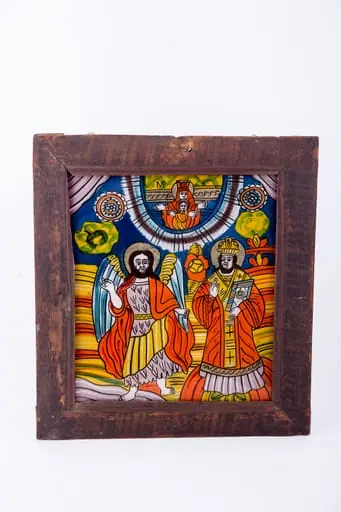 Icoana îi reprezintă pe Sfântul Ioan Botezătorul și Înaintemergătorul Mântuitorului Iisus Hristos și pe Sfântul Mare Ierarh Vasile cel Mare. Cel dintâi este simbolul pocăinței și cel de-al doilea este asprimea dezlegărilor. Sfântul Ioan Botezătorul este îmbrăcat cu o mantie roșie vermillon și ocru și un himation gri-brun sau o haină din păr de cămilă. Este desculț și are aripi de înger. Sfântul Mare Ierarh Vasile cel Mare este îmbrăcat în veșminte liturgice de arhiereu, cu mantie roșie vermillon, sacos alb-gri, epitrahil-patrafir galben, mithră mitopolitană și ține în mâna stânga Sfânta Evanghelie închisă și cu mâna dreaptă binecuvintează. În registrul superior, într-un semicerc de raze, asemenea unei mandorle de nouri, ca într-o deschidere de Ceruri, este Maica Domnului cu Pruncul Iisus Hristos în brațe, amândoi arătând Calea, ocrotind, păzind și binecuvântând. Maica Domnului este Orantă, adică rugătoare. Fondul icoanei este albastru ceruleum, pe care sunt câteva flori mari galben-verzi și doi aștri decorativi. Soarele, luna, stelele și florile adeseori se suprapun simbolic și semantic în icoanele din Țara Oltului. Cromatica este armonioasă, luminoasă și vie: roșu vermillon, galben, ocru, verde, albastru ceruleuum, alb, negru.
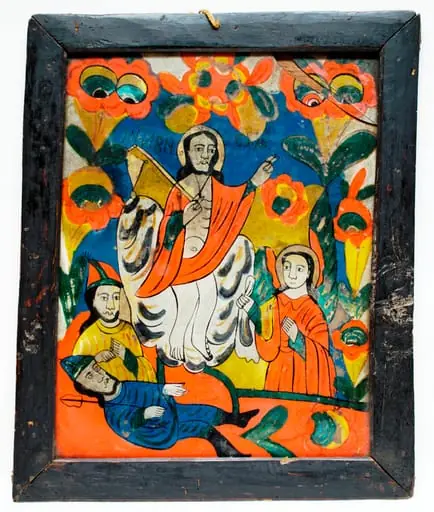 Icoaorat
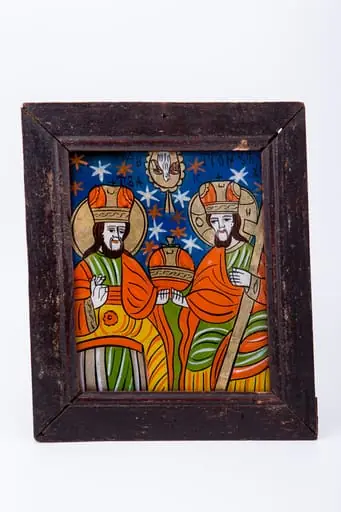 Sfânta Treime prezentă în această icoană este inedită pentru că Dumnezeu-Tatăl și Dumnezeu-Fiul sunt foarte asemănători. Fiul după Chiul și Asemănarea! Sunt înveșmântați în roșu vermillon, galben și verde. Dumnezeu-Fiul are mantia roșie peste umăr - omofor și ține Crucea Răstignirii în mână. Dumnezeu-Tatăl și Dumnezeu-Fiul susțin împreună sfera globului pământesc cu mâinile. În registrul superior, deasupra, este Sfântul Duh care se Pogoară sub forma unui porumbel alb, prin Cerurile deschise, pe un mănunchi de stele bronzii. Fondul este cerul albastru ceruleum cu elemente astrale: stele roșii și albe. Cromatica este armonioasă, luminoasă și puternic-vie, speifică Țării Oltului: roșu vermillon, verde, ocru, galben chihlimbar, albastru ceruleum, roșu stacojiu, alb, negru. Inscripția din româno-chirilică se traduce Sfânta Treime Dumnezeu Tatăl.