Artwork
Sfânta Treime
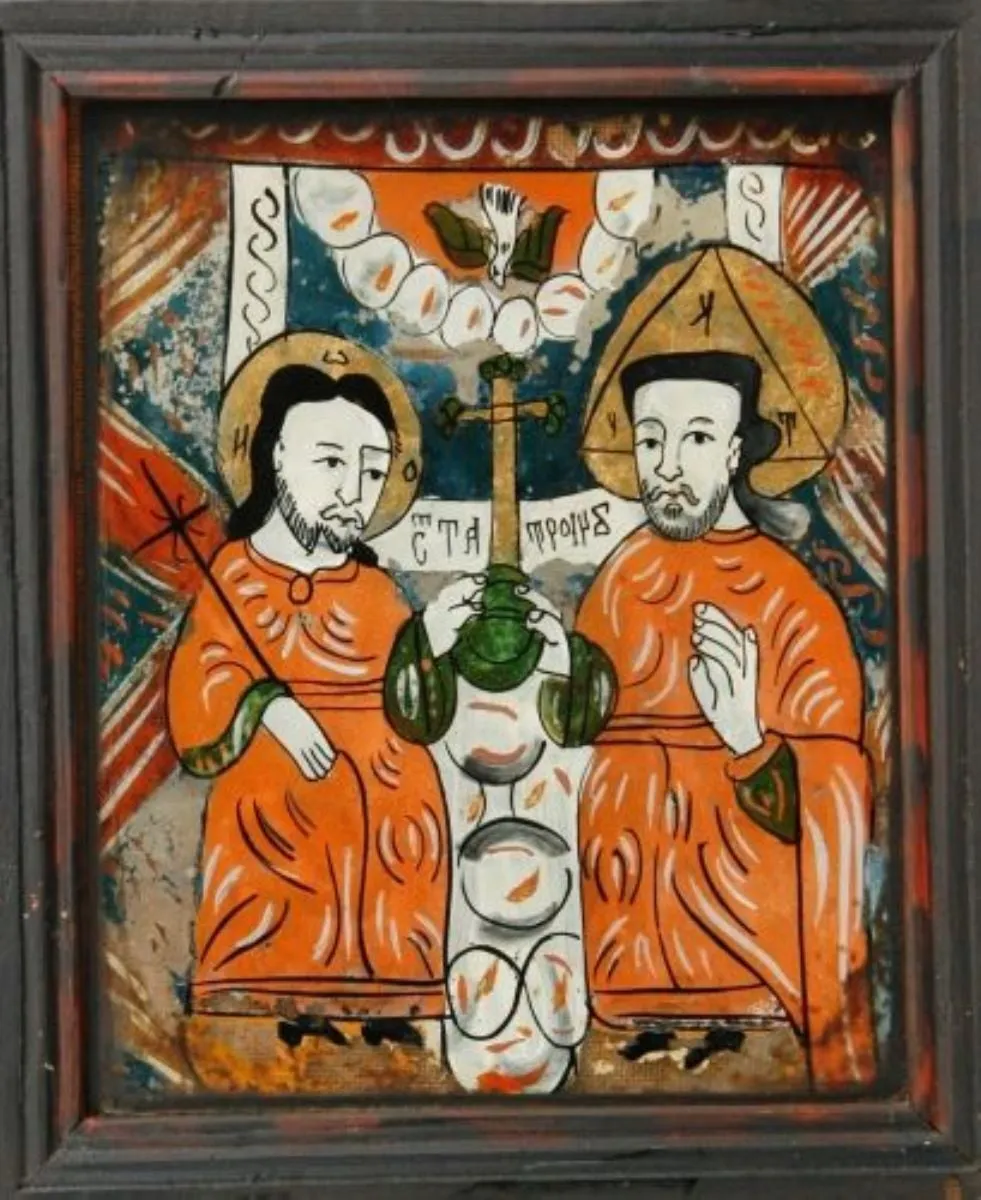
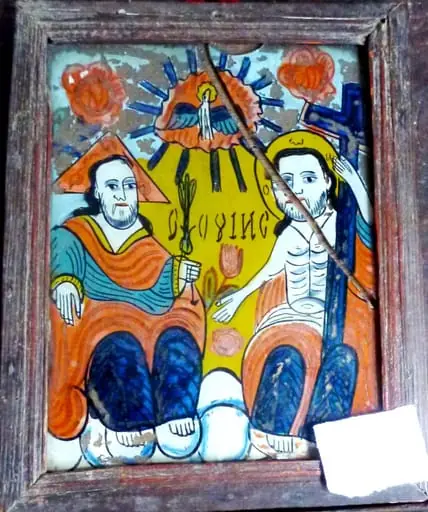
Sfânta Treime is a drawing by Unknown. It dates from 1850 and is held in the collection of the Romanian Peasant Museum.
About this work
Overview
A small devotional panel depicts three solemn figures arranged symmetrically against a sky filled with cloud formations resembling human faces.
A small devotional panel depicts three solemn figures arranged symmetrically against a sky filled with cloud formations resembling human faces. Two figures stand upright in bright orange robes, while a third, hooded form rises between them on a green base. The composition is rigidly frontal, with minimal depth and no perspective, emphasizing spiritual presence over naturalism. Birds fly above, suggesting a celestial realm.
Subject & Meaning
The two robed figures likely represent divine persons from the Christian Trinity, with the halved figure holding a cross possibly symbolizing Christ. The hooded form, supported by a green pedestal, may signify the Holy Spirit or a symbolic altar. The pointed hat on one figure suggests ecclesiastical authority. Together, they convey a static, reverent vision of the Trinity, intended for private contemplation rather than public display.
Technique & Style
The painting uses flat, unmodulated colors and strong outlines to define forms, avoiding chiaroscuro or realistic shading. Details are rendered with precision but without texture or volume. The sky’s cloud faces and flying birds are stylized, not naturalistic. The lack of cross-hatching or gradation reinforces a symbolic, otherworldly tone, aligning with medieval iconographic traditions that prioritize spiritual clarity over physical realism.
History & Provenance
The work’s origin is uncertain, but its style and subject suggest it was created in Eastern Europe during the late medieval or early Renaissance period. Likely used in a domestic or monastic setting, it reflects regional devotional practices. No documented ownership history exists, and its survival in relatively intact condition implies careful preservation, possibly within a religious household or local church collection.
Context
This image belongs to a tradition of small-scale religious panels produced for personal prayer, common in Orthodox and Byzantine-influenced regions. Its emphasis on symbolic figures over narrative action aligns with liturgical imagery meant to evoke divine presence. The inclusion of anthropomorphic clouds reflects a broader medieval tendency to infuse nature with spiritual meaning, reinforcing the sacred atmosphere of the scene.
Legacy
Though not widely known outside regional collections, the painting exemplifies the persistence of medieval iconographic conventions into the early modern period. Its restrained aesthetic and symbolic language offer insight into how faith was visually encoded in everyday devotional objects. It stands as a quiet testament to the enduring power of form and ritual in spiritual expression, beyond the reach of Renaissance naturalism.
Artist & collection

 Domestic Scene
 Giacomo and Cardinal Marco, investing Andrea, Abbot of San Zeno, with his Benefice
 The Nymph of Fontainebleau
 Portrait of a Woman
 Madonna and Child with Saints in the Enclosed Garden
 Venus and Minerva
 Family Group of Four on Sofa
 Wall painting from Room H of the Villa of P. Fannius Synistor at Boscoreale