Artwork
Sfântul Mare Ierarh Nicolae Făcătorul de minuni este redat central, pe tron arhieresc, ținând în mâna stângă Sfânta Evanghelie deschisă și binecuvântează cu mâna dreaptă. Veșmintele arhierești liturgice ale sfântului ierarh sunt într-o alternanță cromatică de orange-verde-albastru-ocru-brun-bronziu și alb și negru. Epitrahilul, patrafirul este brun-bronziu, cu patru cruci pe el, sacosul orange-roșu vermillon. Poartă mithră și are aureolă. În registrul superior îndepărtat sunt Dumnezeu-Tatăl și Maica Domnului, care ating aureola Sfântului Nicolae. Pe fondul verde, Mântuitorul și Maica Domnului au veșminte brune și roșii și sunt așezați pe mandorle de nouri albi-albaștri. Inscripția din româno-chirilică se traduce Sf Nicolae ICXC MP Iisus Hristos Maica Domnului. În registrul inferior, la picioarele Sfântului Ierarh sunt tatăl mulțumitor și îngenuncheat și cele trei fete salvate, prin minune, de sărăcie și păcat. Icoana are o cromatică puternic-vie, spcifică Țării Oltului: roșu vermillon, orange, verde spanac-avocado, albastru ceruleum și bleu-ciel, bru, gri, alb, negru.
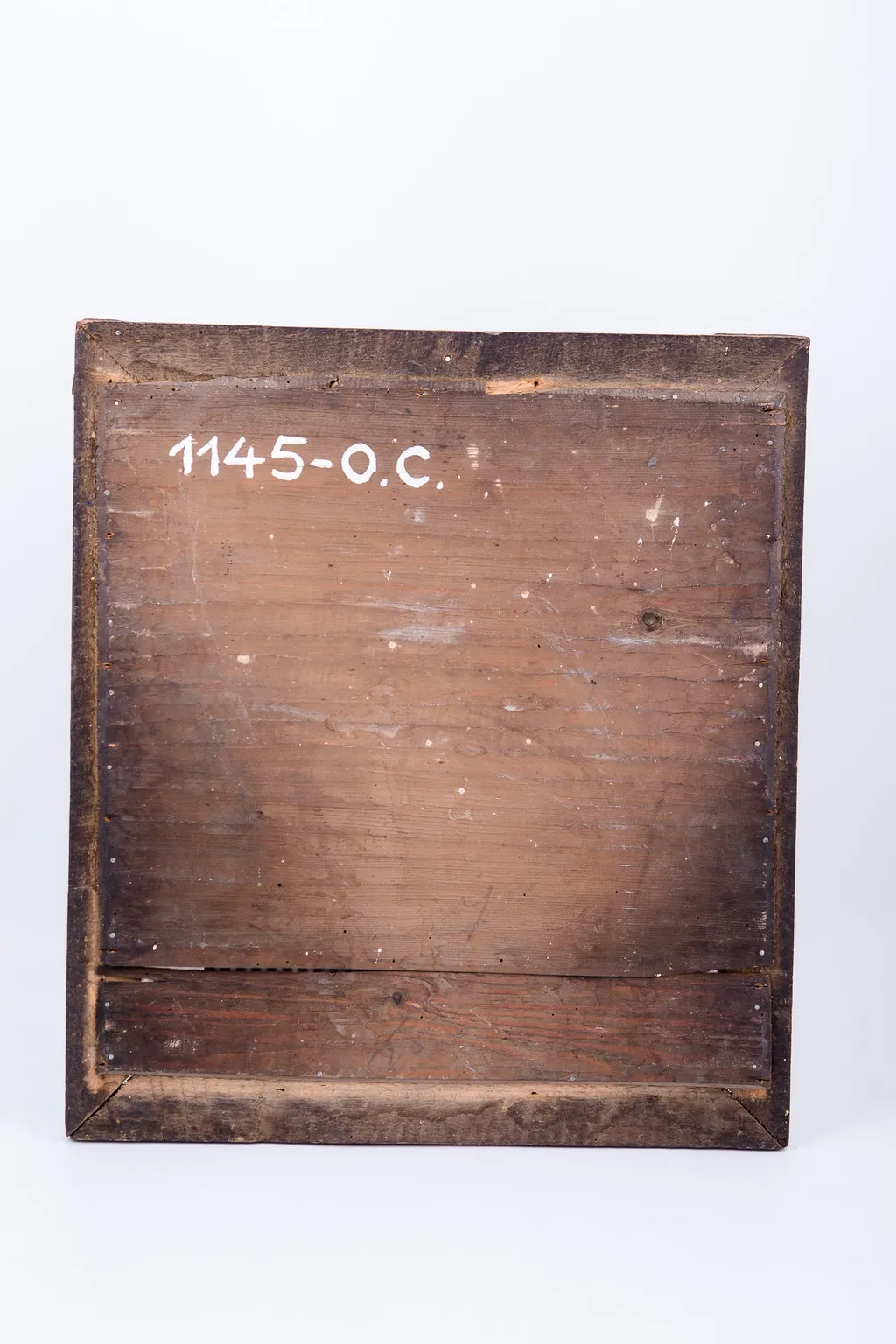
Sfântul Mare Ierarh Nicolae Făcătorul de minuni este redat central, pe tron arhieresc, ținând în mâna stângă Sfânta Evanghelie deschisă și binecuvântează cu mâna dreaptă. Veșmintele arhierești liturgice ale sfântului ierarh sunt într-o alternanță cromatică de orange-verde-albastru-ocru-brun-bronziu și alb și negru. Epitrahilul, patrafirul este brun-bronziu, cu patru cruci pe el, sacosul orange-roșu vermillon. Poartă mithră și are aureolă. În registrul superior îndepărtat sunt Dumnezeu-Tatăl și Maica Domnului, care ating aureola Sfântului Nicolae. Pe fondul verde, Mântuitorul și Maica Domnului au veșminte brune și roșii și sunt așezați pe mandorle de nouri albi-albaștri. Inscripția din româno-chirilică se traduce Sf Nicolae ICXC MP Iisus Hristos Maica Domnului. În registrul inferior, la picioarele Sfântului Ierarh sunt tatăl mulțumitor și îngenuncheat și cele trei fete salvate, prin minune, de sărăcie și păcat. Icoana are o cromatică puternic-vie, spcifică Țării Oltului: roșu vermillon, orange, verde spanac-avocado, albastru ceruleum și bleu-ciel, bru, gri, alb, negru. is a drawing by Unknown. It dates from 1850 and is held in the collection of the ASTRA National Museum Complex. This wooden panel, now seen from its reverse side, once bore a devotional icon of Saint Nicholas, a revered bishop known for miracles.
About this work
The wood’s age and damage hint at how much these religious images have traveled over time.
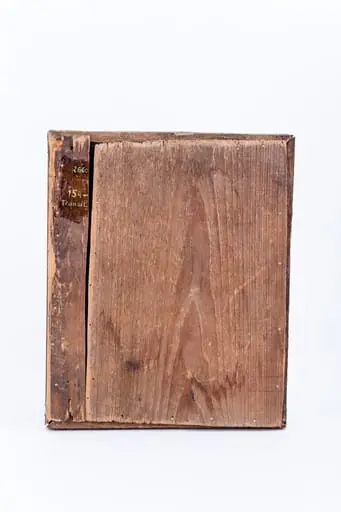
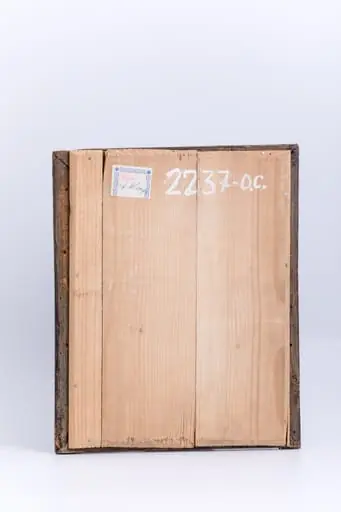
This is the back of a wooden panel. The wood looks old and worn, with visible scratches and patches. Paint has flaked off in spots, leaving bare wood. A faded white number, "1145-O.C.," is written near the top.
The front of this panel is an icon of Saint Nicholas, but we only see the back here. The wood’s age and damage hint at how much these religious images have traveled over time.
Look up cult object to see how icons like this were used in daily life.
Overview
This wooden panel, now seen from its reverse side, once bore a devotional icon of Saint Nicholas, a revered bishop known for miracles. The wood shows signs of age—scratches, patches, and flaked paint—indicating prolonged use and transport. A faint inscription, "1145-O.C.", suggests it was cataloged or numbered, likely during institutional collection. The back’s worn state reflects its function as a support for a sacred image, not merely a frame.
Subject & Meaning
The icon depicts Saint Nicholas seated on an episcopal throne, holding the open Gospel in his left hand and blessing with his right. Above him, God the Father and the Virgin Mary hover in mandorlas of white and blue clouds, their hands touching his halo to signify divine sanction. Below, a grateful father and three rescued daughters kneel, recalling the saint’s legendary act of providing dowries to save them from destitution and moral ruin.
Technique & Style
The painting employs a vivid palette characteristic of the Oltenia region: vermilion, orange, spinach-green, cerulean, and deep browns, contrasted with black and white. Liturgical vestments are rendered in layered hues, with intricate patterns on the epitrahil and sacos. The halo and mandorlas are rendered with symbolic precision, emphasizing spiritual presence over naturalism. The composition follows Byzantine conventions, with hierarchical scale and frontal solemnity.
History & Provenance
The panel’s physical condition—flaking paint, repaired wood, and faded markings—points to decades, possibly centuries, of ritual use and movement. Its survival suggests it was venerated in a local church or household, carried during processions or relocated during upheavals. The inscription "1145-O.C." may reflect 19th-century ecclesiastical inventory practices, linking it to regional collections of Orthodox religious artifacts.
Context
Icons like this were central to Orthodox domestic and liturgical life, serving as conduits between the faithful and the divine. The depiction of Saint Nicholas with his miracles reinforced themes of charity and divine intervention. The Oltenia region’s distinctive color choices reflect local artistic traditions, distinct from Transylvanian or Moldavian styles, and reveal how regional identity shaped sacred imagery even within a shared theological framework.
Legacy
Though only the reverse remains, the panel testifies to the material life of religious objects in rural Orthodox communities. Its wear and repair speak to sustained devotion, while its colors and iconography preserve a regional visual language now largely lost. As a fragment of a once-venerated image, it offers insight into how faith was embodied in everyday objects, carried, touched, and passed through generations.
Artist & collection

 Domestic Scene
 Giacomo and Cardinal Marco, investing Andrea, Abbot of San Zeno, with his Benefice
 The Nymph of Fontainebleau
 Portrait of a Woman
 Madonna and Child with Saints in the Enclosed Garden
 Venus and Minerva
 Family Group of Four on Sofa
 Wall painting from Room H of the Villa of P. Fannius Synistor at Boscoreale
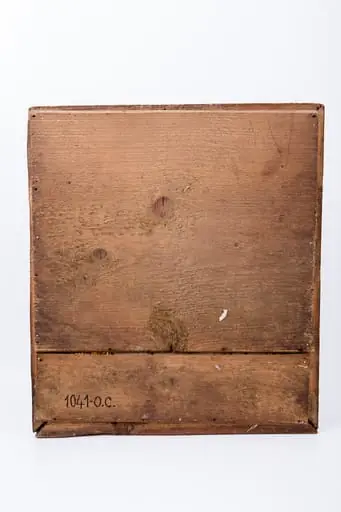 Sfântul Mare Ierarh Nicolae Făcătorul de minuni este redat central, așezat pe tron arhieresc, ținând în mâna stângă Sfânta Evanghelie deschisă și binecuvântează cu mâna dreaptă. Veșmintele arhierești liturgice ale sfântului ierarh sunt într-o alternanță cromatică de roșu vermillon-verde-ocru și alb și negru. Epitrahilul, patrafirul este verde, cu patru cruci pe el, sacosul roșu vermillon. Poartă mithră și are aureolă. În registrul inferior în colțul din stânga Sfântului Nicolae este tatăl celor trei fete, salvate de sărăcie și desfrânare, îngenuncheat, mulțumind prin ajutor. În colțul din dreapta Sfântului sunt cele trei fete cu coronițe pe cap, coronițele simbolizând atât bogăția materialnică, cât și cumințenia și curățenia sufletească. În registrul superior, dreapta sfântului, este Mântuitorul Dumnezeu-Fiul binecuvântând și în partea stângă este Maica Domnului ocrotind. Inscripția din româno-chirilică se traduce Sf Nicolae ICXC MP Iisus Hristos Maica Domnului. Cromatica este specifică Țării Oltului: roșu vermillon, verde de China, galben chihlimbar, ocru, albastru ceruleum, alb, negru.
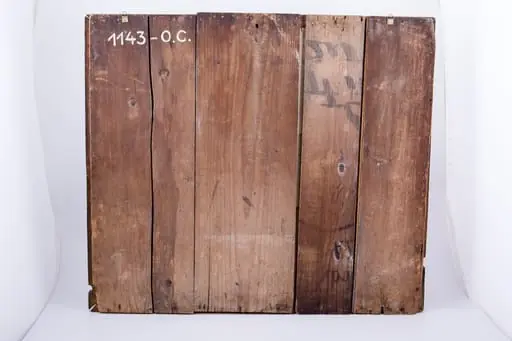 Icoana este împărțită pe două tematici iconografice: Sfântul Mare Ierarh Vasile și Sfânta Treime. Sfântul Vasile cel Mare este îmbrăcat în veșminte arhierești în combinația de roșu-zmeuriu, albastru cobalt, verde și alb. Are barba și părul lungi. Poartă mitrhră arhierească și aureolă. Binecuvântează cu mâna dreaptă și ține în mâna stângă Sfânta Evanghelie închisă. Dumnezeu-Fiul ține Crucea pe umărul stâng, Dumnezeu-Tatăl are globul pământesc și dimpreună susțin coroana Împărăției Cerești. Dumnezeu-Tatăl și Dumnezeu-Fiul sunt înveșmântați în roșu vermillon-zmeuriu, albastru cobalt și verde, cu bogăție de detalii decorativ-ornamentale fine și minuscule pe veșmintele împărătești, dungi albe. În registrul îndepărtat superior este cerul auriu cu o mandorlă de nouri rotunzi albaștri.
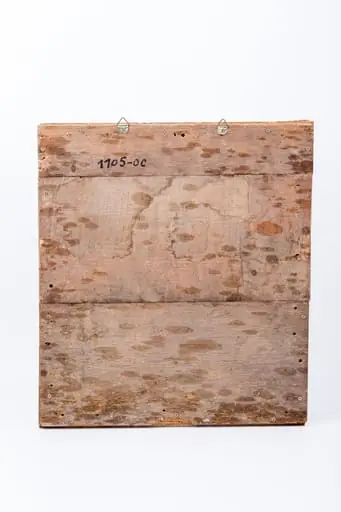 Sfântul Mare Ierarh Nicolae Făcătorul de minuni este redat central, șezând pe tron arhieresc, ținând în mâna stângă Sfânta Evanghelie închisă și binecuvântează cu mâna dreaptă. Veșmintele arhierești liturgice ale sfântului ierarh sunt într-o alternanță cromatică de stacojiu-acajou-brun închis-kaki-bronziu și alb și negru. Epitrahilul, patrafirul este verde de China și brun-bronziu, cu patru cruci pe el, sacosul maro-stacojiu-acajou. Poartă mithră și are aureolă. În registrul superior îndepărtat sunt Dumnezeu-Tatăl și Maica Domnului, care Binecuvântează și Ocrotește pe Sfântului Nicolae. Pe fondul verde, Mântuitorul și Maica Domnului au veșminte brun-verzi-bronzii. În registrul inferior, în dreapta sfântului ierarh este tatăl fetelor, mulțumind îngenucheat fiind și în stânga sfântului, în raport cu Maica Domnului deasupra sunt cele trei fete salvate. În registrul inferior fondul este predominant roz somon, iar în cel superior albastru ceruleum. Inscripția din româno-chirilică se traduce Sf Nicolae ICXC MP Iisus Hristos Maica Domnului. Icoana are cromatică spcifică Mărginimii Sibiului: stacojiu-acajou-brun închis-kaki-bronziu și alb și negru, verde de China, albastru ceruleum, alb, negru.
 Sfântul Mare Mucenic Teodor Tiron este așezat călare pe un cal alb, ținând Crucea în mâna dreaptă. Mantia Sfântulu Mucenic Teodor este roșie-vermillon, pantalonii verzi, cămașa de cavaler verde, cu năsturei și găetane. Fondul este albastru ceruleum și în registrul inferior este roșu vermillon, cărămiziu. Întreaga compoziție iconografică este presărată de elemente fitomorfe-geometrizante, formate din petale albe. Cromatica este armonioasă; roșu vermillon, cărămiziu, ocru, verde spanac-avocado, albastru ceruleum, alb și ngru. Icoana este de Nicula. Inscripția din româno-chirilică se traduce Sf Teodor.
 Sfântul Mare Ierarh Nicolae, făcător de minuni, este îmbrăcat în veșminte liturgice, de ierarh, sacos roșu-vermillon, ocru și verde, cu epitrahil-patrafir crem-bej, cu o cruce mare galbenă, asemenea unui engolpion. Sfântul Nicolae ține în mâna dreaptă Sfânta Evanghelie închisă și cu stânga Binecuvântează. Este unul dintre cei mai populari și iubiți sfinți, ocrotitor al caselor, familiilor și copiilor. Are barbă sură și mithră arhierească și aureolă. Fondul este albastru ceruleum, cu elemente astrale - stele roșii și albe. În dreapta și stânga Sfântului Ierarh, așezat pe un tron arhieresc, sunt doi îngeri-serfimi. Tronul arhieresc al Sfântului Nicolae este bogat ornamentat cu elemente decorative geometrizante arhitecturale albastre, cu o pernă rulou galbenă, cu ciucuri. Veșmântul Sfântului Nicolae este deosebit și prin elementele ornamental-decorative drapaje, cute și falduri delicate și ingenue. Cromatica este armonioasă și serafic-diafană: roșu vermillon, orange, albastru ceruleum regal, verde mușchi de pădure, ivoriu, gri, ocru, bej, negru, alb. Icoana este de Șcheii Brașovului.
 Sfântul Mare Mucenic Gheorghe este așezat călare pe un cal alb, cu șaua ocru-galbenă, omorând balaurul gri-verzui cu lancea, pe care o ține cu amândouă mâinile. Fondul icoanei este roșu vermillon, cu un spațiu luminos de galben-chihlimbar în împrejurul Sfântului Gheorghe, în centrul icoanei ușor întrepătrundu-se toate culorile. Mantia Sfântului Mucenic Purtător de Biruință este roșie vermillon cu liniuțe albe, având tunica ocru-galbenă, cu mânecile verzi-olive înspre gri, pantalonii cărămizii și cizmele negre. Întreaga compoziție iconografică este încadrată de un chenar decorativ geometrizant alb-zinc și de un chenar decorativ fitomorf, format dintr-o ghirlandă din 5 ruje roșii-cărămizii, cu motivul linii albe șerpuite în interior, cu frunze gri-verzui, alungite. Cromatica este armonioasă: roșu vermillon, cărămiziu, corai, vernil, olive, gri-verzui, kaki, galben-chihlimbar, bronziu, brun, crem, alb și negru. Icoana excelează prin cromatica armonioasă-pastelată și prin desenul fin. Icoana este din Nordul Transilvaniei, Nicula.
 Cei Trei Sfinți Ierarhi Vasile cel Mare, Ioan Gură-de-Aur și Sfântul Grigorie Cuvântătorul de Dumnezeu slujesc și săvârșesc Sfânta Liturghie împreună. Sunt înveșmântați în veșminte liturgice: sacos, felon și epitrahil. Sfântul Vasile cel Mare binecuvântează cu crucea în mâna stângă și ține în mâna dreaptă Sfânta Evanghelie. Sfântul Ioan Gură-de-Aur și Sfântul Grigorie binecuvântează cu mâna stângă și ține în mâna dreaptă Sfânta Evanghelie. Fondul este văzduhul verde văratic, bogat ornamentat cu elemente astrale albe și roșii, în registrul superior, în registrul inferior este un câmp galben-chihlimbar. Inscripția din româno-chirilică se traduce Sf Vasile Sf Ioan Sf Grigorie. Cromatica este armonioasă și luminos-pastelată: roșu vermillon, roz, corai, gri, albastru ceruleum, cobalt, verde văratic, galben chihlimbar, alb, negru. Icoana este din Țara Oltului, Șcheii Brașovului.
 Sfântul Mare Ierarh Grigorie Cuvântătorul de Dumnezeu, sau Sfântul Grigorie Teologul sau de Nazianz. Este unul din cei Trei Sfinți Ierarhi, alături de Sfântul Vasile cel Mare și Sfântul Ioan Gură-de-Aur. Sfântul Grigorie are Sfânta Liturghie a Darurilor înainte Sfințite, care se săvârșește în timpul Postului Mare. Este îmbrăcat în veșminte liturgice arhierești, sacos roșu vermillon, epitrahil verde, nuanță de spanac-avocado, cu patru cruci. Poartă mithră și aureolă. Ține în mâna stângă Sfânta Evanghelie deschisă și binecuvintează cu mâna dreaptă. Fondul este albastru ceruleum cu stele albe. Icoana este de Țara Oltului. Cromatica este armonioasă: roșu vermillon, verde spanac-avocado, albastru ceruleum, nergu, alb. Inscripția din româno-chirilică se traduce Sf Grigorie.
 Sfântul Mare Mucenic Gheorghe este așezat călare pe un cal alb-gri, omorând balaurul verde-gri-antracit cu lancea, pe care o ține în amândouă mâinile. Fondul icoanei este cerul cobalt-senin, în registrul superior și alb-bej-bronziu în cel inferior, în centrul icoanei ușor întrepătrundu-se toate culorile. Tunica Sfântului Mucenic Purtător de Biruință este roșie vermillon, cu mânecile verzi, având pantalonii gri, cizme negre și tunică roșie-vermillon. Întreaga compoziție iconografică este încadrată de un chenar decorativ fitomorf, format dintr-o ghirlandă de 7 ruje - trandafiri sălbatici și bujori roșii și roz cu petale și pistil alternativ colorate cu albastru cobalt, roz și roșu vermillon. Ghirlanda excelează prin delicatețea desenului și bogăția cromatică armonioasă. Ziua de praznic a Sfântului Gheorghe este în 23 aprilie, primăvara, justificându-se pentru încă o dată prezența ghirlandei înflorite. Inscripția din româno-chirilică se traduce S. Georgie. Cromatica este armonioasă; roșu vermillon, roz, albastru cobalt, ceruleum, cobalt, gri antracit, ocru, bronziu, brun, crem, alb și negru. Icoana este din Nordul Transilvaniei, Nicula.