Artwork
Sfântul Mare Mucenic Gheorghe este așezat călare pe un cal alb-gri cu harnașament bogat, omorând balaurul brun-bronziu cu creastă, solzi și coadă lungă, trecând peste el cu lancea, pe care o ține în mâna dreaptă. În partea dreaptă a Sfântului Gheorghe, în registrul îndepărtat, este pictată domnița salvată și ocrotită de marele mucenic, cu mâinile ridicate, atât de teamă și spaimă, cât și de mulțumire către sfântul purtător de biruință. Fondul este albastru, în registrul superior, doi îngeri așează o cunună de mucenic pe capul sfântului. Mantia Sfântului Mucenic Purtător de Biruință este stacojiu-acajou cu interiorul roșu, având cămașa de cavaler cu zale. Culoarea roșie este caracteristică mucenicilor și martirilor. Cromatica este armonioasă; roșu stacojiu, acajou, albastru ceruleum, brun, bej, bronziu, alb și ngru. Pe fondul cerului albastru ceruleum este inscripția în româno-chirilică Sfântul Ghiorgie. Icoana este de Valea Sebeșului, de la începutul secolului al XX-lea.
Sfântul Mare Mucenic Gheorghe este așezat călare pe un cal alb-gri cu harnașament bogat, omorând balaurul brun-bronziu cu creastă, solzi și coadă lungă, trecând peste el cu lancea, pe care o ține în mâna dreaptă. În partea dreaptă a Sfântului Gheorghe, în registrul îndepărtat, este pictată domnița salvată și ocrotită de marele mucenic, cu mâinile ridicate, atât de teamă și spaimă, cât și de mulțumire către sfântul purtător de biruință. Fondul este albastru, în registrul superior, doi îngeri așează o cunună de mucenic pe capul sfântului. Mantia Sfântului Mucenic Purtător de Biruință este stacojiu-acajou cu interiorul roșu, având cămașa de cavaler cu zale. Culoarea roșie este caracteristică mucenicilor și martirilor. Cromatica este armonioasă; roșu stacojiu, acajou, albastru ceruleum, brun, bej, bronziu, alb și ngru. Pe fondul cerului albastru ceruleum este inscripția în româno-chirilică Sfântul Ghiorgie. Icoana este de Valea Sebeșului, de la începutul secolului al XX-lea. is a drawing by Unknown. It dates from 1850 and is held in the collection of the ASTRA National Museum Complex. The icon depicts Saint George, a great martyr, mounted on a white‑gray horse with elaborate trappings.
About this work
If you're interested in learning more about this painting, you might want to look up the Museum of Ethnography, where it is held.
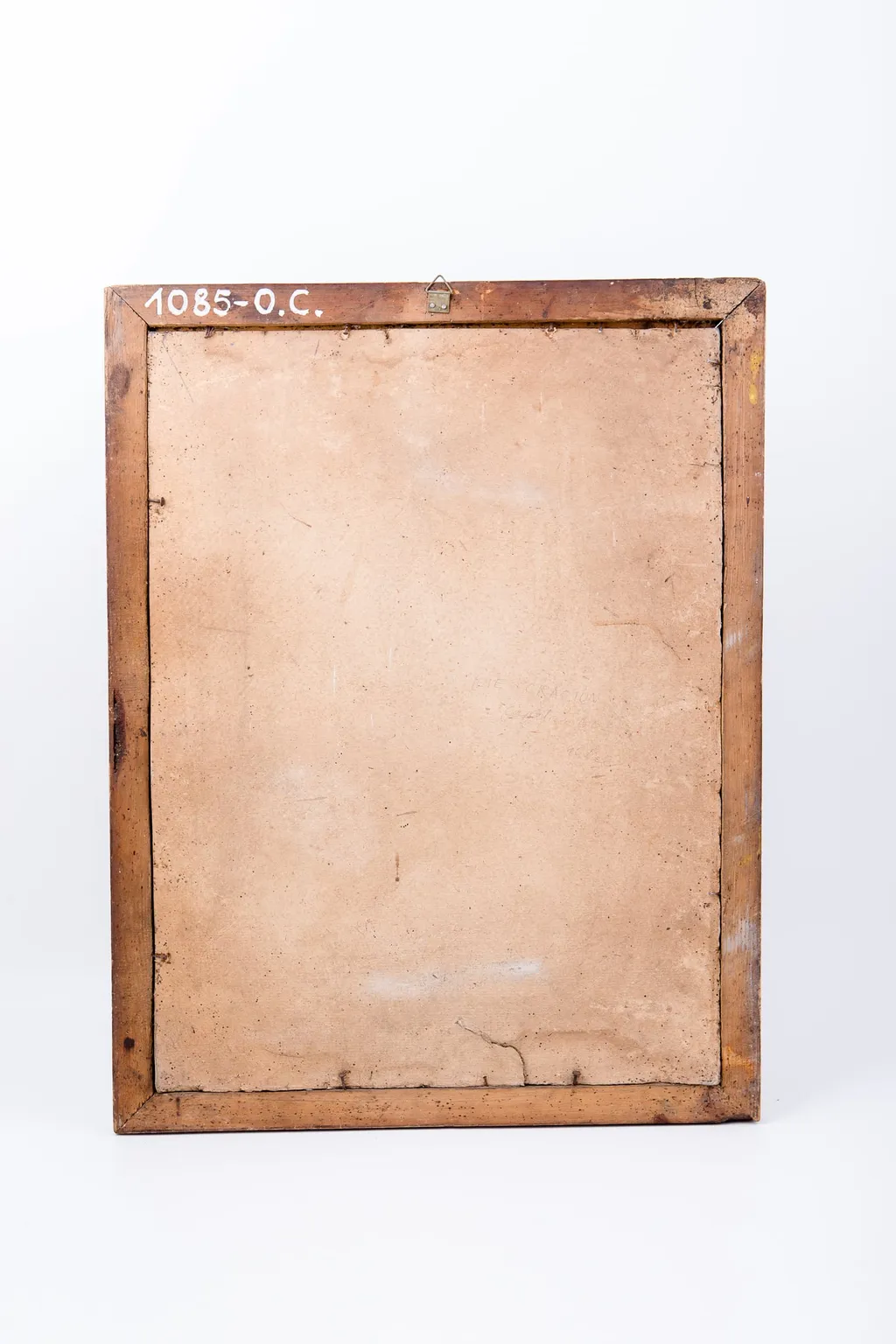
This image shows the back of a framed painting, with a light brown wooden frame and a light pinkish-beige backing. The frame has a small metal hook at the top, and the backing has a few scratches and marks. In the top-left corner, the number "1085-O.C." is written in white paint.
The frame is rectangular, with a thin border around the edges. The backing is slightly larger than the frame, and it has a few small holes and cracks. The overall appearance of the frame and backing suggests that they are old and possibly handmade.
If you're interested in learning more about this painting, you might want to look up the Museum of Ethnography, where it is held.
Overview
The icon depicts Saint George, a great martyr, mounted on a white‑gray horse with elaborate trappings. He thrusts a lance into a bronze‑colored dragon, whose crest, scales and long tail are rendered in detail. The saint’s mantle combines a dark mahogany hue with a red interior, while his armor features chainmail. The composition includes a rescued noblewoman on the right, her hands raised in a mixture of fear and gratitude.
Subject & Meaning
The scene illustrates the traditional legend of Saint George’s triumph over evil, symbolized by the slain dragon. The rescued lady represents the faithful saved by the saint’s intercession. Above, two angels place a martyr’s crown on George’s head, emphasizing his sanctified victory. The use of red in the saint’s garments aligns with the customary colors for martyrs in Orthodox iconography.
Technique & Style
Executed in the early twentieth‑century Valea Sebeș tradition, the icon employs a harmonious palette of mahogany, deep red, cerulean blue, bronze, beige, white and black. The background features a blue sky with a Romanian‑Cyrillic inscription reading “Sfântul Gheorghe.” The figures are outlined with clear lines, and the drapery and armor display intricate detailing typical of regional folk painting.
History & Provenance
Created at the beginning of the 1900s in the Valea Sebeș region, the work now resides in the Museum of Ethnography. The frame, a light brown wooden structure with a pinkish‑beige backing, bears the identifier “1085‑O.C.” painted in white, suggesting an early cataloguing system within the museum’s collection.
Context
The icon reflects Romanian Orthodox devotional art, where saints are portrayed with vivid colors and narrative elements to convey spiritual lessons. The inclusion of the rescued noblewoman and the angels underscores the communal aspect of salvation and the veneration of martyr saints in local religious practice.
Artist & collection

 Domestic Scene
 Giacomo and Cardinal Marco, investing Andrea, Abbot of San Zeno, with his Benefice
 The Nymph of Fontainebleau
 Portrait of a Woman
 Madonna and Child with Saints in the Enclosed Garden
 Venus and Minerva
 Family Group of Four on Sofa
 Wall painting from Room H of the Villa of P. Fannius Synistor at Boscoreale
 Peisaj ieșean
 Compoziție cu păpuși
 Semn al înfloririi
 În centrul icoanei este Crucea, iar în dreapta crucii este Sfânta Împărpteasă Elena și în stânga este Împăratul Constantin, fiul său. Veșmintele sfinților împărați sunt pictate cu roșu vermillon, ocru, brun, alb și verde absint. Deasupra fiecăruia este inscripționat numele, inversat. În spatele Crucii, lipit de cruce, sunt ramuri de finic, asemenea unor raze de soare, amintind de semnul luminos apărut pe cer In hoc signo vinces - prin acest semn vei învinge. Crucea ste împodobită pe brațele vertical și orizontal, cu un vrej lung de flori și frunze, ca o ghirlandă de Rusalii. Icoana este o bogăție de culoare, lumină și detalii semnificative. Crucea este împodobită cu elemente fitomorfe: vrej-tulpină agățătoare, frunze și flori. În spatele crucii sunt doi îngeri serafimi. Icoana este de Țara Oltului. Inscripția în româno-chirilică se traduce Sf Împ Constantin Sf Împ Elena. Cromatica este armonioasă și bogată: roșu vermillon, galben-ocru, albastru ceruleum, verde kaki-olive, absint, brun, alb, negru.
 Maica Domnului Împărăteasă a Cerurilor, pe tron așezată, ține Pruncul Iisus Hristos, în brațe. Maica Domnului este îmbrăcată cu mantie cu maforion brun, cu interiorul căptușit cu verde închis. Poartă aureolă și coroniță roșie de împărăteasă. Pruncul Iisus Hristos este îmbrăcat cu gri și verde închis, are aureolă și binecuvântează cu mâna dreaptă. În registrul superior sunt ocrotitori și păzitori Sfinții Arhangheli Mihail și Gavriil, sprijinindu-se cu mâinile de cele două turnulețe - elemente decorativ geometrizante din structura arhitecturală a bogatului tron arhieresc al Maicii Domnului Împărăteasă. În registrul superior sunt Sfântul Mare Evanghelist Luca, cel care a pictat-o pentru prima dată pe Maica Domnului cu Pruncul Iisus Hristos. Sfântul Evanghelist Luca apare împreună cu simbolul reprezentativ - vițelul - Parabola Întoarcerii Fiului risipitor. În cealaltă parte este Sfântul Evanghelist Ioan, cu vulturul, asemenea căruia se înalță în zbor Cuvântul Dumnezeiesc, fiind Teologul Iubirii. Cromatica este armonioasă, caldă și luminoasă: roșu vermillon, verde spanac-avocado, ocru, brun, gri, alb, negru. Inscripția din româno-chirilică se traduce Maica Domnului MP Iisus Hristos IC XC. Icoana este încadrată de un chenar decorativ geometrizant, pe laterale, ca două panglici late, cu ghirlande de flori mari, de culoare verde-gri. Icoana este datată 1866. Icoana este a lui Savu Moga, din Arpașu de Sus, Țara Făgărașului.
 Peisaj dobrogean
 Peisaj Vâlcov