Artwork
În centrul icoanei este Crucea, iar în dreapta crucii este Sfânta Împărpteasă Elena și în stânga este Împăratul Constantin, fiul său. Veșmintele sfinților împărați sunt pictate cu roșu vermillon, ocru, brun, alb și verde absint. Deasupra fiecăruia este inscripționat numele, inversat. În spatele Crucii, lipit de cruce, sunt ramuri de finic, asemenea unor raze de soare, amintind de semnul luminos apărut pe cer In hoc signo vinces - prin acest semn vei învinge. Crucea ste împodobită pe brațele vertical și orizontal, cu un vrej lung de flori și frunze, ca o ghirlandă de Rusalii. Icoana este o bogăție de culoare, lumină și detalii semnificative. Crucea este împodobită cu elemente fitomorfe: vrej-tulpină agățătoare, frunze și flori. În spatele crucii sunt doi îngeri serafimi. Icoana este de Țara Oltului. Inscripția în româno-chirilică se traduce Sf Împ Constantin Sf Împ Elena. Cromatica este armonioasă și bogată: roșu vermillon, galben-ocru, albastru ceruleum, verde kaki-olive, absint, brun, alb, negru.
În centrul icoanei este Crucea, iar în dreapta crucii este Sfânta Împărpteasă Elena și în stânga este Împăratul Constantin, fiul său. Veșmintele sfinților împărați sunt pictate cu roșu vermillon, ocru, brun, alb și verde absint. Deasupra fiecăruia este inscripționat numele, inversat. În spatele Crucii, lipit de cruce, sunt ramuri de finic, asemenea unor raze de soare, amintind de semnul luminos apărut pe cer In hoc signo vinces - prin acest semn vei învinge. Crucea ste împodobită pe brațele vertical și orizontal, cu un vrej lung de flori și frunze, ca o ghirlandă de Rusalii. Icoana este o bogăție de culoare, lumină și detalii semnificative. Crucea este împodobită cu elemente fitomorfe: vrej-tulpină agățătoare, frunze și flori. În spatele crucii sunt doi îngeri serafimi. Icoana este de Țara Oltului. Inscripția în româno-chirilică se traduce Sf Împ Constantin Sf Împ Elena. Cromatica este armonioasă și bogată: roșu vermillon, galben-ocru, albastru ceruleum, verde kaki-olive, absint, brun, alb, negru. is a drawing by Unknown. It dates from 1850 and is held in the collection of the ASTRA National Museum Complex.
About this work
"* The front of this panel shows a religious scene with a cross at the center, two figures (likely saints), and golden rays behind it.
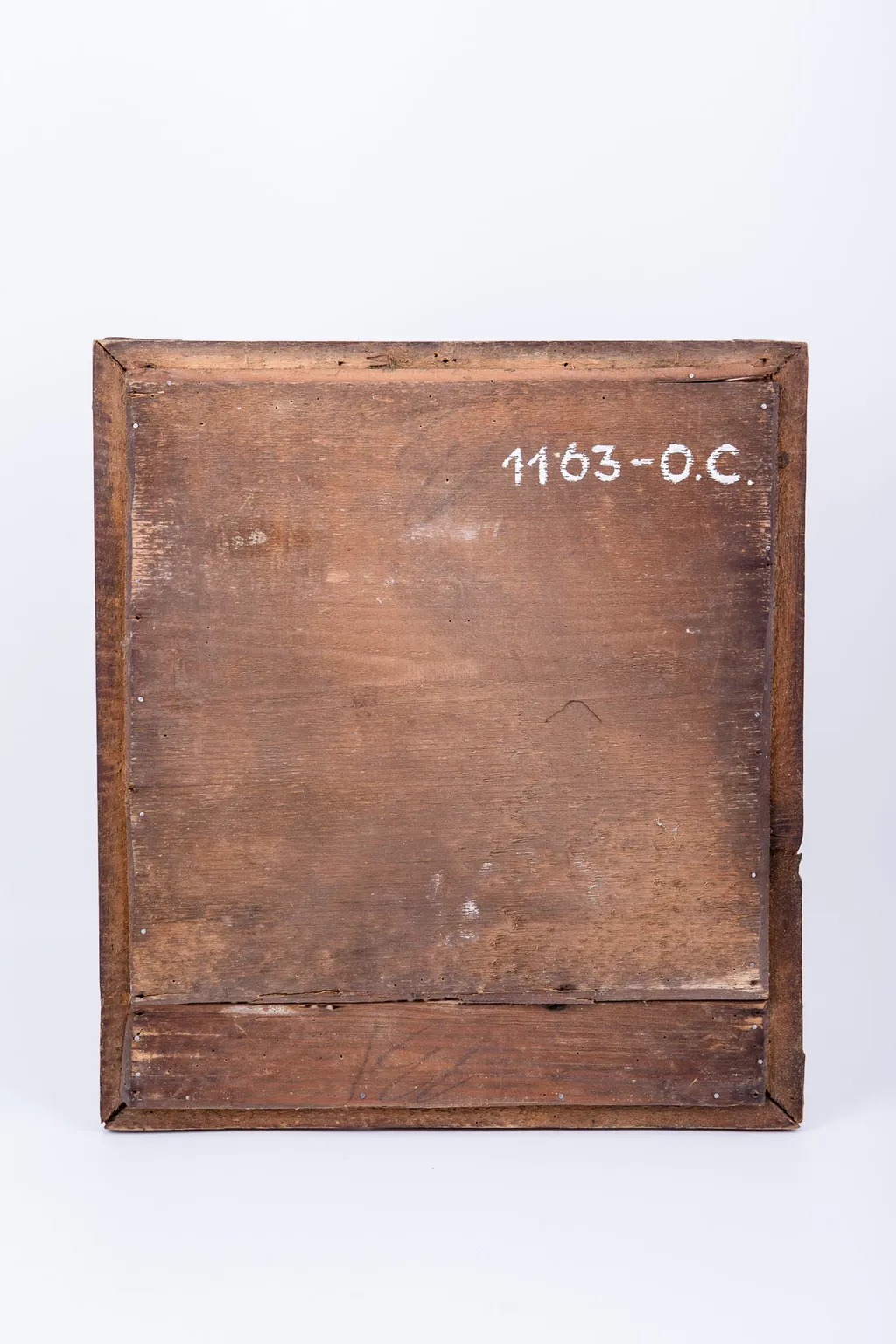
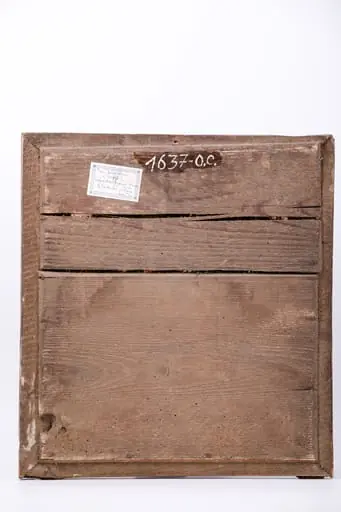
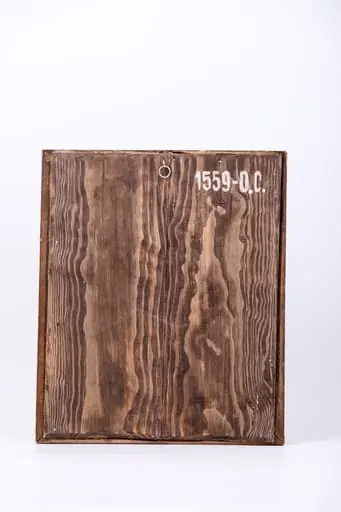
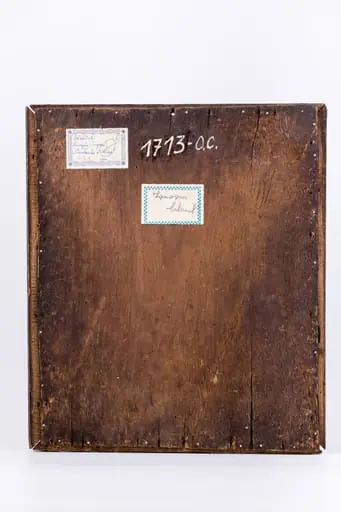
This is the back of a wooden panel—no painting visible here. The wood is aged, with a mix of brown and gray tones, and looks worn from time. A faded white label near the top reads *"1163-O.C."*
The front of this panel shows a religious scene with a cross at the center, two figures (likely saints), and golden rays behind it. The colors are bold: deep reds, greens, and golds.
Next, check out inscription to see how old texts like this one were written.
Overview
The panel presents a central cross flanked by two imperial saints: Saint Empress Elena on the right and her son, Emperor Constantine, on the left. Above each figure their name is inscribed in reversed script. Behind the cross a fan of pine branches spreads like sun‑rays, recalling the victorious sign of the cross.
Subject & Meaning
The composition emphasizes the triumph of the Christian sign, echoing the phrase *In hoc signo vinces* (“by this sign you shall conquer”). The presence of the imperial couple underscores the link between the early Christian empire and the sacred narrative, while the surrounding seraphic angels reinforce a heavenly endorsement.
Technique & Style
The saints are rendered in a vivid palette of vermilion, ochre, brown, white, and absinthe green, with additional accents of cerulean blue, olive‑kaki, and black. The cross is adorned with a garland of long‑stemmed flowers and foliage, creating a vegetal motif that frames the central motif. Names are painted in Romanian‑Cyrillic script, reversed for decorative effect.
History & Provenance
The work originates from the Olt region of Romania, a locale known for richly colored ecclesiastical icons. A faint label on the reverse side bears the notation “1163‑O.C.”, indicating a possible dating or cataloguing reference within a local collection.
Context
The icon reflects the tradition of Romanian Orthodox art, where imperial figures are often depicted alongside sacred symbols to convey both political legitimacy and spiritual protection. The use of bright, contrasting hues and intricate vegetal ornamentation aligns with regional aesthetic preferences of the period.
Artist & collection

 Domestic Scene
 Giacomo and Cardinal Marco, investing Andrea, Abbot of San Zeno, with his Benefice
 The Nymph of Fontainebleau
 Portrait of a Woman
 Madonna and Child with Saints in the Enclosed Garden
 Venus and Minerva
 Family Group of Four on Sofa
 Wall painting from Room H of the Villa of P. Fannius Synistor at Boscoreale
 În centrul icoanei este Crucea, iar în dreapta crucii este Împăratul Constantin și în stânga este Împărăteasă Elena, mama sa. Veșmintele sfinților împărați sunt pictate cu roșu vermillon, roz, ocru, brun, alb și bronziu. Deasupra fiecăruia este inscripționat numele. Pe brațele Crucii sunt elemente forale și vegetale, realizate prin petale punctiforme roșii. Deasupra Sfinților Împărați sunt volutele și drapajele unor draperii roșii și galbene, care au menirea să încadreze în spațiu și timp tematica iconografică. Icoana este de Țara Oltului. Inscripția în româno-chirilică se traduce Sfântul Constantin Sfânta Elena. Fondul este albastru-violaceu, iar în registrul inferior există un caroiaj alb-gri-negru. Cromatica este armonioasă și bogată: roșu vermillon, roz, orange, galben-ocru, albastru violaceu, verde kaki, brun, alb, negru.
 În centrul icoanei este Crucea, iar în dreapta crucii este Sfântul Împărat Constantin și în stânga este Împărăteasa Elena, mama sa. Deasupra fiecăruia este inscripționat numele. Veșmintele sfinților împărați sunt pictate cu roșu vermillon, kaki și verde mușchi de pădure. Poartă coroane împărătești și aureole de sfinți, mantiiile de împărați le au prinse la gât cu fibulă. Fondul este albastru regal, culoarea cerului. În registrul inferior este un câmp luminos de galben-ocru și o pardoseală într-un caroiaj alb-negru. Crucea este mare cât întreaga suprafață a icoanei, având în spate două aripi verzi din ramuri de măslin, finic, laur. Cromatica este armonioasă: roșu vermillon, albastru ceruleum, bleu-ciel, regal, brun, galben-ocru, albastru, verde mușchi de pădure, alb, negru. Inscripția din româno-chirilică se traduce Constantin Elena. Icoana reprezintă pictura de Nicula.
 În centrul icoanei este Crucea aurie-bronzie, iar în dreapta crucii este Sfântul Împărat Constantin, și în stânga este Împărăteasa Elena, mama sa. Deasupra fiecăruia este inscripționat numele. În spatele Crucii, lipit de cruce, este un soare stilizat - Soarele alb al dreptății. Crucea găsită este susținută cu bucurie de cei doi sfinți. Veșmintele Sfinților Constantin și Elena sunt într-o combinație de roșu vermillon și verde kaki. Soarele din spatele Crucii și spațiul galben de lumină duce cu gândul la Crucea de lumină apărută pe cer In hoc signo vinces - prin acest semn vei învinge. Icoana este bogat ornamentată de culoare, lumină și detalii semnificative, elemente decorative geometrizante șerpuitoare și ondulatorii. Fondul icoanei este cerul de noapte, albastru ultramarin bleumarin întunecat. Întreaga compoziție este încadrată armonios de un chenar decorativ geometrizant roșu stacojiu-vișiniu cu linia albă șerpuitoare, specifică centrului de la Nicula. Cromatica este armonioasă și bogată: roșu vermillon, roșu stacojiu-vișiniu, galben-chihlimbar, albastru ultramarin bleumarin, verde kaki, ocru, alb, negru. Icoana este de Nicula. Inscripția din româno-chirilică se traduce Constantin Elena. Icoana este crăpată și lipită.
 În centrul icoanei este Crucea aurie, cu vrejul de ramificații fitomorfe orange, iar în stânga crucii este Sfântul Împărat Constantin și în dreapta este Împărăteasa Elena, mama sa. Crucea găsită este susținută cu bucurie de cei doi sfinți. Veșmintele Sfinților Constantin și Elena sunt într-o combinație de roșu vermillon, galben și orange. Spațiul albastru senin, din cerul din fondul icoanei, duce cu gândul la Crucea de lumină apărută pe cer In hoc signo vinces - prin acest semn vei învinge. În registrul inferior, este un câmp decorativ geometrizant alternativ de roșu-orange-roz-gri. În registrul superior, în colțurile stânga-dreapta sunt 2 îngeri serafimi. Cromatica este armonioasă: roșu vermillon, roz, galben-ocru, albastru cobalt, ceruleum, alb, negru. Icoana este de Țara Oltului. Inscripția din româno-chirilică se traduce Sf Constantin Elena.
 În centrul icoanei este Crucea roșie-vermillon, cu capetele brațelor împodobite verde-trilobat, pe care este Răstignit Mântuitorul Iisus Hristos, iar în dreapta crucii este Sfântul Împărat Constantin și în stânga este Împărăteasa Elena, mama sa. Sub Cruce este un spațiu galben izvorâtor de lumină. Crucea găsită este susținută cu bucurie de cei doi sfinți. Veșmintele Sfinților Constantin și Elena sunt într-o combinație de roșu vermillon și albastru cobalt. Spațiul galben de lumină duce cu gândul la Crucea de lumină apărută pe cer In hoc signo vinces - prin acest semn vei învinge. Fondul icoanei este cerul albastru bleu-ciel. Întreaga compoziție este încadrată armonios de un chenar fitomorf, format din rujele de Nicula, 6 trandafiri mari roșii cu motivul zăluței albe în interior. Cromatica este armonioasă și senină: roșu vermillon, galben-chihlimbar, albastru cobalt și bleu-ciel, verde brad, de China, alb, negru. Icoana este de Nicula. De menționat este că în icoană este Mântuitorul Iisus Hristos Răstignit pe Crucea, susținută de Sfinții Constantin și Elena. În această compoziție fiind, icoana este considerată mai rară prin tematica abordată, de obicei lângă Mântuitorul Răstignit sunt Maica Domnului și Sfântul Apostol și Evanghelist Ioan Teologul. Inscripția din româno-chirilică se traduce Restignirea.
 În centrul icoanei este Crucea galbenă, cu terminațiile brațelor trilobate pictate cu roșu-alb-gri, iar în dreapta crucii este Sfântul Împărat Constantin, și în stânga este Împărăteasa Elena, mama sa. În spatele Crucii, este cerul albastru regal, încadrat de o ghirlandă de 4 ruje. Crucea găsită este susținută cu bucurie de cei doi sfinți. Veșmintele Sfinților Constantin și Elena sunt într-o combinație de roșu vermillon, gri antracit. Fondul icoanei este cerul albastru-cobalt, în registrul superior, iar în registrul inferior, este un câmp de galben luminos. În registrul superior, este o boltă-cupolă-arcadă albă luminoasă. Cromatica este armonioasă: roșu vermillon, galben-ocru, albastru regal, gri antracit, alb, negru. Icoana este de Nicula. Inscripția din româno-chirilică se traduce Constantin cu Elena. Postamentul Crucii este realizat printr-un caroiaj alb-negru.