Artwork
Sfeșnic kuty cu trei brațe
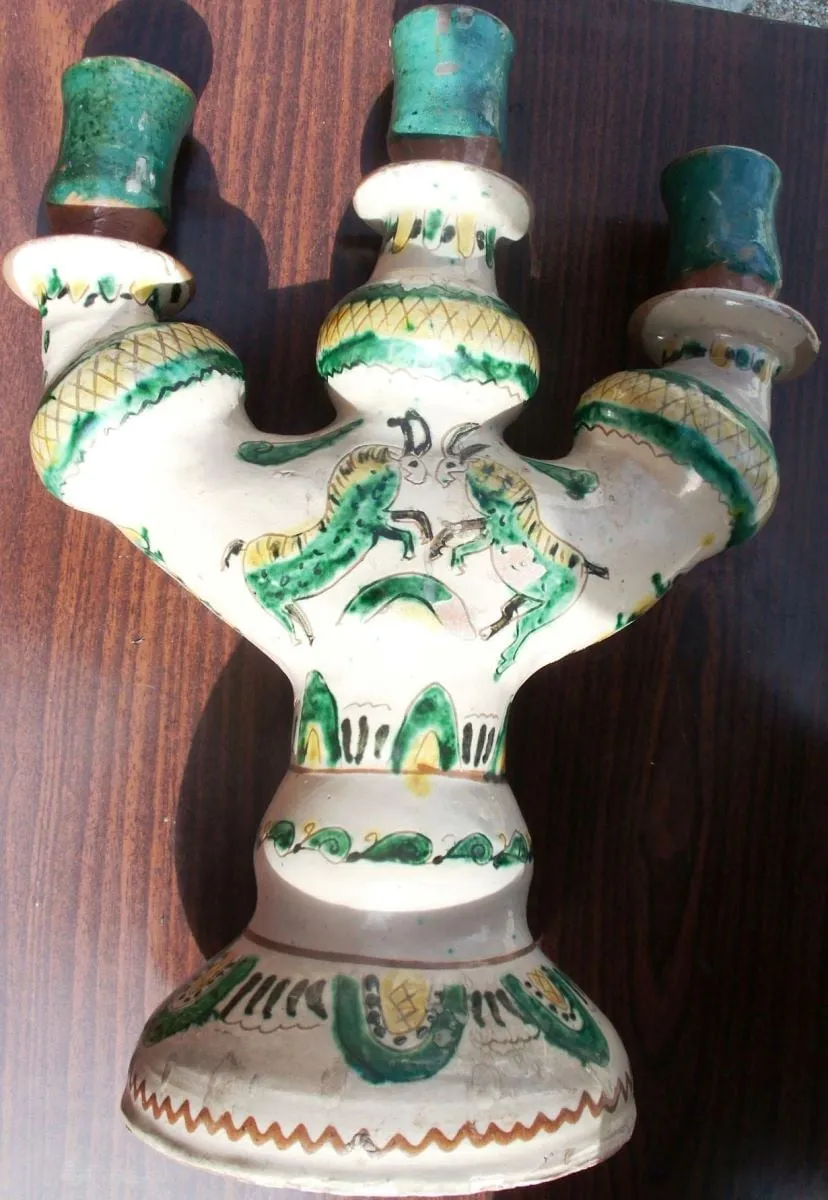
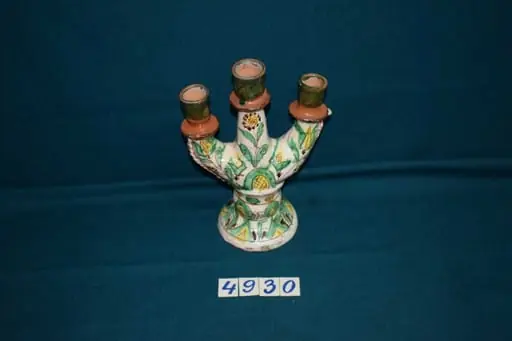
Sfeșnic kuty cu trei brațe is a photography by Unknown. It dates from 1850 and is held in the collection of the Golești Viticulture and Pomiculture Museum. A three-armed ceramic candlestick, known as a sfesnic kuty, is depicted in a photograph.
About this work
Overview
Its form is characterized by a broad, rounded base and three curved arms extending outward, each terminating in a small holder for candles.
A three-armed ceramic candlestick, known as a sfesnic kuty, is depicted in a photograph. Its form is characterized by a broad, rounded base and three curved arms extending outward, each terminating in a small holder for candles. The surface is decorated with alternating green and yellow stripes, and a central motif of two goats facing one another. The base edge is adorned with a zigzag border, adding rhythmic detail to the object’s silhouette.
Subject & Meaning
The paired goats at the center may symbolize duality, balance, or pastoral life, common themes in folk decorative traditions. Their mirrored posture suggests harmony or ritual significance, possibly tied to seasonal or religious observances. The candlestick’s multiple arms could reflect liturgical use, where simultaneous lighting of candles held symbolic weight, perhaps in domestic or communal worship settings.
Technique & Style
Crafted from ceramic, the piece displays hand-modeled forms and painted decoration in limited, contrasting colors. The zigzag base pattern and striped body indicate adherence to regional folk aesthetics, where repetition and geometric clarity prevail. The arms are subtly curved, suggesting functional consideration alongside ornamentation. Details are rendered with precision but without fine brushwork, pointing to workshop or local artisan production.
History & Provenance
This object belongs to a category of traditional Romanian ceramic candlesticks, likely produced in the 19th or early 20th century. Such items were common in rural households and religious contexts, particularly in Moldavia and Transylvania. Its survival in photographic form suggests it was collected or documented by ethnographers, though its specific origin and maker remain undocumented.
Context
Sfesnic kuty were part of everyday religious and domestic life in Romanian villages, often used during holidays or rites such as Easter or Christmas. Their design reflects a fusion of Christian symbolism and pre-Christian folk motifs. The presence of animals like goats aligns with broader Eastern European decorative traditions where livestock represented fertility, protection, or abundance.
Legacy
Though attributed to an unknown artisan, this candlestick exemplifies the persistence of vernacular ceramic traditions in Eastern Europe. It contributes to the understanding of how utilitarian objects carried cultural meaning beyond function. Today, similar pieces are preserved in ethnographic collections, serving as tangible links to pre-industrial craft practices and rural spiritual life.
Artist & collection
Museum
Golești Viticulture and Pomiculture Museum
Continue through works from the same source collection.
 Domestic Scene
 Giacomo and Cardinal Marco, investing Andrea, Abbot of San Zeno, with his Benefice
 The Nymph of Fontainebleau
 Portrait of a Woman
 Madonna and Child with Saints in the Enclosed Garden
 Venus and Minerva
 Family Group of Four on Sofa
 Wall painting from Room H of the Villa of P. Fannius Synistor at Boscoreale