Artwork
Shiva, Parvati and Nandi
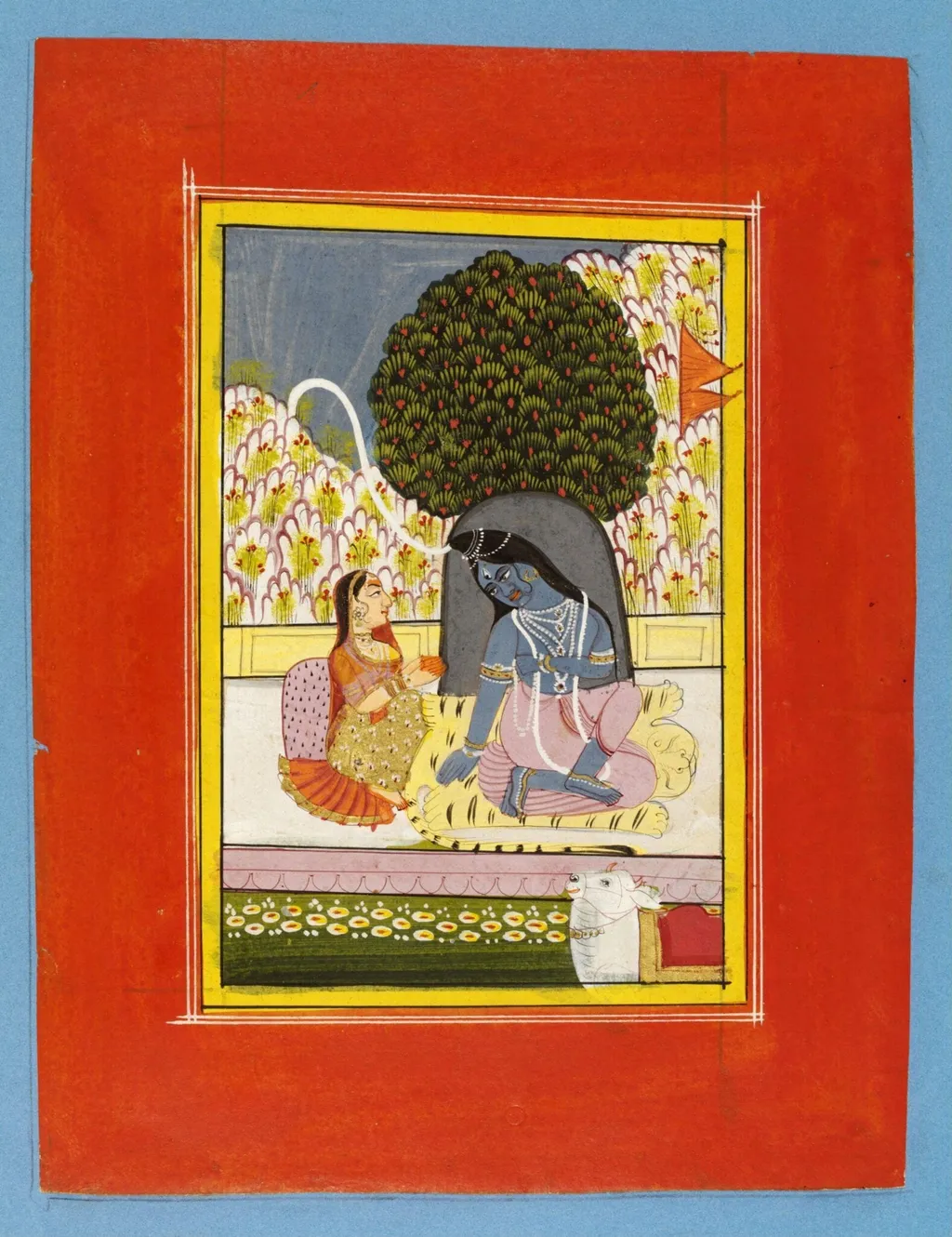
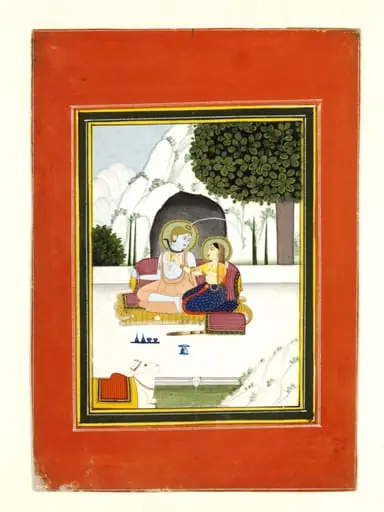
Shiva, Parvati and Nandi is a paint painting by Unknown. It dates from 1850 and is held in the collection of the Victoria and Albert Museum. The work presents a Hindu trio—Shiva, his consort Parvati, and the bull Nandi—arranged within a stylised mountainous setting.
About this work
Overview
Rendered with opaque watercolour and gold on paper, the composition balances vivid pigments with strong contour lines, creating a striking visual impact.
The work presents a Hindu trio—Shiva, his consort Parvati, and the bull Nandi—arranged within a stylised mountainous setting. Rendered with opaque watercolour and gold on paper, the composition balances vivid pigments with strong contour lines, creating a striking visual impact. The scene is anchored by a large tree under which the deities are seated, surrounded by dense foliage and distant architectural elements.
Subject & Meaning
Shiva and Parvati are depicted in a tranquil pose, suggesting divine harmony and marital unity, while Nandi, the sacred bull, stands as their attendant. The inclusion of a white elephant and an arched building in the background hints at royal or ceremonial contexts, reinforcing the deities' association with protection, fertility, and cosmic order within Hindu tradition.
Technique & Style
The artist employed opaque watercolour combined with gold leaf, allowing saturated hues to emerge against a luminous ground. Bold outlines define the figures and foliage, while the compact leaf clusters convey a sense of abundance. The use of gold accentuates the divine aura of the subjects, and the overall flatness reflects a decorative aesthetic common in 19th‑century Indian manuscript painting.
History & Provenance
Created circa 1850, the painting was originally catalogued as RP 51/2237 within the Department of Engraving, Illustration & Design. It was later transferred to the museum’s painting collection, where it remains documented as an example of mid‑nineteenth‑century devotional art produced for private or temple patronage.
Context
The work belongs to a period when Indian artists frequently blended traditional iconography with materials such as watercolour and gold to meet both local devotional needs and the tastes of colonial collectors. Its mountainous backdrop and architectural motifs echo the visual language of regional courtly paintings, situating the divine narrative within a recognizable earthly landscape.
Artist & collection

 Domestic Scene
 Giacomo and Cardinal Marco, investing Andrea, Abbot of San Zeno, with his Benefice
 The Nymph of Fontainebleau
 Portrait of a Woman
 Madonna and Child with Saints in the Enclosed Garden
 Venus and Minerva
 Family Group of Four on Sofa
 Wall painting from Room H of the Villa of P. Fannius Synistor at Boscoreale