Artwork
Talger
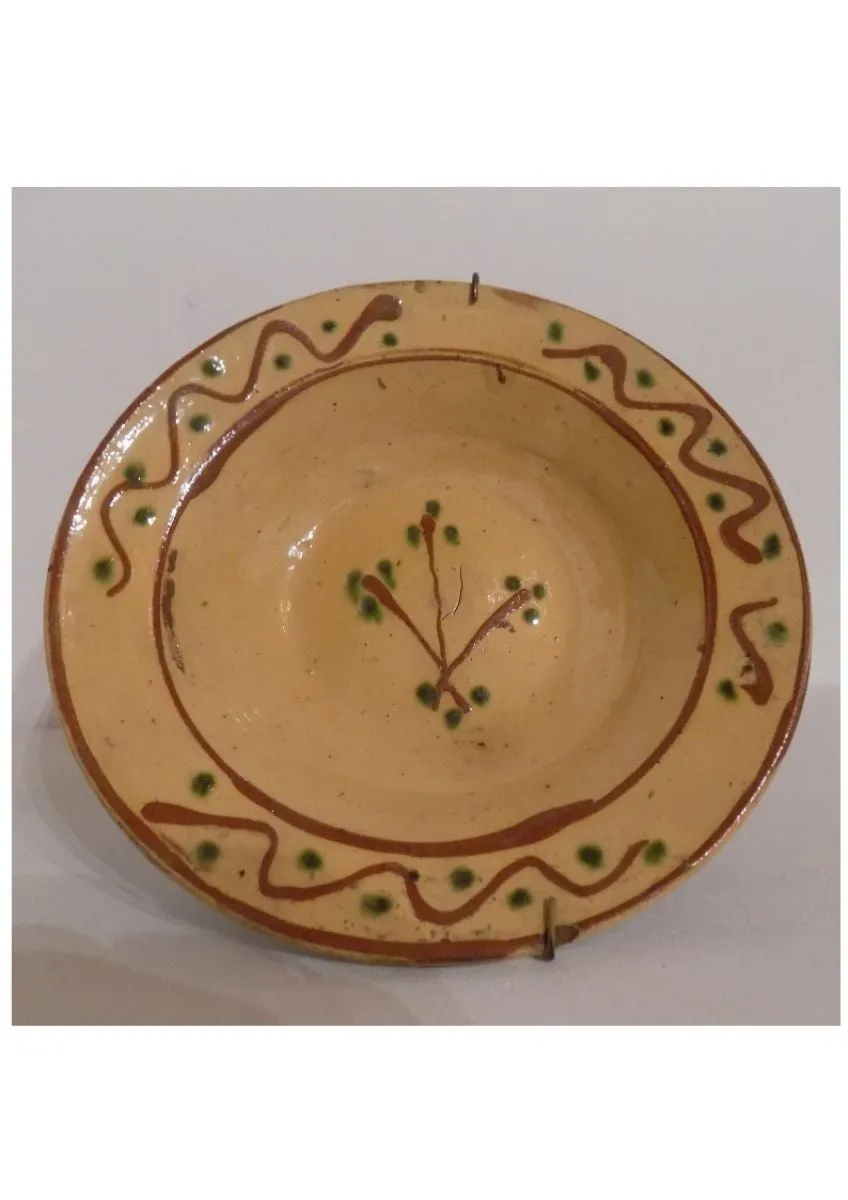
Talger is a print by Unknown. It dates from 1951 and is held in the collection of the Moldova National Museum Complex. A circular ceramic dish with an unglazed, hand-formed surface, this object features minimal decoration and a visibly irregular rim.
About this work
Overview
A circular ceramic dish with an unglazed, hand-formed surface, this object features minimal decoration and a visibly irregular rim.
A circular ceramic dish with an unglazed, hand-formed surface, this object features minimal decoration and a visibly irregular rim. The exterior bears a wavy brown band dotted with tiny green marks, while the interior holds a single, stylized plant motif in red and green against a pale brown ground. Its modest scale and uneven edges suggest handmade production, likely for domestic or ritual use rather than commercial sale.
Subject & Meaning
The central design is a simplified botanical form, possibly representing a local plant species or symbolic vegetation. Its placement at the center and use of contrasting colors imply functional or ceremonial significance, though no definitive cultural interpretation is recorded. The repetition of green and red may reflect regional color symbolism, but its exact meaning remains undocumented.
Technique & Style
Crafted by hand without a wheel, the dish shows subtle asymmetry and a coarse texture consistent with low-fired earthenware. Decoration was applied sparingly, using pigment likely derived from natural minerals. The wavy border and dotting technique suggest a deliberate, repetitive hand motion, indicating adherence to a local aesthetic tradition rather than individual artistic innovation.
History & Provenance
No maker’s mark or inscription is present, and no documented provenance accompanies the object. It was acquired by the Museum of Ethnography as part of a broader collection of utilitarian ceramics, likely from a rural or indigenous community. Its origins remain unidentified, though similar forms appear in regional archaeological and ethnographic records.
Context
This object aligns with small-scale ceramic traditions found in communities where functional ware was made locally using accessible materials. Its simplicity and lack of ornamentation suggest it was not intended for elite use. Comparable pieces are found in household contexts across similar cultural zones, often used for storage, serving, or ritual offerings.
Legacy
Though unsigned and unattributed, the dish contributes to understanding everyday material culture in pre-industrial societies. It exemplifies how aesthetic choices in utilitarian objects reflect local knowledge and inherited practices. Its preservation in a museum setting allows ongoing study of non-elite craftsmanship and regional ceramic diversity.
Artist & collection
 Domestic Scene
 Giacomo and Cardinal Marco, investing Andrea, Abbot of San Zeno, with his Benefice
 The Nymph of Fontainebleau
 Portrait of a Woman
 Madonna and Child with Saints in the Enclosed Garden
 Venus and Minerva
 Family Group of Four on Sofa
 Wall painting from Room H of the Villa of P. Fannius Synistor at Boscoreale
 Castron
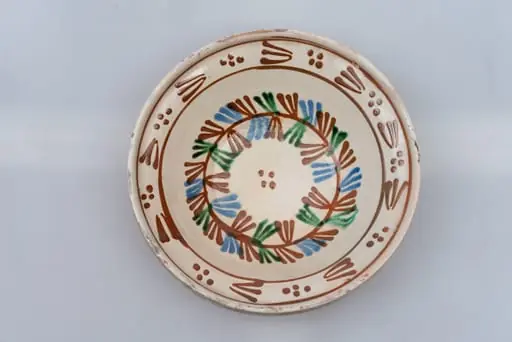 Farfurie adâncă de tip castron, cu corp tronconic și buză îngustă verticală. Este acoperită pe fața interioară și pe exteriorul buzei cu un strat de humă albă, peste care este pictat cu cornul decorul format din motive geometrice: centrul farfuriei este decorat cu o linie circulară de culoare maro, decorată cu grupuri de câte trei linii drepte dispuse în formă de V, de culoare maro, verde, albastru și un grup de patru puncte în centru. Un al doilea registru decorativ, situat sub buza farfuriei și încadrat între două linii circulare, se compune din motive formate din grupuri de câte trei linii maro dispuse în formă de V, intercalate de grupuri de câte patru puncte maro. Cromatica: alb, verde, albastru, maro. Suprafața ornamentată a farfuriei este acoperită cu un strat de smalț transparent.
 strachină
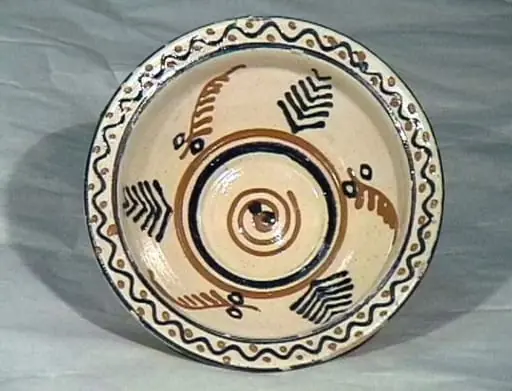
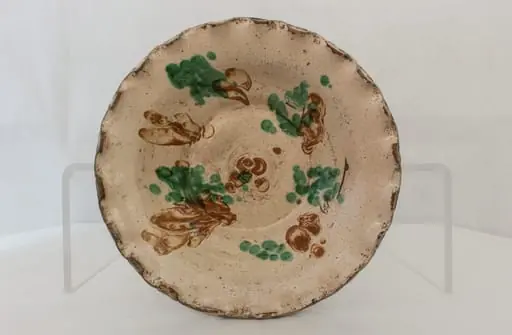 Vas de formă rotundă, cu pereții ușor evazați, smălțuit în interior, cu marginea vălurită, decorat (în mod unic) pe suprafața interioară cu motive punctiforme și neregulate, dispuse aleatoriu, realizate cu pensula. Cromatică: verde, maro, bej.
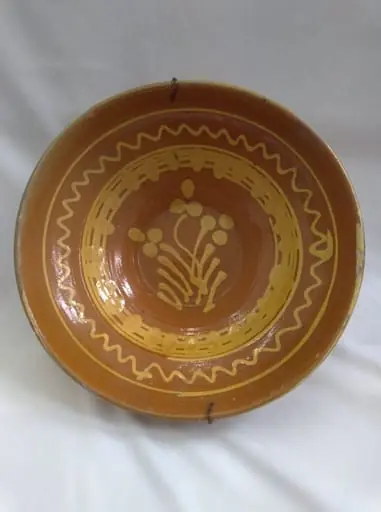
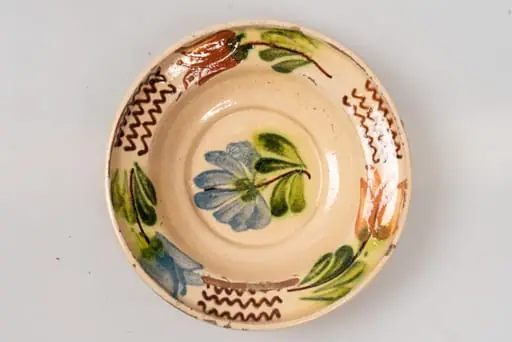 Farfurie adâncă, cu buza evazată și muchia buzei ridicată. Piesa este acoperită pe suprafața interioară cu un strat de angobă albă peste care este pictat cu pensula și cu cornul decorul format din motive florale și geometrice: fundul farfuriei conține o floare cu petale alungite de culoare albastră și frunze verzi. Alte trei flori (una cu petale de culoare albastră, a doua de culoare maro-roșcat iar cea de-a treia de culoare siena arsă), cu tulpină maro și frunze verzi, decorează buza farfuriei. Între cele trei flori, sunt pictate trei motive aproximativ identice, formate din trei linii vălurite paralele, de culoare maro. Suprafața ornamentată a farfuriei este acoperită cu un strat de smalț transparent. Cromatica: alb, verde, siena arsă, maro, maro-roșcat, albastru.
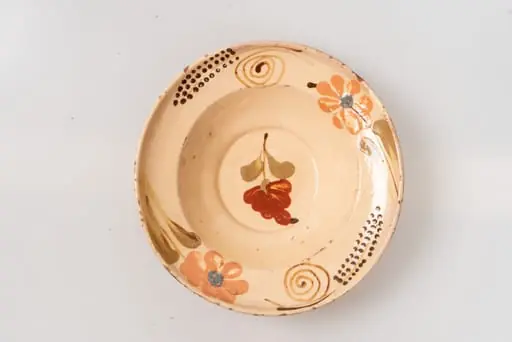 Farfurie adâncă de tip castron, cu fund mic, corp tronconic, buză evazată și muchia buzei ridicată. Piesa este acoperită pe suprafața interioară și pe exteriorul muchiei buzei cu un strat de angobă albă, peste care este pictat cu pensula și cu cornul decorul format din motive florale și geometrice: fundul farfuriei conține o floare cu petale maro-roșcat și frunze verzi; alte două flori cu petale rotunde de culoare siena arsă, cu mijlocul format dintr-un punct albastru și cu frunze verzi, decorează buza farfuriei. Între cele două flori, sunt pictate două motive aproximativ identice formate dintr-o linie spiralată de culoare maro și un grup de puncte maro-închis, sugerând o frunză alungită. Suprafața ornamentată a farfuriei este acoperită cu un strat de smalț transparent. Cromatica: alb, verde, albastru, siena arsă, maro-închis, maro-roșcat.
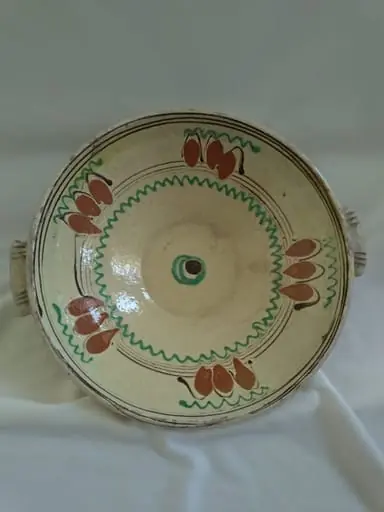 Strachină cu toartă