Artwork
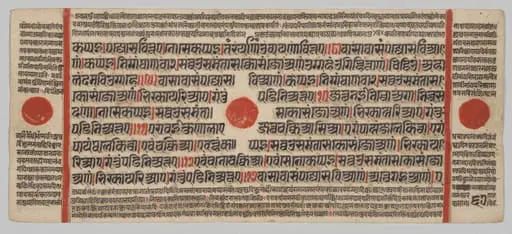
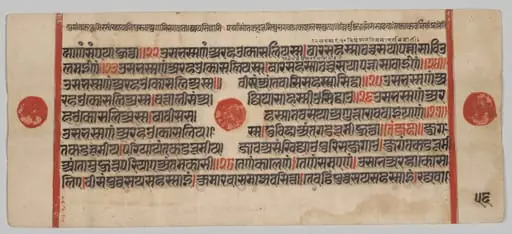
Text, Folio 52 (verso), from a Kalpa-sutra
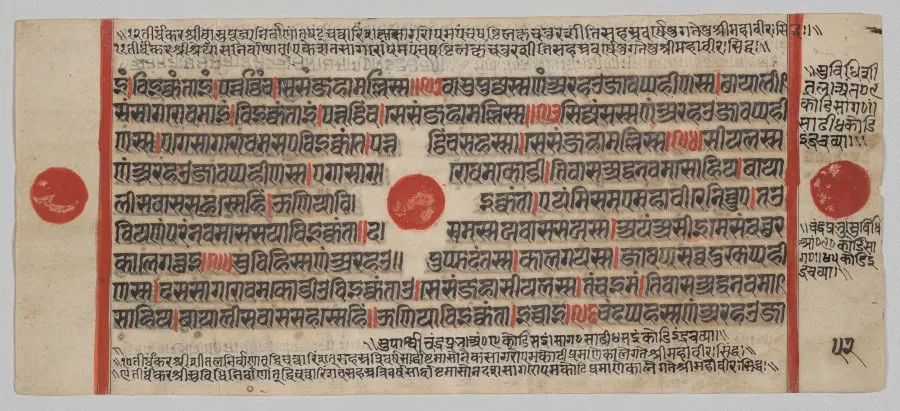
Text, Folio 52 (verso), from a Kalpa-sutra is an unspecified painting by the Mughal Painting artist Unknown. It dates from 1488 and is held in the collection of the Cleveland Museum of Art. This folio is a fragment from a Kalpa-sutra manuscript, a Jain religious text written in an early South Asian script.
About this work
Overview
The surface is densely covered in black ink, arranged in orderly lines, with selective red underlining and three circular red seals along the edges.
This folio is a fragment from a Kalpa-sutra manuscript, a Jain religious text written in an early South Asian script. The surface is densely covered in black ink, arranged in orderly lines, with selective red underlining and three circular red seals along the edges. The paper shows signs of age—yellowing and faint crease marks—indicating use and handling over time. The presence of seals and emphasis through color suggests ritual or institutional significance.
Subject & Meaning
The text contains passages from the Kalpa-sutra, a canonical Jain work detailing the lives of the Tirthankaras and monastic rules. The red underlining likely highlights key doctrinal phrases or passages meant for recitation. The seals may denote ownership by a monastery, a scribe’s certification, or institutional authority. Its purpose was liturgical or educational, preserving sacred knowledge through careful transcription.
Technique & Style
The script reflects an early regional variant of the Devanagari or Jain Prakrit writing systems, characterized by rounded forms and consistent spacing. Ink was applied with a reed or bamboo stylus, while red pigment—possibly vermilion—was used for emphasis and sealing. The paper, likely handmade from bark or cotton, shows wear consistent with repeated handling, suggesting it was a working copy rather than a ceremonial object.
History & Provenance
This folio likely originated in western India between the 14th and 16th centuries, a period when Jain communities actively produced and preserved religious manuscripts. The seals may correspond to monastic libraries or royal patrons who supported textual transmission. Its survival implies careful storage, possibly in temple archives or private collections, before entering modern institutional holdings.
Context
In medieval Jain tradition, the manual copying of sacred texts was an act of devotion. Scribes worked under strict guidelines, often in scriptoriums attached to temples. The use of red for emphasis and sealing mirrored broader South Asian practices seen in Hindu and Buddhist manuscripts, reinforcing textual authority through visual markers shared across religious traditions.
Legacy
Fragments like this preserve the material culture of Jain scholarship and the discipline of manuscript production. They offer insight into how religious knowledge was transmitted before print, emphasizing accuracy, ritual care, and institutional oversight. Today, such folios serve as primary sources for linguistic, religious, and art historical study, anchoring modern understanding to tangible historical artifacts.
Artist & collection

 Domestic Scene
 Giacomo and Cardinal Marco, investing Andrea, Abbot of San Zeno, with his Benefice
 The Nymph of Fontainebleau
 Portrait of a Woman
 Madonna and Child with Saints in the Enclosed Garden
 Venus and Minerva
 Family Group of Four on Sofa
 Wall painting from Room H of the Villa of P. Fannius Synistor at Boscoreale
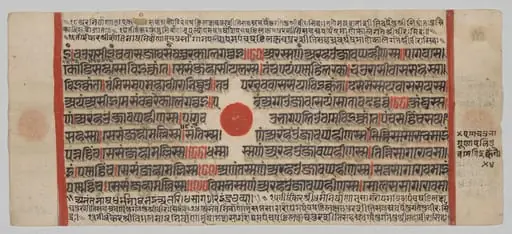 Text, Folio 52 (recto), from a Kalpa-sutra
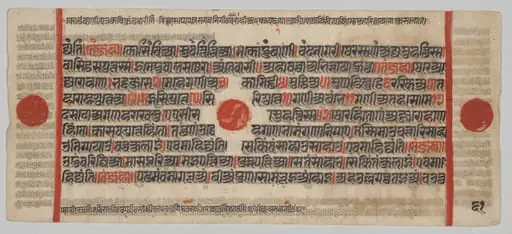 Text, Folio 61 (verso), from a Kalpa-sutra
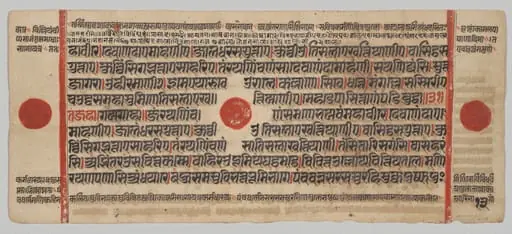 Text, Folio 13 (verso), from a Kalpa-sutra
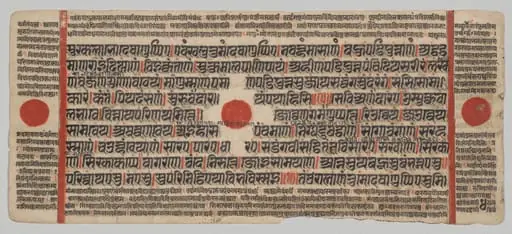 Text, Folio 4 (verso), from a Kalpa-sutra
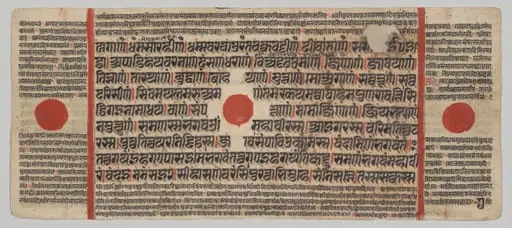 Text, Folio 7 (verso), from a Kalpa-sutra
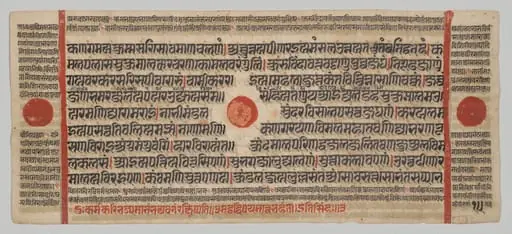 Text, Folio 15 (verso), from a Kalpa-sutra
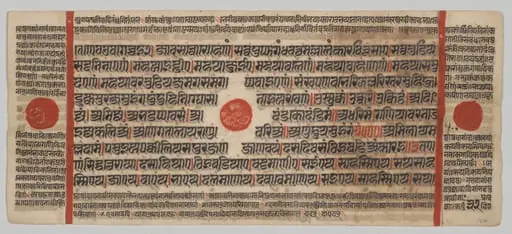 Text, Folio 32 (verso), from a Kalpa-sutra
 Text, Folio 67 (verso), from a Kalpa-sutra
 Text, Folio 56 (verso), from a Kalpa-sutra