Artwork
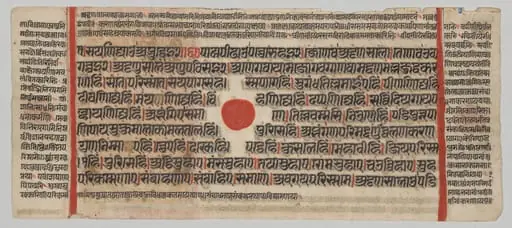
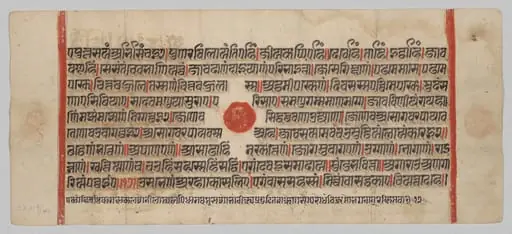
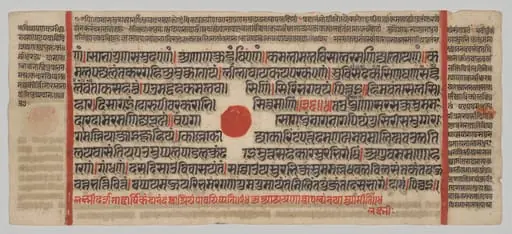
Text, folio 61 (recto), from a Kalpa-sutra
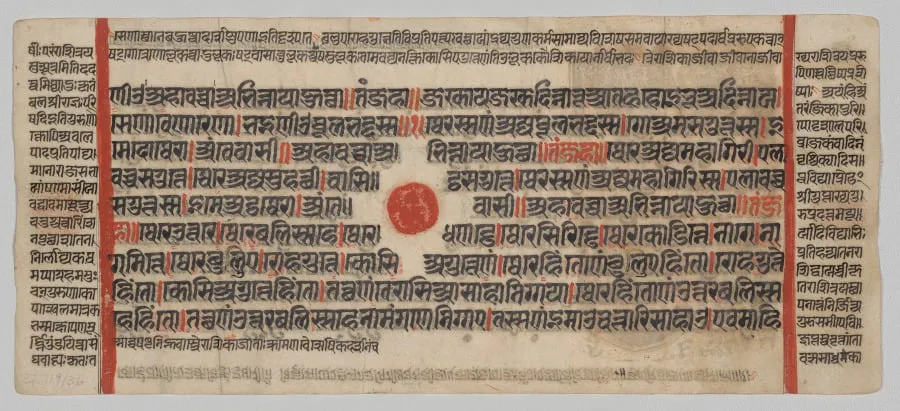
Text, folio 61 (recto), from a Kalpa-sutra is an unspecified painting by the Mughal Painting artist Unknown. It dates from 1488 and is held in the collection of the Cleveland Museum of Art. This folio comes from a manuscript of the Kalpa-sutra, a Jain religious text.
About this work
Overview
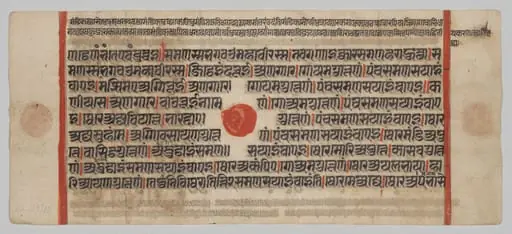
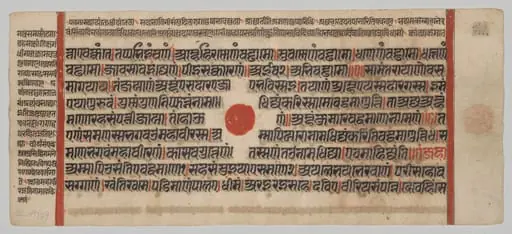
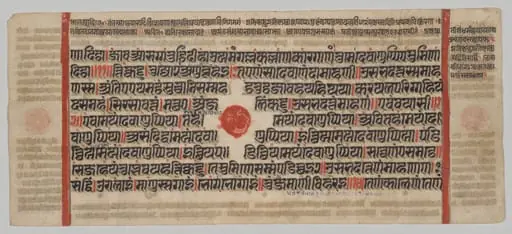
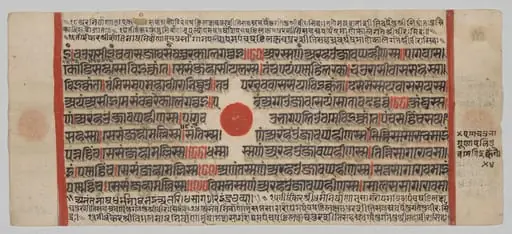
Red ink outlines the top and bottom edges, framing the text, while a central red circle with a dot marks a structural or liturgical division.
This folio comes from a manuscript of the Kalpa-sutra, a Jain religious text. The page is densely covered in dark brown ink script arranged in horizontal lines, filling the entire surface. Red ink outlines the top and bottom edges, framing the text, while a central red circle with a dot marks a structural or liturgical division. The paper shows signs of age, but the contrast between ink and substrate remains legible.
Subject & Meaning
The text contains passages from the Kalpa-sutra, which details the lives of Jain Tirthankaras and monastic rules. The red circle likely signals a pause or transition in recitation, serving as a visual cue for ritual reading. Its placement reflects the importance of precise textual transmission in Jain tradition, where oral and written forms are equally revered.
Technique & Style
The script is executed in a fine, uniform hand using iron-gall ink, typical of medieval Indian manuscript production. Red borders and the central dot were applied with precision, possibly using a reed pen or brush. The layout prioritizes clarity and density, minimizing empty space to maximize textual content within limited material resources.
History & Provenance
This folio was likely produced in western India during the 15th century, a period when Jain communities actively commissioned illustrated manuscripts. Its survival suggests careful handling within monastic or scholarly circles. Though its exact provenance is undocumented, similar folios are held in collections across India and the West, indicating historical circulation among religious institutions.
Context
Manuscripts like this were used in Jain ritual recitations and study, often kept in temple libraries. The absence of illustration here contrasts with other Kalpa-sutra folios, suggesting this may be a textual companion rather than a devotional image. Its design reflects a preference for textual purity, aligning with ascetic values that emphasized content over ornamentation.
Legacy
This folio exemplifies the enduring Jain commitment to preserving sacred texts through meticulous calligraphy. It contributes to a broader understanding of how religious knowledge was transmitted in pre-modern South Asia. Today, such manuscripts serve as primary sources for scholars studying Jain theology, paleography, and the material culture of medieval India.
Artist & collection

 Domestic Scene
 Giacomo and Cardinal Marco, investing Andrea, Abbot of San Zeno, with his Benefice
 The Nymph of Fontainebleau
 Portrait of a Woman
 Madonna and Child with Saints in the Enclosed Garden
 Venus and Minerva
 Family Group of Four on Sofa
 Wall painting from Room H of the Villa of P. Fannius Synistor at Boscoreale