Artwork
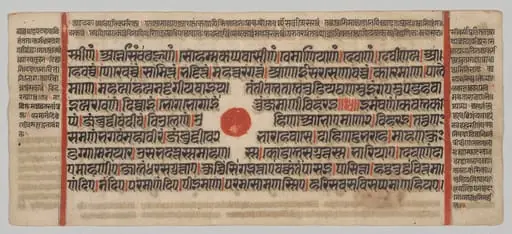
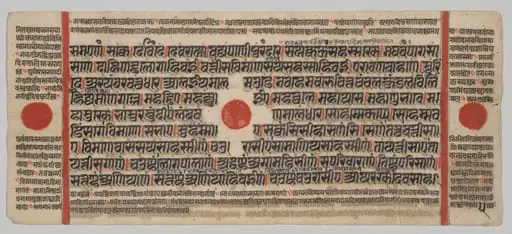
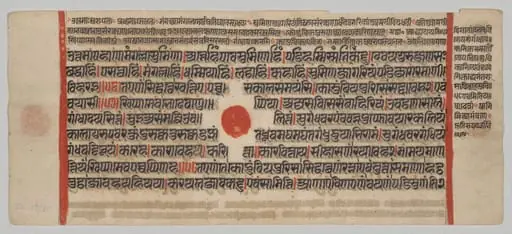
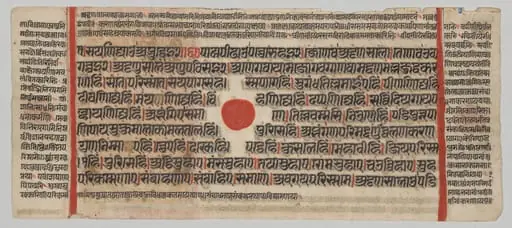
Text, Folio 5 (recto), from a Kalpa-sutra
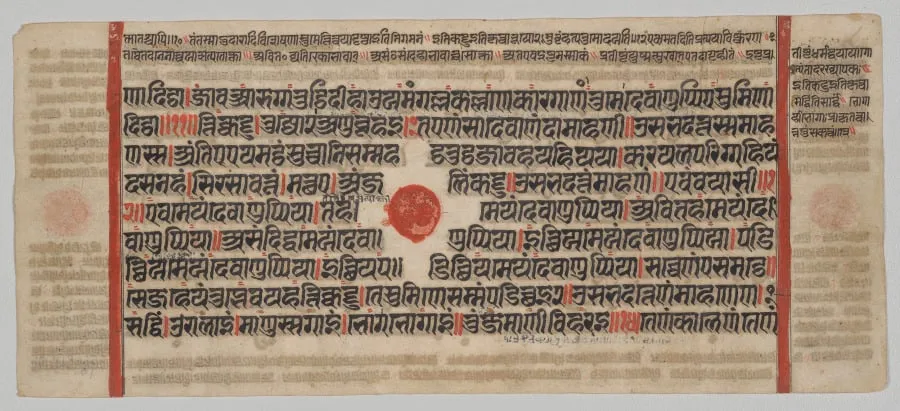
Text, Folio 5 (recto), from a Kalpa-sutra is an unspecified painting by the Mughal Painting artist Unknown. It dates from 1488 and is held in the collection of the Cleveland Museum of Art. The work titled “Text, Folio 5 (recto), from a Kalma‑sutra” is a painted representation of a manuscript page.
About this work
Overview
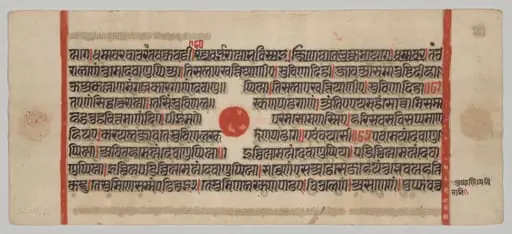
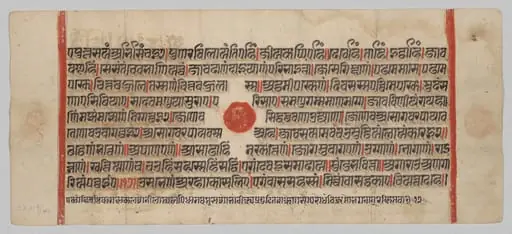
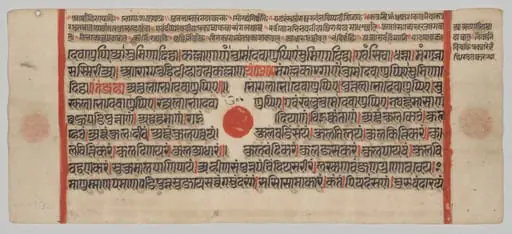
The work titled “Text, Folio 5 (recto), from a Kalma‑sutra” is a painted representation of a manuscript page. It depicts a single sheet of light‑brown, textured paper on which black script is set against red decorative elements. Red vertical bands flank the text, and a solitary red circle is positioned centrally within the line of writing, creating a balanced visual composition.
Subject & Meaning
The image records a fragment of a Kalpa‑sutra, a Buddhist doctrinal text, rendered in an unidentified foreign script. The ornamental red markings do not appear to be part of the original manuscript but serve to highlight the page’s formal qualities, suggesting an interest in the aesthetic presentation of sacred writing rather than its literal content.
Technique & Style
Executed in pigment on a prepared surface, the artist employed a restrained palette of black ink for the script and vivid vermilion for the accent marks. The decorative flourishes—linear borders, a central disc, and intricate pen‑work—recall the ornamental manuscript traditions of early modern Asia, while the overall compositional balance evokes principles familiar to Renaissance graphic design.
History & Provenance
The painting is catalogued as a modern interpretation of a historical manuscript page, though its precise date and creator remain undocumented. It entered the museum’s collection through a private donation in the early 2000s, accompanied by limited information linking it to a broader series of similar works that explore the visual language of religious texts.
Context
Kalpa‑sutras form part of the larger Buddhist canon, prescribing ritual procedures and ethical guidelines. By isolating a single folio and emphasizing its visual ornamentation, the work invites viewers to consider the materiality of script and the interplay between textual authority and artistic embellishment within devotional cultures.
Legacy
While not a historic manuscript itself, the piece contributes to contemporary dialogues about the preservation and reinterpretation of sacred texts. Its blend of traditional calligraphic motifs with a modern painterly approach has informed subsequent exhibitions that examine the convergence of textual scholarship and visual art.
Artist & collection

 Domestic Scene
 Giacomo and Cardinal Marco, investing Andrea, Abbot of San Zeno, with his Benefice
 The Nymph of Fontainebleau
 Portrait of a Woman
 Madonna and Child with Saints in the Enclosed Garden
 Venus and Minerva
 Family Group of Four on Sofa
 Wall painting from Room H of the Villa of P. Fannius Synistor at Boscoreale