Artwork
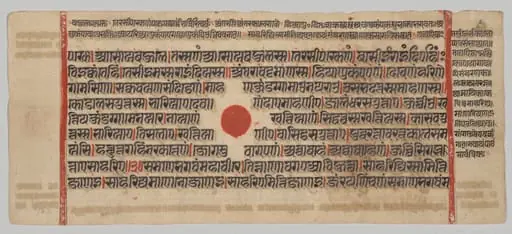
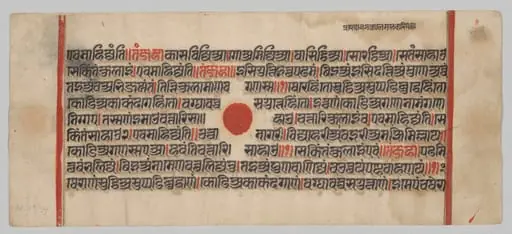
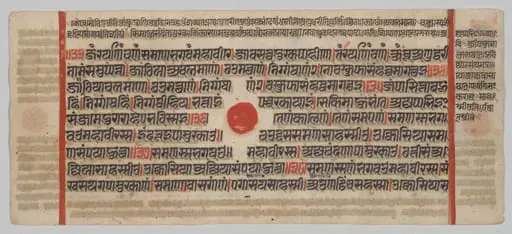
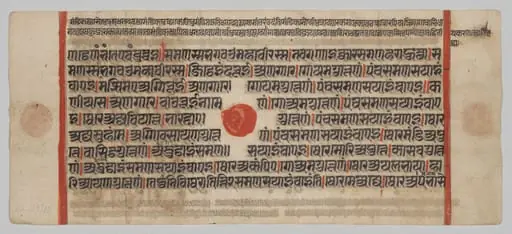
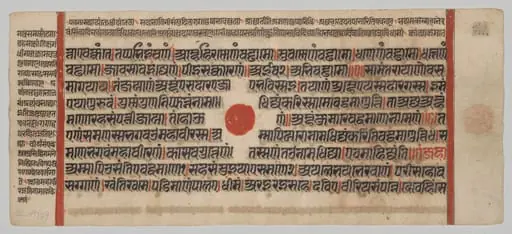
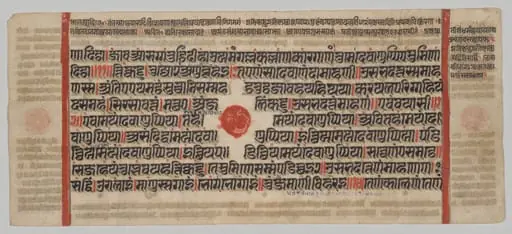
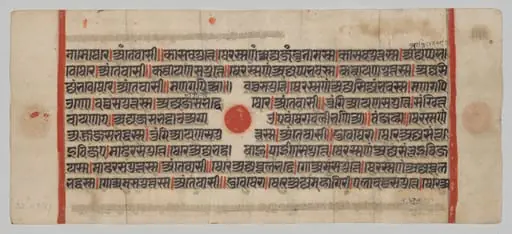
Text, Folio 55 (recto), from a Kalpa-sutra
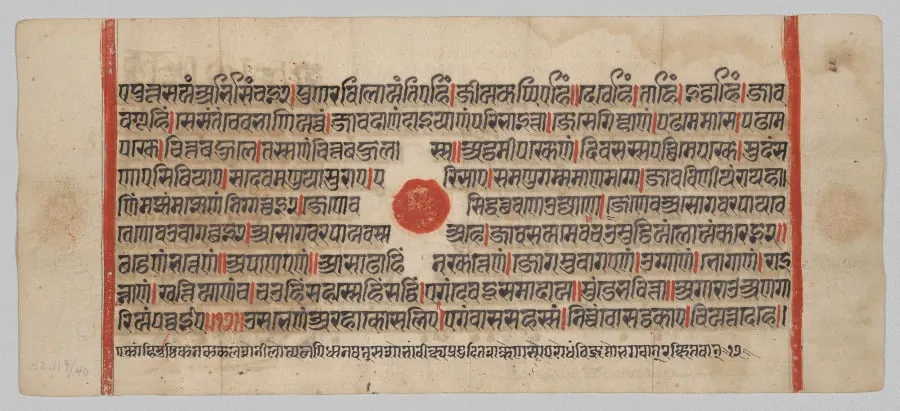
Text, Folio 55 (recto), from a Kalpa-sutra is an unspecified painting by the Mughal Painting artist Unknown. It dates from 1488 and is held in the collection of the Cleveland Museum of Art. This folio is a fragment of a manuscript likely from a Kalpa-sutra tradition, featuring densely written text in an undeciphered script.
About this work
Overview
Its lack of imagery and focus on script suggest a devotional or liturgical function, prioritizing textual authority over pictorial representation.
This folio is a fragment of a manuscript likely from a Kalpa-sutra tradition, featuring densely written text in an undeciphered script. Rendered in black ink with selective red highlights, the page bears signs of prolonged use—fading, creasing, and surface wear. A single red circle anchors the center, offering visual emphasis without illustration. Its lack of imagery and focus on script suggest a devotional or liturgical function, prioritizing textual authority over pictorial representation.
Subject & Meaning
The content remains linguistically unidentified, limiting interpretive clarity. However, its association with the Kalpa-sutra tradition implies a Jain religious context, possibly containing doctrinal passages, ritual instructions, or biographical accounts of Tirthankaras. The central red circle may symbolize spiritual focus, cosmic order, or a marker for recitation, reflecting the sacred role of written word in Jain practice.
Technique & Style
The script is meticulously inscribed in black ink, with red pigment used sparingly for emphasis—likely for section dividers, syllabic markers, or ritual annotations. The handwriting exhibits consistency, suggesting a trained scribe. The absence of ornamentation or figural elements aligns with Jain textual austerity, where the purity of the written word supersedes visual embellishment.
History & Provenance
The physical condition—yellowed paper, frayed edges, and ink abrasion—indicates repeated handling over centuries. Likely produced in western India between the 14th and 16th centuries, it may have been part of a monastic library or used in communal recitations. Its survival suggests it was preserved with care, despite its utilitarian function, hinting at enduring ritual significance.
Context
This folio belongs to a broader tradition of Jain manuscript culture, where sacred texts were copied with precision and reverence. Unlike illustrated codices, this example reflects a minimalist aesthetic, emphasizing textual integrity. Similar unillustrated folios were used in monastic study and liturgical settings, where the act of reading itself held spiritual weight.
Legacy
As a surviving artifact of a largely non-visual Jain textual practice, this folio offers insight into the material culture of religious scholarship. Its undeciphered script underscores the loss of linguistic knowledge over time, while its wear testifies to the enduring ritual life of handwritten scripture in pre-modern South Asia.
Artist & collection

 Domestic Scene
 Giacomo and Cardinal Marco, investing Andrea, Abbot of San Zeno, with his Benefice
 The Nymph of Fontainebleau
 Portrait of a Woman
 Madonna and Child with Saints in the Enclosed Garden
 Venus and Minerva
 Family Group of Four on Sofa
 Wall painting from Room H of the Villa of P. Fannius Synistor at Boscoreale