Artwork
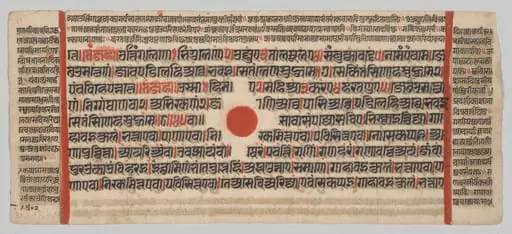
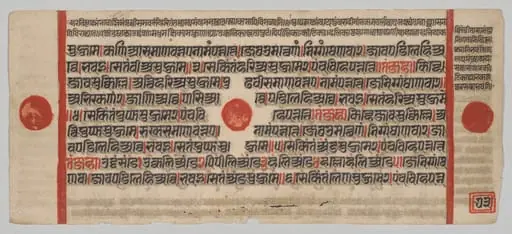
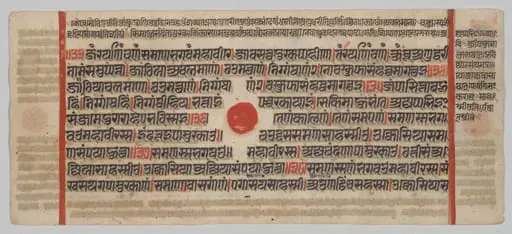
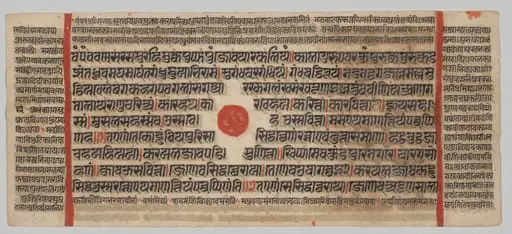
Text, Folio 73 (recto), from a Kalpa-sutra
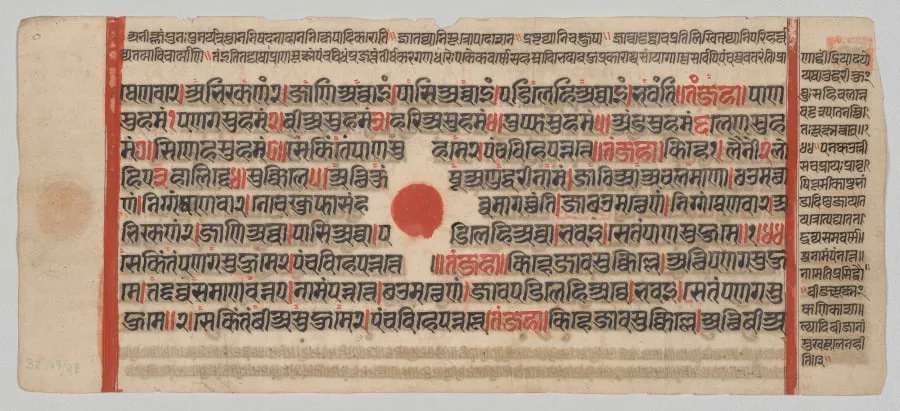
Text, Folio 73 (recto), from a Kalpa-sutra is an unspecified painting by the Mughal Painting artist Unknown. It dates from 1488 and is held in the collection of the Cleveland Museum of Art. The object is a single folio from a Kalpa‑sutra, presented as a painted page rather than a bound volume.
About this work
Overview
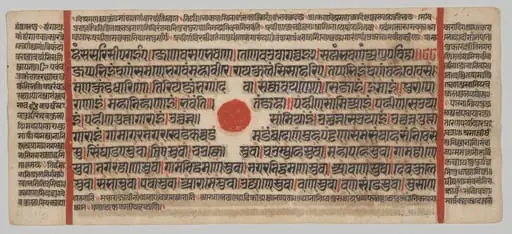
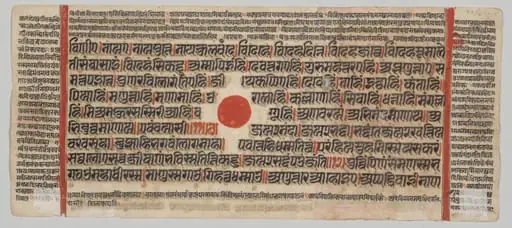
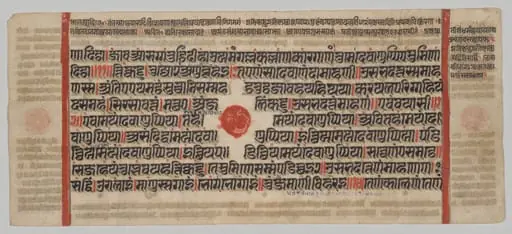
The object is a single folio from a Kalpa‑sutra, presented as a painted page rather than a bound volume. Executed on aged paper, the surface bears dense script in black and red ink, with the composition filling the entire sheet. Margins are highlighted by thin red lines, and a small, vivid red circle occupies the central area of the page.
Subject & Meaning
The page contains a passage of the Kalpa‑sutra, a Buddhist text concerned with ritual rules and monastic discipline. The red circle likely functions as a visual cue, marking a key term, doctrinal point, or liturgical instruction within the densely written material.
Technique & Style
The scribe employed a dual‑ink method, using black for the main body of the script and red for headings, marginal marks, and the central emblem. The ink is applied with a fine brush, producing tightly packed characters that leave little negative space, while the red circle provides a contrasting focal point.
History & Provenance
The folio originates from a manuscript tradition in which sacred texts were manually copied for transmission within monastic communities. The paper’s wear, fading ink, and marginal red lines indicate prolonged use and handling, suggesting it served a functional, perhaps ritual, purpose rather than decorative display.
Context
Kalpa‑sutras belong to the broader corpus of Buddhist literature that codifies monastic conduct and ceremonial practices. Such manuscripts were essential for preserving doctrinal continuity across generations, especially before the advent of printing technologies.
Legacy
Pages like this illustrate the material culture of Buddhist textual transmission, offering insight into the scribal conventions, visual hierarchies, and practical concerns of pre‑modern monastic libraries. They remain valuable to scholars studying the evolution of script, manuscript production, and religious pedagogy.
Artist & collection

 Domestic Scene
 Giacomo and Cardinal Marco, investing Andrea, Abbot of San Zeno, with his Benefice
 The Nymph of Fontainebleau
 Portrait of a Woman
 Madonna and Child with Saints in the Enclosed Garden
 Venus and Minerva
 Family Group of Four on Sofa
 Wall painting from Room H of the Villa of P. Fannius Synistor at Boscoreale