Artwork
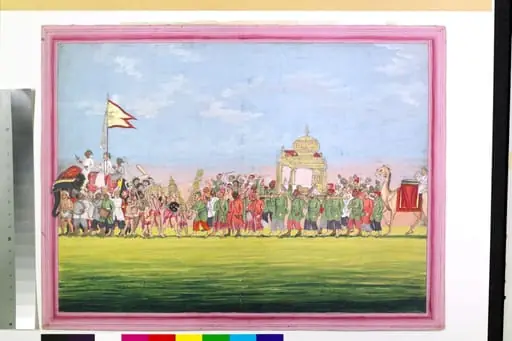
The departure of King Thibaw and Queen Supayalat from Mandalay at the end of the Third Burma War in 1885.
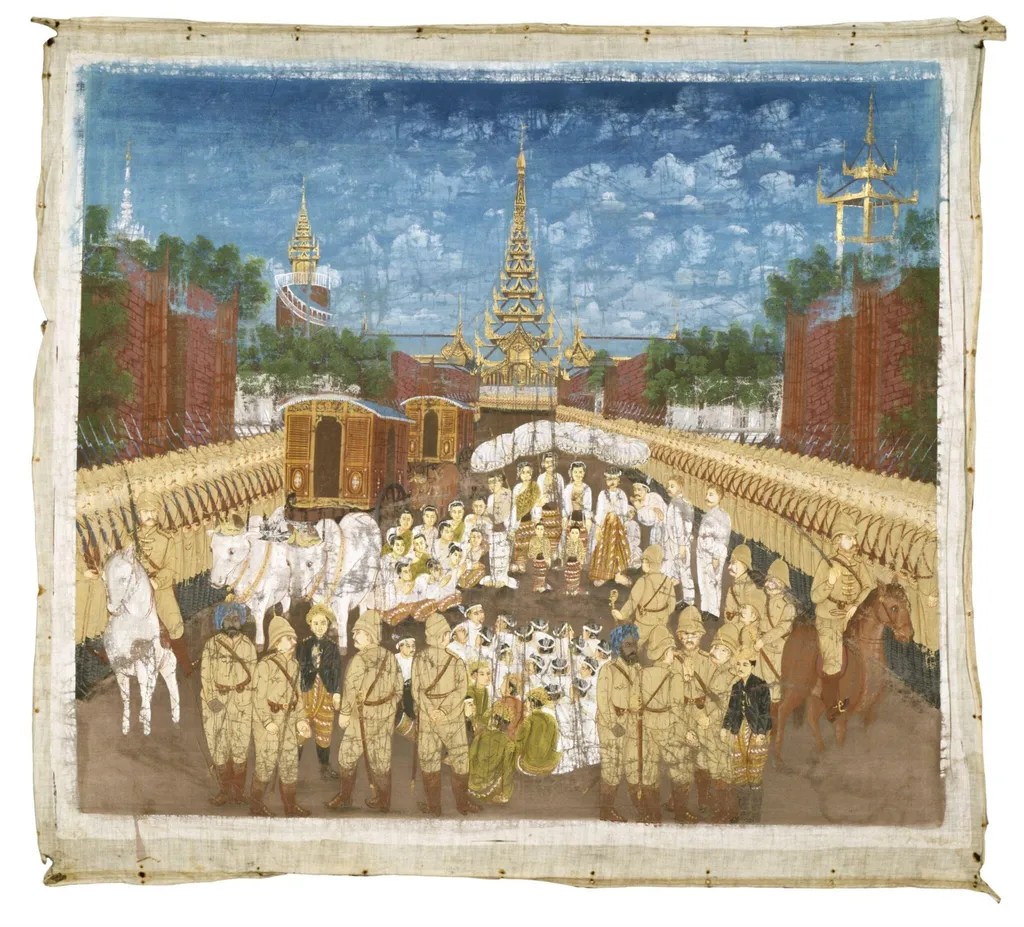
The departure of King Thibaw and Queen Supayalat from Mandalay at the end of the Third Burma War in 1885. is a paint painting by the Impressionist artist Unknown. It dates from 1885 and is held in the collection of the Victoria and Albert Museum.
About this work
Overview
The scene captures the royal family at the moment they leave the palace grounds, preparing to board a river steamer bound for India.
This painting depicts the forced exile of King Thibaw and Queen Supayalat from Mandalay in November 1885, following Britain’s annexation of Upper Burma after the Third Anglo-Burmese War. The scene captures the royal family at the moment they leave the palace grounds, preparing to board a river steamer bound for India. The composition centers on the monarchs under ceremonial umbrellas, surrounded by courtiers, British soldiers, and local officials, emphasizing the transition of power and the end of the Konbaung Dynasty’s rule.
Subject & Meaning
The painting portrays not merely a departure but the symbolic collapse of Burmese sovereignty. The royal couple, flanked by their children, are rendered with dignity yet isolation, their presence dwarfed by the disciplined ranks of British troops lining the road. The inclusion of Burmese officials in traditional attire alongside British and Sikh officers underscores the colonial imposition. The palace behind them serves as a silent witness to the loss of an independent kingdom, transforming the scene into a visual elegy for a fallen monarchy.
Technique & Style
The work employs a detailed, narrative-driven style typical of colonial-era portraiture, prioritizing clarity and historical record over emotional abstraction. Figures are arranged in a horizontal plane to guide the viewer’s eye from the royal group to the background palace and surrounding forces. While the painting shows careful attention to costume and architecture, it avoids dramatic lighting or atmospheric effects like sfumato, instead favoring flat, even illumination to emphasize the ceremonial and documentary nature of the moment.
History & Provenance
Commissioned shortly after the annexation of Burma, the painting likely originated from a British colonial official or artist documenting the event for imperial audiences. It reflects the British desire to visually cement the legitimacy of their rule by recording the deposition of the Burmese monarchy. The specific attire of the figures, including the luntaya-acheik silk of the Burmese officials, suggests the artist had access to eyewitness accounts or photographs, aiming for accuracy in the representation of a politically charged moment.
Context
The Third Anglo-Burmese War lasted only two weeks in November 1885, ending with minimal resistance as British forces moved swiftly to occupy Mandalay. The exile of Thibaw and Supayalat marked the formal end of Burma’s monarchy, which had endured for over two centuries. The painting captures the immediate aftermath of this conquest, when British authority was being visibly established through ritualized displays of control—military presence, ceremonial protocol, and the removal of royal symbols from the heart of the capital.
Legacy
As one of the few visual records of the Burmese royal family’s final days in Mandalay, the painting serves as a historical artifact of colonial transition. It has been used in academic and museum settings to illustrate the end of indigenous rule in Southeast Asia under British imperialism. While not widely known outside specialized circles, it remains a quiet but potent testament to the personal and political costs of empire, preserved as a document of a moment when power shifted irrevocably.
Artist & collection

 Domestic Scene
 Giacomo and Cardinal Marco, investing Andrea, Abbot of San Zeno, with his Benefice
 The Nymph of Fontainebleau
 Portrait of a Woman
 Madonna and Child with Saints in the Enclosed Garden
 Venus and Minerva
 Family Group of Four on Sofa
 Wall painting from Room H of the Villa of P. Fannius Synistor at Boscoreale