Artwork
Vishnu
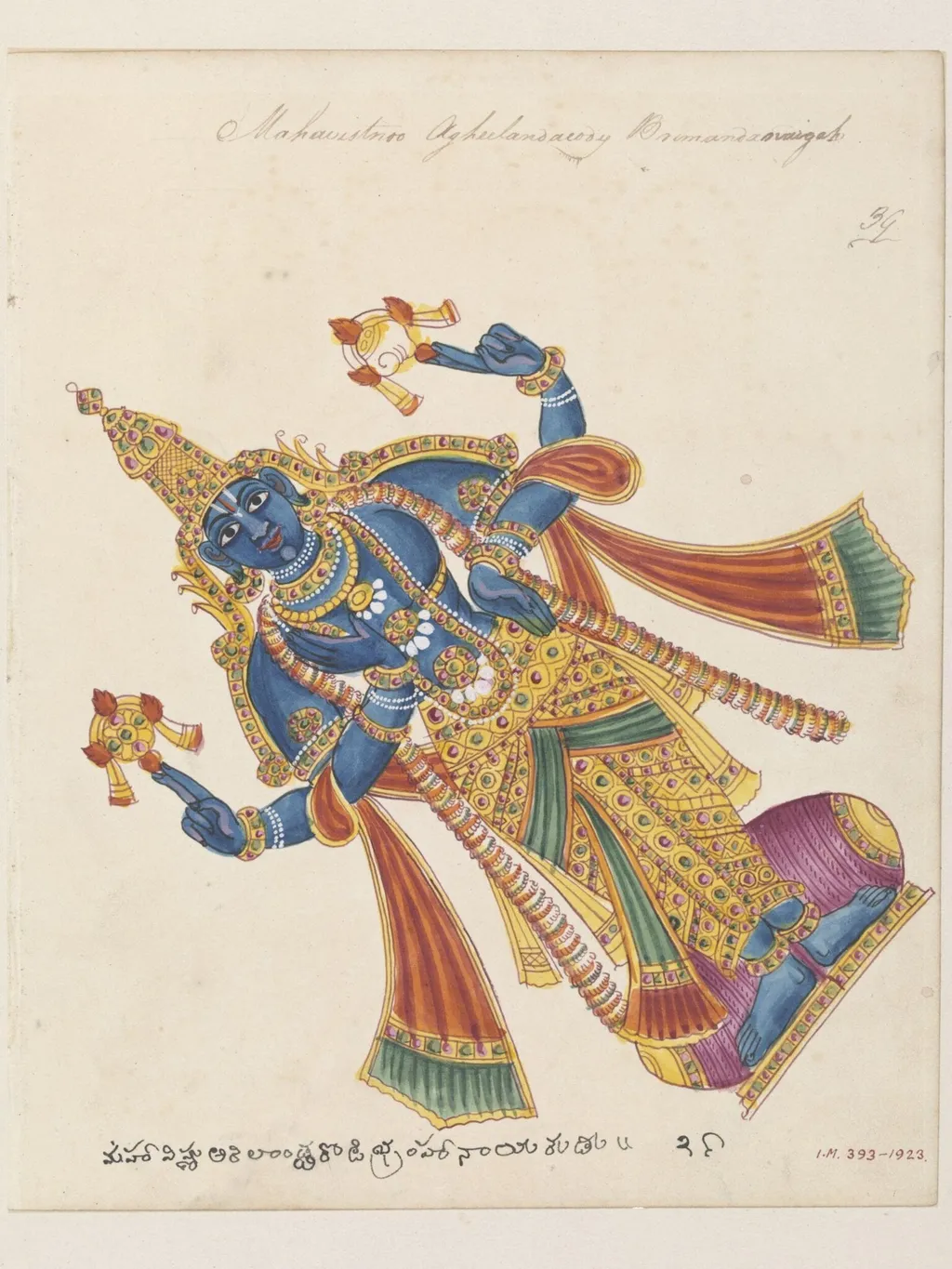
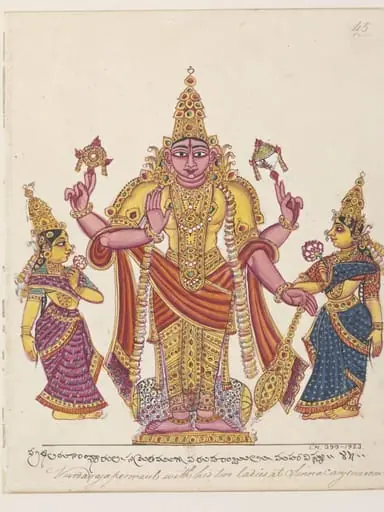
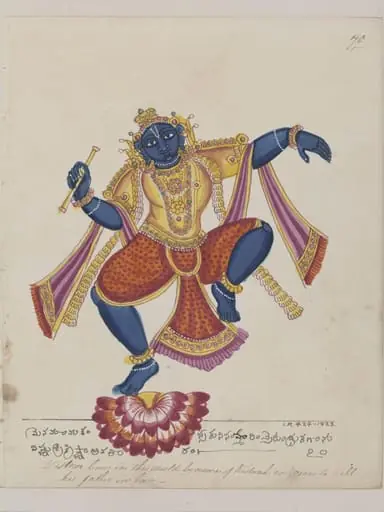
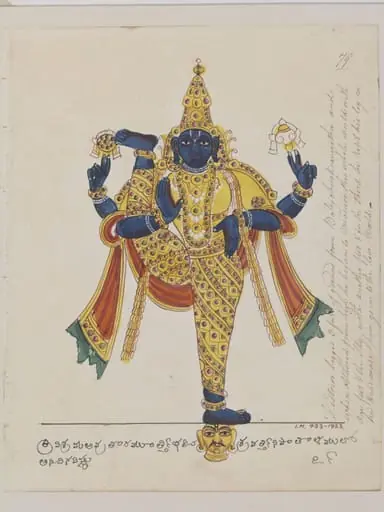
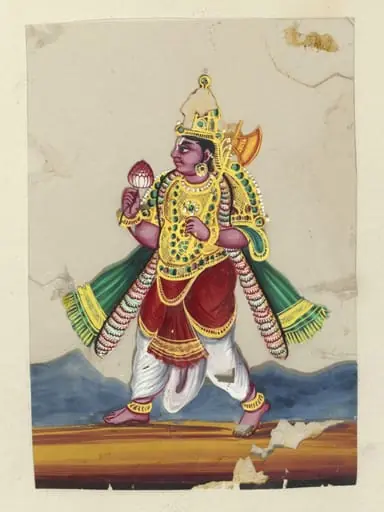
Vishnu is a paint painting by the Patna School of Painting artist Unknown. It dates from 1820 and is held in the collection of the Victoria and Albert Museum.
About this work
Overview
This painting presents Vishnu, a principal deity in Hinduism, rendered in a vertical composition that emphasizes his divine presence.
This painting presents Vishnu, a principal deity in Hinduism, rendered in a vertical composition that emphasizes his divine presence. He stands atop a lotus, surrounded by radiant halos and richly detailed adornments. The work blends traditional Indian iconography with subtle European painting techniques, resulting in a synthesis of spiritual symbolism and refined brushwork that reflects cross-cultural artistic exchange in the late 18th or early 19th century.
Subject & Meaning
Vishnu is depicted with four arms, each holding a symbolic object: the conch shell (sound of creation), the discus (cosmic order), the mace (strength), and a lotus bud (purity and spiritual unfolding). His gestures—the abhaya-mudra (fearlessness) and varada-mudra (blessing)—convey protection and grace. The lotus beneath him signifies divine emergence from chaos, reinforcing his role as preserver of the universe in Hindu cosmology.
Technique & Style
The artist employs a delicate, luminous brushwork reminiscent of European Romanticism, particularly in the soft modeling of flesh and the ethereal glow of the halos. Yet the gold leafing of the crown, the precise rendering of jewelry, and the flat, decorative background remain rooted in Indian miniature traditions. The contrast between the deep blue skin and the warm gold tones creates a striking visual harmony, bridging regional aesthetics.
History & Provenance
The painting’s origin is undocumented, with no recorded artist or date. Its stylistic fusion suggests it was produced in a region where Indian courts engaged with European artistic influences, possibly in the Deccan or Bengal during the colonial period. It likely served a devotional or courtly function, commissioned by a patron interested in both religious tradition and evolving visual languages of the time.
Context
During the late 1700s and early 1800s, Indian artists increasingly absorbed Western techniques through contact with British colonial artists and printed images. This work reflects that convergence: traditional Hindu iconography was reinterpreted with softer modeling and atmospheric lighting, aligning with Romantic ideals of the sublime while preserving sacred symbolism for local audiences.
Legacy
This painting stands as an example of how religious art adapted during periods of cultural exchange. It preserves the integrity of Hindu iconography while demonstrating the influence of European aesthetics, offering insight into how devotional imagery evolved under colonial encounter. Its quiet synthesis continues to inform scholarly understanding of hybrid artistic identities in South Asia.
Artist & collection

 Domestic Scene
 Giacomo and Cardinal Marco, investing Andrea, Abbot of San Zeno, with his Benefice
 The Nymph of Fontainebleau
 Portrait of a Woman
 Madonna and Child with Saints in the Enclosed Garden
 Venus and Minerva
 Family Group of Four on Sofa
 Wall painting from Room H of the Villa of P. Fannius Synistor at Boscoreale