Artwork
The Managers of the Empire Theatre
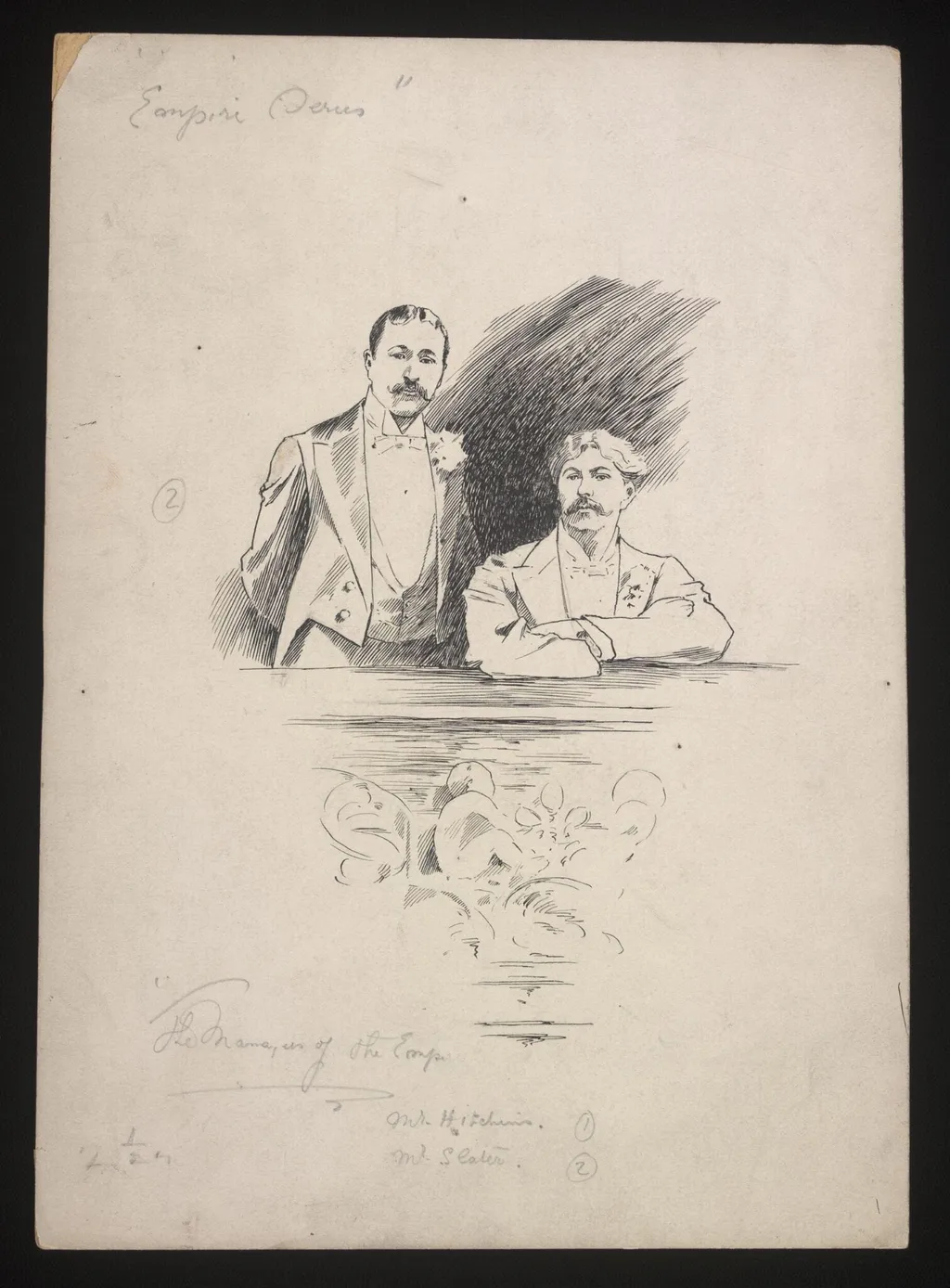
The Managers of the Empire Theatre is a drawing by Unknown. It dates from 1900 and is held in the collection of the Victoria and Albert Museum. This pen-and-ink drawing depicts five men seated around a table, likely managers of the Empire Theatre in London.
About this work
The artist used tiny lines, called cross-hatching, to shade the faces and clothes.
The image shows five men in suits sitting around a table. The room is plain, with a clock and papers on the wall. Their faces are serious, like they’re handling big decisions.
This drawing was made for a magazine around 1900. It’s unsigned, so we don’t know who drew it. The artist used tiny lines, called cross-hatching, to shade the faces and clothes.
See these same men in person at the Victoria and Albert Museum.
Overview
This pen-and-ink drawing depicts five men seated around a table, likely managers of the Empire Theatre in London. Created for reproduction in a late 19th- or early 20th-century illustrated periodical, it lacks a signature or date. The work is part of a broader series of theatrical sketches commissioned for print, reflecting the era’s interest in documenting backstage figures of popular entertainment. It entered the museum’s collection in 1914 through a donation by Sir William James Ingram.
Subject & Meaning
The five men, dressed in formal suits, appear engaged in quiet deliberation. Their expressions are composed, suggesting the weight of administrative responsibility. The plain interior—marked only by a wall clock and scattered papers—emphasizes the mundane, bureaucratic nature of their role. Rather than celebrating performance, the image focuses on the unseen labor sustaining theatrical production, portraying management as a serious, unglamorous occupation.
Technique & Style
The artist employed fine cross-hatching to model form and texture, particularly in the men’s faces and tailored garments. The precise, controlled lines create subtle tonal gradations without wash or color, typical of journalistic illustration of the period. The composition is tightly framed, directing attention to the group’s interaction. The absence of decorative elements reinforces the drawing’s function as a documentary image for mass publication.
History & Provenance
The drawing was produced as part of a series commissioned for illustrated newspapers or magazines around 1900. It remained in private hands until 1914, when Sir William James Ingram donated it, along with other theatrical sketches, to what is now the Victoria and Albert Museum. The artist’s identity remains unknown, as was common for illustrators working under editorial assignment during this period.
Context
During the late Victorian and Edwardian eras, illustrated periodicals frequently featured behind-the-scenes portrayals of theatre life to satisfy public curiosity. These images balanced entertainment with realism, documenting not just performers but the administrators who managed venues. This drawing aligns with a trend of visual journalism that elevated ordinary professional spaces as subjects worthy of public attention.
Legacy
As a preserved example of journalistic illustration from a transitional period in visual media, the drawing offers insight into how theatre was perceived beyond the stage. Its inclusion in a major museum collection underscores its value as a historical document rather than a work of fine art. It continues to inform studies of media, management, and cultural representation in early 20th-century Britain.
Artist & collection

 Domestic Scene
 Giacomo and Cardinal Marco, investing Andrea, Abbot of San Zeno, with his Benefice
 The Nymph of Fontainebleau
 Portrait of a Woman
 Madonna and Child with Saints in the Enclosed Garden
 Venus and Minerva
 Family Group of Four on Sofa
 Wall painting from Room H of the Villa of P. Fannius Synistor at Boscoreale