Artwork
Deux ex capacité de l'ancien régime
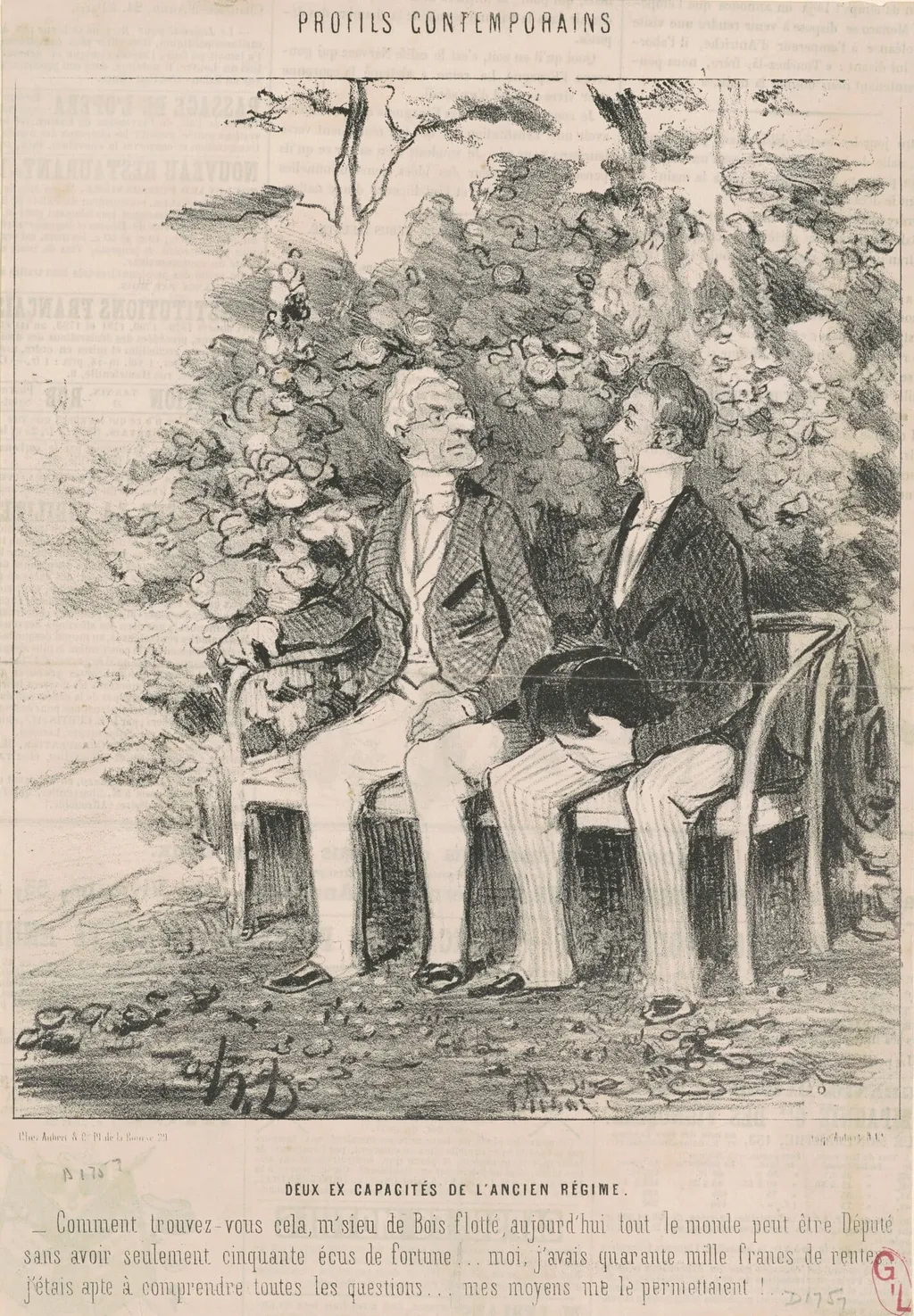
Deux ex capacité de l'ancien régime is an ink print by the Romanticist artist Honoré Daumier. It dates from 1848 and is held in the collection of the National Gallery of Art.
About this work
Overview
Deux ex capacité de l'ancien régime is a lithograph by Honoré Daumier, created during a period of political and social transformation in France.
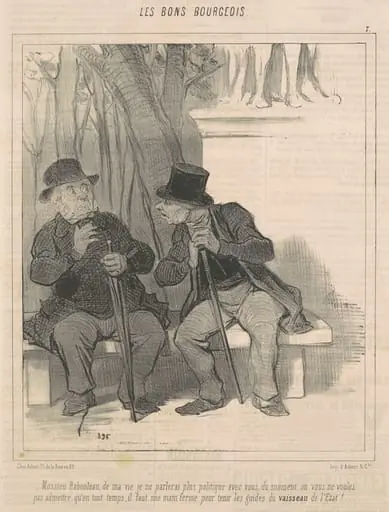
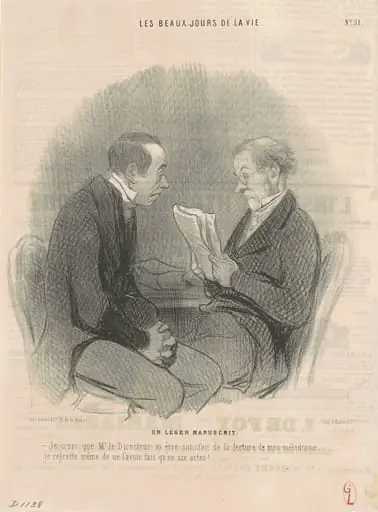
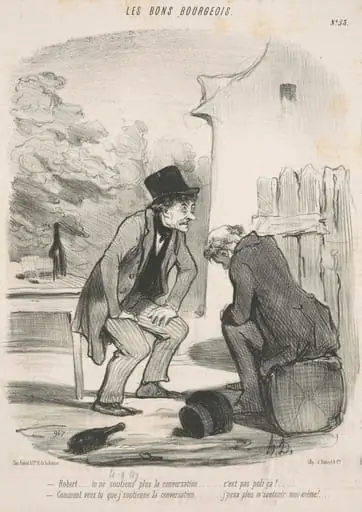
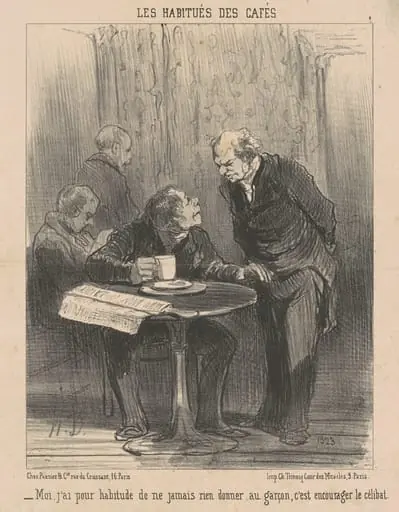
Deux ex capacité de l'ancien régime is a lithograph by Honoré Daumier, created during a period of political and social transformation in France. The work belongs to a series of prints that observe everyday life with subtle irony. Rendered in monochrome, it presents two men in formal attire seated on a public bench, their interaction framed by dense foliage. The medium of lithography allowed Daumier to produce multiple copies, making his social commentary widely accessible.
Subject & Meaning
The two figures, dressed in the attire of the upper class, appear engaged in quiet, deliberate conversation. Their postures suggest formality and restraint, contrasting with the natural setting around them. Daumier uses this scene to imply the persistence of aristocratic rituals even as the old regime’s power waned. The dialogue, though unseen, is implied through gesture and proximity, hinting at the hollow continuity of social customs in a changing world.
Technique & Style
Daumier employed lithography to achieve tonal nuance and expressive line work. The composition relies on contrast between the sharply defined figures and the softly rendered foliage, guiding the viewer’s focus to the interaction. His style is economical yet precise, using minimal strokes to convey texture, mood, and psychological tension. The absence of color emphasizes the gravity of the scene, aligning with the medium’s tradition of political and satirical printmaking.
History & Provenance
Created in the mid-19th century, the print emerged during the aftermath of the 1848 Revolution, when debates over class and governance were intense. Daumier, known for his critical depictions of French society, often published such works in journals like Le Charivari. While the exact provenance of this specific lithograph is not widely documented, it aligns with his broader output targeting institutional hypocrisy and the lingering influence of pre-revolutionary elites.
Context
France in the 1850s was navigating the transition from monarchy to republic, then to empire under Napoleon III. Daumier’s work reflects the unease surrounding the persistence of aristocratic manners among the newly empowered bourgeoisie. The bench, a public space, becomes a stage for the silent negotiation of social hierarchy. The lush surroundings may symbolize nature’s indifference to human pretense, reinforcing the critique of inherited privilege.
Legacy
Daumier’s lithographs, including this one, helped redefine printmaking as a vehicle for social observation rather than mere illustration. His ability to capture unspoken tensions in ordinary scenes influenced later realist and modernist artists. Though less celebrated than his political caricatures, works like Deux ex capacité de l'ancien régime demonstrate his nuanced understanding of class performance and the quiet endurance of social codes.
Artist & collection
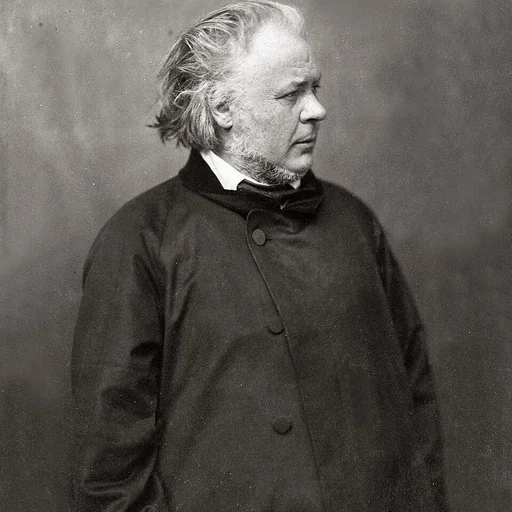
Artist
Honoré-Victorin Daumier was a French painter, sculptor, and printmaker, whose many works offer commentary on the social and political life in France, from the Revolution of 1830 to the fall of the Second French Empire in 1870.