Artwork
The Ten Kings of Purgatory: King of the River of Suffering of the Second Court
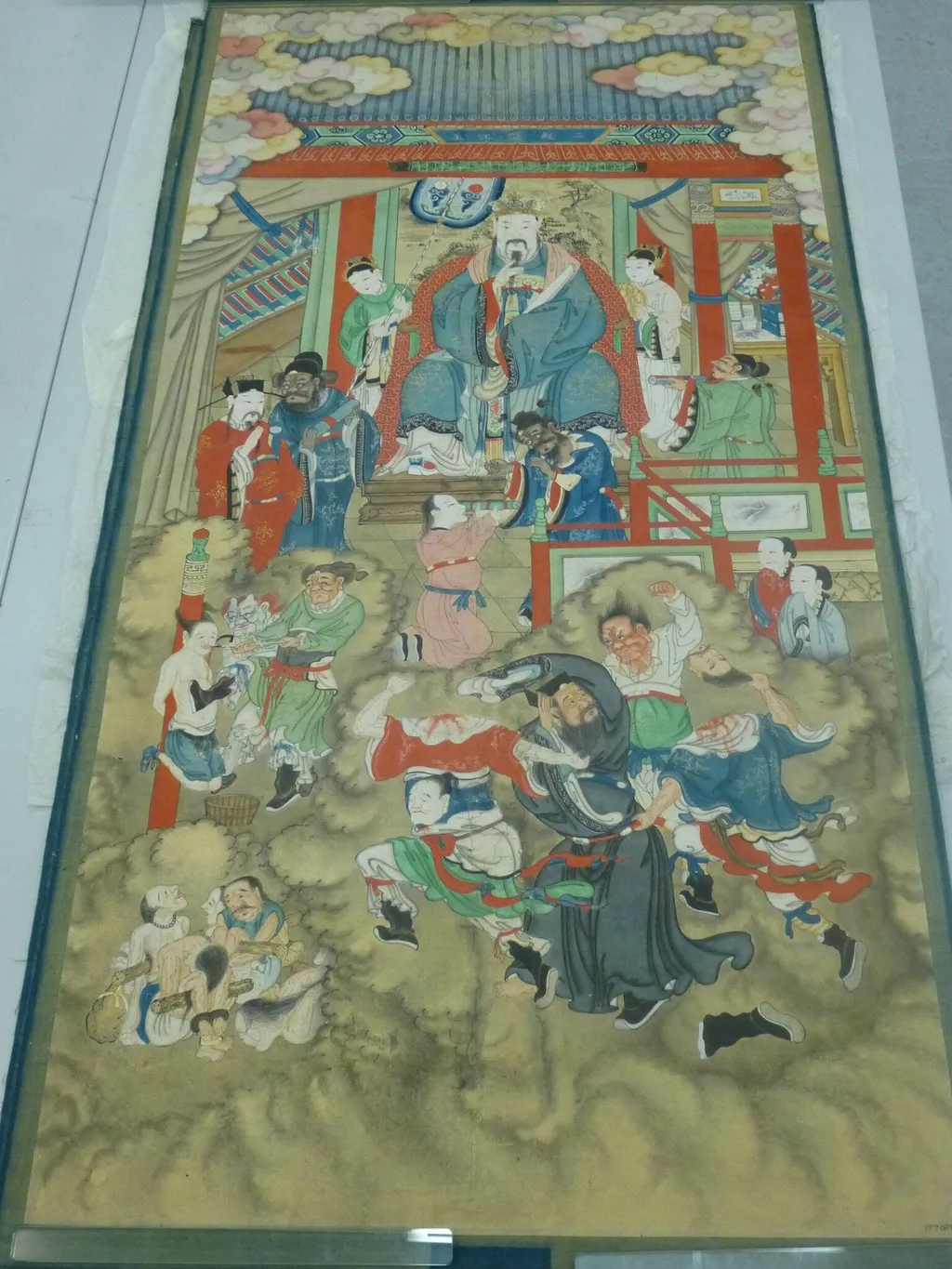
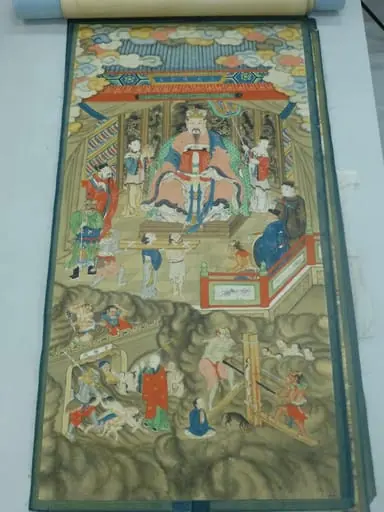
The Ten Kings of Purgatory: King of the River of Suffering of the Second Court is a paint painting by the Romanticist artist Unknown. It dates from 1800 and is held in the collection of the Victoria and Albert Museum.
About this work
Overview
This ink and color painting, dated around 1800, portrays a judicial figure from the second court of the afterlife in Chinese Buddhist cosmology. It was acquired by the Victoria and Albert Museum in 1869 through a donation by Miss Fortescue. The work’s origin remains anonymous, and its provenance was clarified in 2022 through archival research within the museum’s Asia Department records.
Subject & Meaning
The central figure represents a king presiding over souls undergoing judgment in the second stage of purgatorial suffering.
The central figure represents a king presiding over souls undergoing judgment in the second stage of purgatorial suffering. He sits in authority, surrounded by petitioners in postures of anguish, prayer, or submission. The scene reflects the belief that the dead must face moral reckoning before progressing through the afterlife’s courts, with each ruler enforcing karmic consequences according to Buddhist doctrine.
Technique & Style
Rendered in mineral pigments on silk, the painting employs precise brushwork and layered colors to define figures and space. The king’s blue robe and red sash contrast with the warm, atmospheric background of red, green, and yellow tones. Decorative clouds and stylized forms frame the composition, while the foreground figures are rendered with expressive gestures to convey emotional and spiritual distress.
History & Provenance
The painting entered the Victoria and Albert Museum’s collection in 1869 following a donation by Miss Fortescue. Its origins were unclear until a 2022 provenance review traced its acquisition history through the museum’s Asia Department registers. No earlier documentation of its creation or ownership has been identified, leaving its maker and initial context undocumented beyond its late Qing-era style.
Context
This work belongs to a series illustrating the Ten Kings of Hell, a theme rooted in medieval Chinese Buddhist texts that merged indigenous beliefs with Indian eschatology. Such paintings were often used in funerary rituals or temple settings to instruct the living on moral conduct and the consequences of actions beyond death. The composition aligns with devotional art produced in southern China during the 18th and 19th centuries.
Legacy
As part of a larger iconographic tradition, the painting preserves a visual language of moral judgment that once guided popular religious practice. Though no longer used in ritual, it remains a key artifact for understanding how Buddhist afterlife concepts were rendered in material form. Its presence in a Western museum underscores the global circulation of religious art during the colonial era.
Artist & collection

 Domestic Scene
 Giacomo and Cardinal Marco, investing Andrea, Abbot of San Zeno, with his Benefice
 The Nymph of Fontainebleau
 Portrait of a Woman
 Madonna and Child with Saints in the Enclosed Garden
 Venus and Minerva
 Family Group of Four on Sofa
 Wall painting from Room H of the Villa of P. Fannius Synistor at Boscoreale
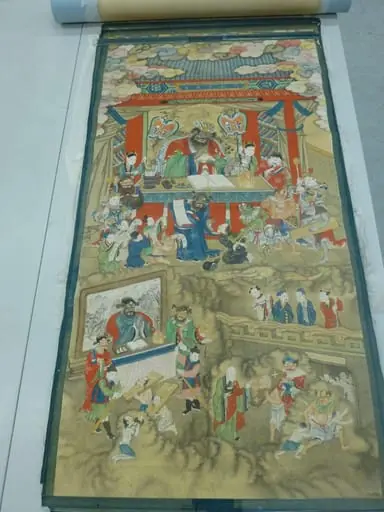 The Ten Kings of Purgatory: King of Transformations of the Sixth Court
![The Ten Kings of Purgatory: King Who Turns the Wheel [of Rebirth] of the Tenth Court, by Unknown](https://artifactworldgallery.com/img/unknown--the-ten-kings-of-purgatory-king-who-turns-the-wheel-of-rebir--23b32c0dc6c2eb18-w320.webp) The Ten Kings of Purgatory: King Who Turns the Wheel [of Rebirth] of the Tenth Court
The Ten Kings of Purgatory: King Who Turns the Wheel [of Rebirth] of the Tenth Court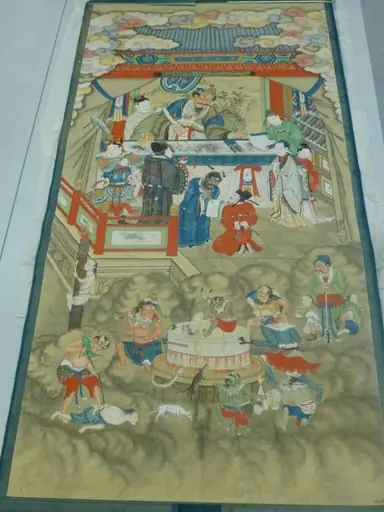 The Ten Kings of Purgatory: King of the Five Offices of the Fourth Court
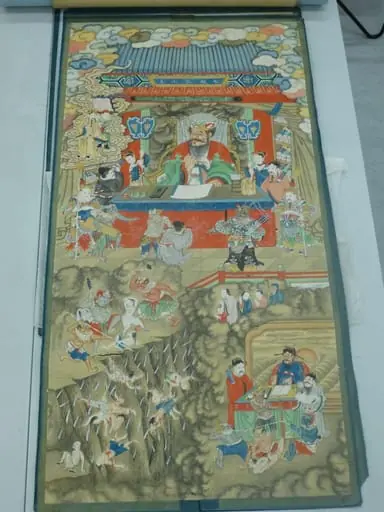 The Ten Kings of Purgatory: King of Mount Tai of the Seventh Court
 The Ten Kings of Purgatory: King Songdi of the Third Court
 金處士筆 十王図の内|Ten Kings of Hell
 金處士筆 十王図の内|Ten Kings of Hell