Artwork
View of the Northern Gate of Dendera or Tentyra
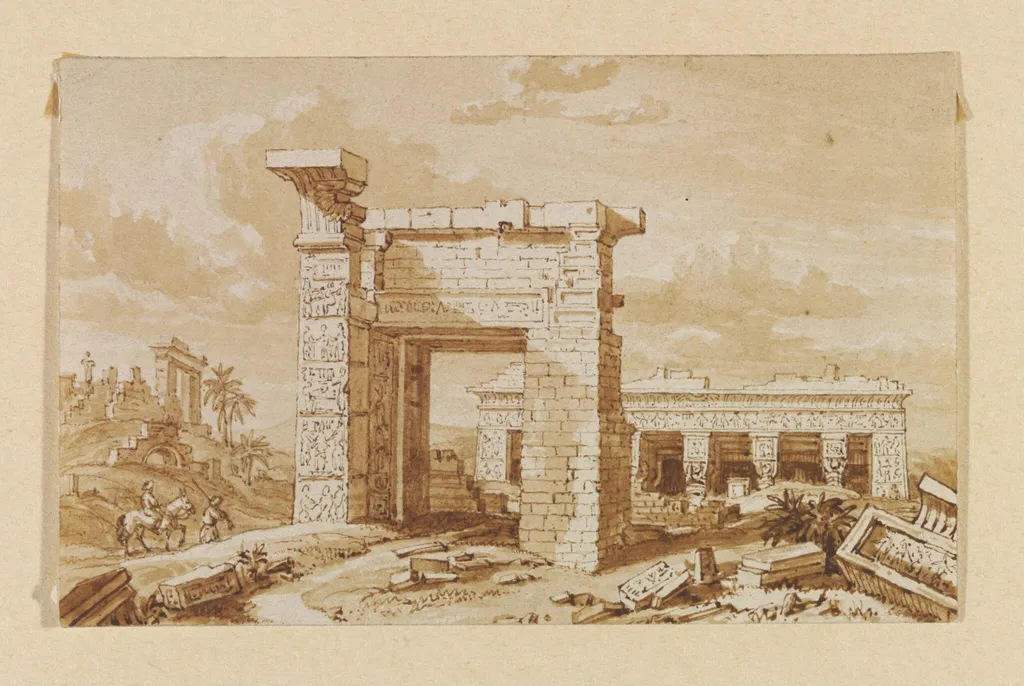
View of the Northern Gate of Dendera or Tentyra is a drawing by the Romanticist artist Unknown. It dates from 1830 and is held in the collection of the Victoria and Albert Museum. This 1830 drawing captures the northern entrance of the Dendera temple complex, known in antiquity as Tentyra.
About this work
Overview
Created as one of seven preparatory sketches, it was intended for inclusion in Reverend Michael Russell’s 1831 book on Egypt.
This 1830 drawing captures the northern entrance of the Dendera temple complex, known in antiquity as Tentyra. Created as one of seven preparatory sketches, it was intended for inclusion in Reverend Michael Russell’s 1831 book on Egypt. The work reflects early 19th-century European efforts to document Egyptian monuments, drawing from earlier published engravings while adding observational detail. Its purpose was illustrative rather than purely archival.
Subject & Meaning
The drawing portrays the gate in a state of partial ruin, with fallen stones and weathered carvings suggesting centuries of neglect. Two riders on horseback appear near the left margin, offering scale and hinting at contemporary presence amid ancient remains. The hieroglyphic reliefs on the lintel and columns are rendered with care, emphasizing their symbolic weight despite their decay. The scene conveys a quiet tension between enduring monumentality and the passage of time.
Technique & Style
Executed in ink and wash, the drawing employs light linework and subtle shading to suggest the texture of eroded stone. Cross-hatching defines the depth of carved reliefs and the roughness of broken masonry. The background is minimally detailed, with a single palm tree and distant ruins establishing context without distraction. The artist’s restrained approach prioritizes clarity and structural accuracy over dramatic effect, aligning with documentary aims of the period.
History & Provenance
Originally credited to Joseph Schranz, the drawing was later reattributed after its link to Russell’s publication was confirmed. It derives stylistically from Plate 4 of Volume IV of *Description de l'Égypte*, but incorporates localized observations not present in the original engraving. Its survival as a preparatory sketch suggests it was valued during the production of Russell’s illustrated volume, though it was not reproduced in the final publication.
Context
Created during a period of heightened European interest in Egypt’s antiquities, the drawing reflects the transition from military survey to scholarly documentation. While French expeditions had produced detailed records, British travelers like Russell sought to synthesize these findings for a wider audience. This sketch, though derivative in source, represents a personal engagement with the site, bridging academic record and visual interpretation.
Legacy
Though not published in Russell’s volume, the drawing survives as evidence of how early 19th-century illustrators interpreted and adapted existing sources. It contributes to the broader archive of Western visual responses to Egyptian ruins, illustrating the iterative nature of archaeological illustration. Its modest scale and unadorned technique contrast with later romanticized depictions, offering a quieter, more observational record of the site’s condition at the time.
Artist & collection

 Domestic Scene
 Giacomo and Cardinal Marco, investing Andrea, Abbot of San Zeno, with his Benefice
 The Nymph of Fontainebleau
 Portrait of a Woman
 Madonna and Child with Saints in the Enclosed Garden
 Venus and Minerva
 Family Group of Four on Sofa
 Wall painting from Room H of the Villa of P. Fannius Synistor at Boscoreale
 Perspective view of the Temple of Antaeopolis
 Figures among Classical Ruins, probably in Sicily
 `Dabode Nubia '
 Landscape with Classical Ruins
 Guerfeh Hassan - Nubia
 View of the Western facade of the Boukoleon Palace
 Ruine la Sigus
 Views of Rome: The Arch or Titus
 Lateral Elevation of the Typhonium at Dendera