Artwork
Vilaval Ragini
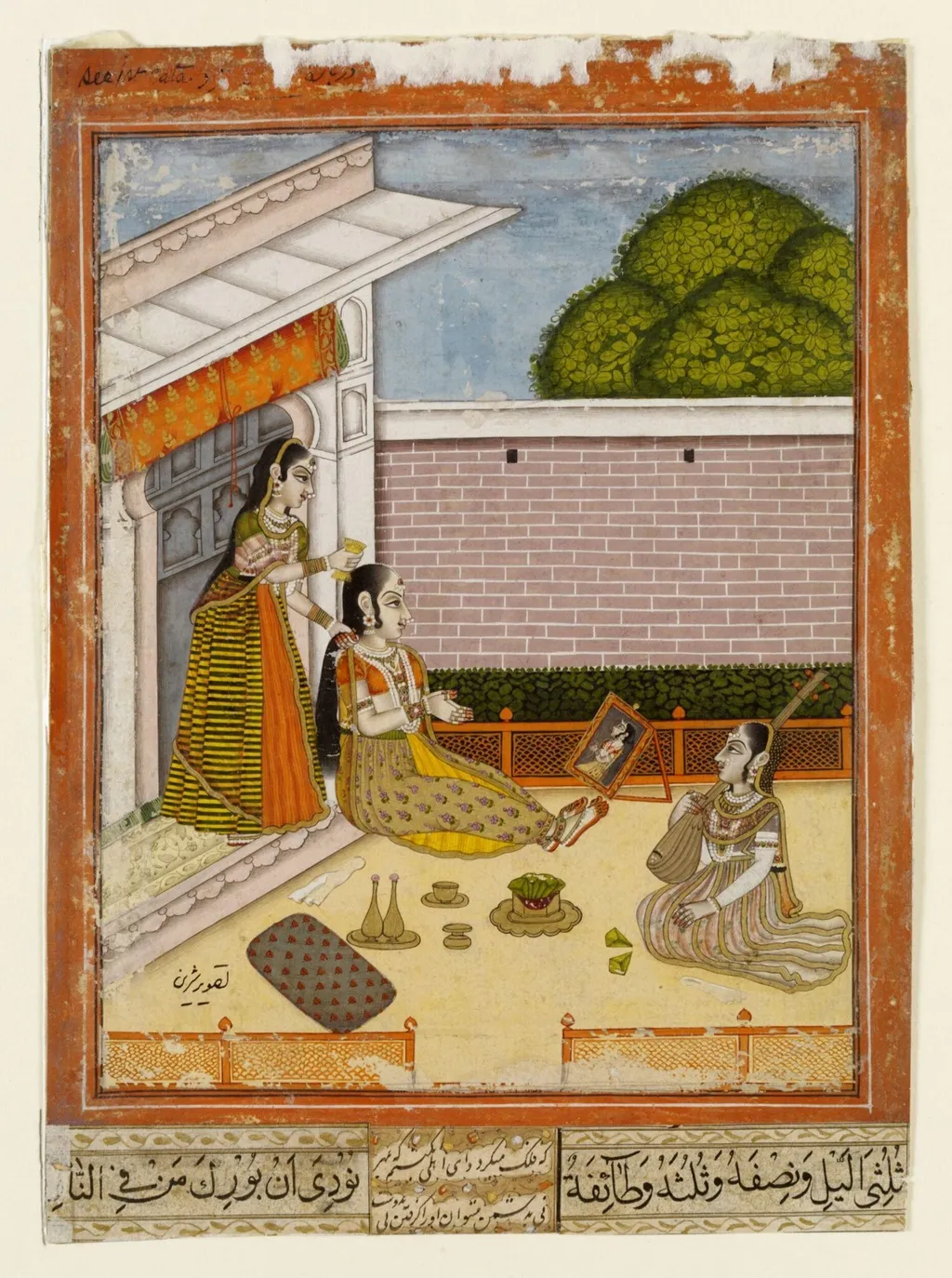
Vilaval Ragini is a paint painting by the Mughal Painting artist Unknown. It dates from 1770 and is held in the collection of the Victoria and Albert Museum.
About this work
Overview
The restrained palette of yellow, ochre, and green, along with delicate gold borders, reflects the refined aesthetic of late Mughal or Rajput courtly painting.
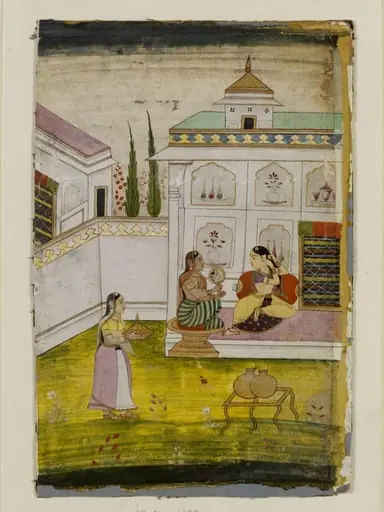
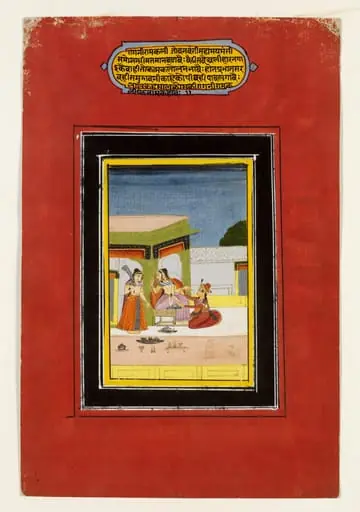
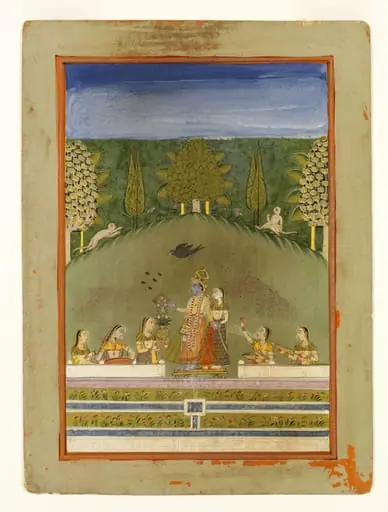
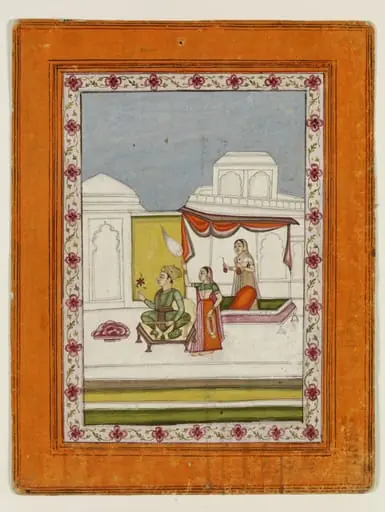
This small-scale painting, executed in opaque watercolour and gold on paper, illustrates Vilaval Ragini, a melodic mode from the Ragamala tradition. It captures a quiet domestic moment within a walled courtyard, where three women interact subtly amid architectural details and natural elements. The restrained palette of yellow, ochre, and green, along with delicate gold borders, reflects the refined aesthetic of late Mughal or Rajput courtly painting.
Subject & Meaning
Vilaval Ragini is personified through the serene presence of a woman seated on the ground, holding a framed image—possibly symbolizing devotion or memory. A second woman attends to her hair, while a third observes from nearby, creating a contemplative rhythm. The scene evokes the emotional tone associated with the raga: introspective, tender, and lyrical, aligning musical theory with visual narrative in a tradition where ragas were embodied as human figures.
Technique & Style
The artist employed fine brushwork to render intricate patterns on clothing and jewelry, using layered washes to achieve subtle gradations in skin tones and fabric. Gold highlights frame the composition and accentuate decorative elements, while the muted earth tones ground the scene in quiet realism. Spatial depth is suggested through overlapping figures and a low wall receding into greenery, typical of Pahari or Rajput miniature conventions.
History & Provenance
The painting likely originated in a Rajput court workshop during the 18th century, a period when Ragamala series were systematically commissioned by patrons seeking to visualize musical modes. Its preservation suggests it was part of a larger album, possibly collected by a royal or aristocratic patron. Exact provenance remains undocumented, but stylistic cues point to the Punjab Hills or Rajasthan region.
Context
Ragamala paintings emerged as a fusion of Indian musical theory and visual art, where each raga was assigned a mood, time of day, and human figure. Vilaval, associated with evening and longing, was often depicted through intimate, solitary, or tender scenes. This work reflects a broader trend in early modern India where poetry, music, and painting converged to express spiritual and emotional states through symbolic imagery.
Legacy
Though not widely exhibited, this painting contributes to the understanding of how Indian musical traditions were visually codified. It exemplifies the quiet sophistication of regional miniature painting beyond Mughal centers, preserving a non-dramatic, psychologically nuanced approach to narrative. Its survival offers insight into the domestic and aesthetic lives of courtly women in pre-colonial India.
Artist & collection

 Domestic Scene
 Giacomo and Cardinal Marco, investing Andrea, Abbot of San Zeno, with his Benefice
 The Nymph of Fontainebleau
 Portrait of a Woman
 Madonna and Child with Saints in the Enclosed Garden
 Venus and Minerva
 Family Group of Four on Sofa
 Wall painting from Room H of the Villa of P. Fannius Synistor at Boscoreale