Artwork
Ramakali Ragini
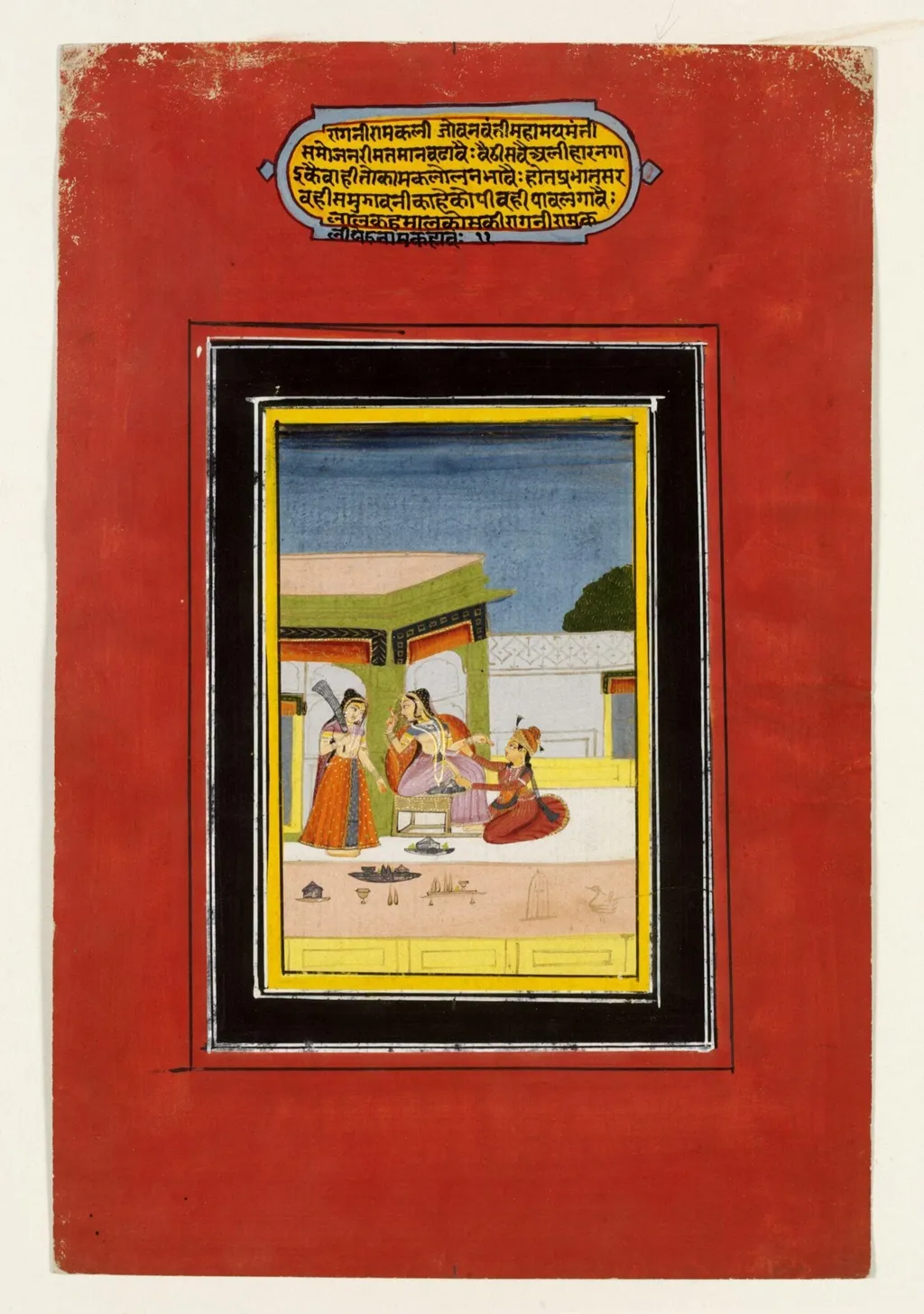
Ramakali Ragini is a paint painting by the Mughal Painting artist Unknown. It dates from 1850 and is held in the collection of the Victoria and Albert Museum. Created around 1850, this work combines opaque watercolour with gold leaf on paper.
About this work
Overview
Created around 1850, this work combines opaque watercolour with gold leaf on paper.
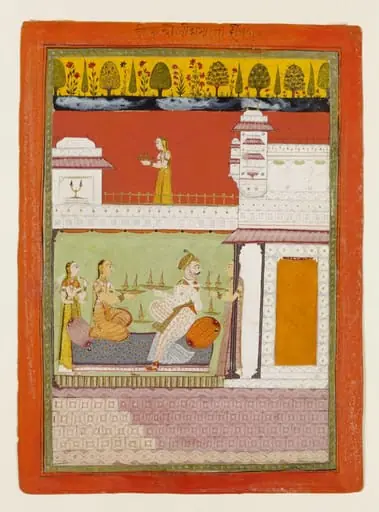
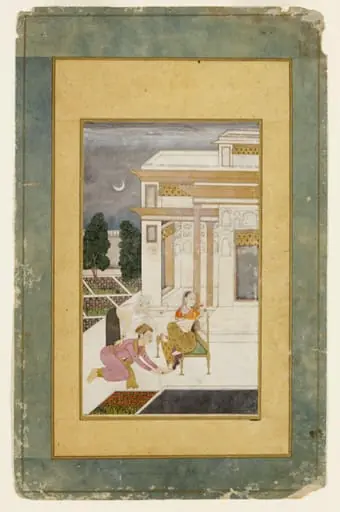
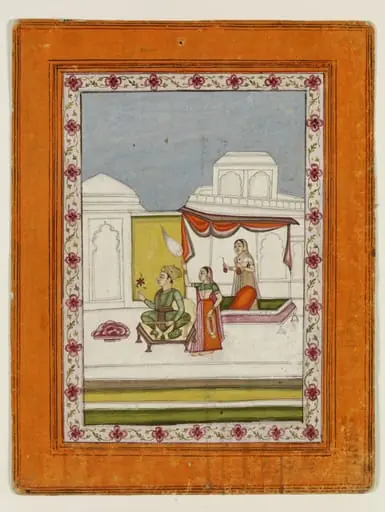
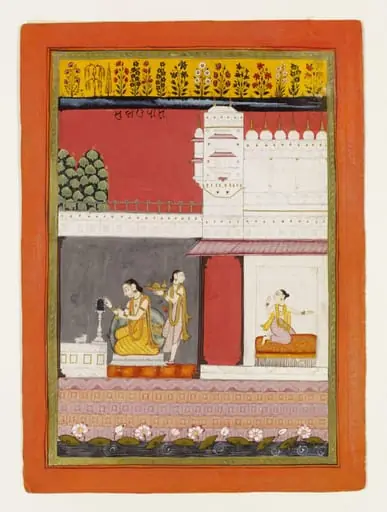
Created around 1850, this work combines opaque watercolour with gold leaf on paper. It presents a domestic interior scene within a pavilion characterized by green pillars and a red‑tiled roof, rendered in vivid, flat tones without gradated shading. The composition includes a seated woman in blue, two standing women in orange and purple, and a kneeling man in a red turban, all surrounded by modest objects such as bowls and a fan.
Subject & Meaning
The central figure is a lady attended by a maid, while a servant holds a peacock‑feather fan, suggesting a ceremonial or musical context. The title references the Ramakali Ragini, a specific mode in Indian classical music, indicating that the scene may depict a performance or a moment associated with that melodic form.
Technique & Style
The artist employed opaque watercolour, allowing for saturated, uniform colour fields, and applied gold leaf to accentuate details. The palette is bold, with distinct blocks of orange, purple, blue and red, and the lack of chiaroscuro gives the picture a decorative, two‑dimensional quality typical of mid‑nineteenth‑century Indian courtly painting.
History & Provenance
The painting originates from the mid‑19th century Indian tradition and is now part of the Victoria and Albert Museum’s collection. Its provenance traces back to the period when such works were produced for elite patrons, reflecting both artistic practice and cultural interests in music and domestic elegance of the time.
Artist & collection

 Domestic Scene
 Giacomo and Cardinal Marco, investing Andrea, Abbot of San Zeno, with his Benefice
 The Nymph of Fontainebleau
 Portrait of a Woman
 Madonna and Child with Saints in the Enclosed Garden
 Venus and Minerva
 Family Group of Four on Sofa
 Wall painting from Room H of the Villa of P. Fannius Synistor at Boscoreale