Artwork
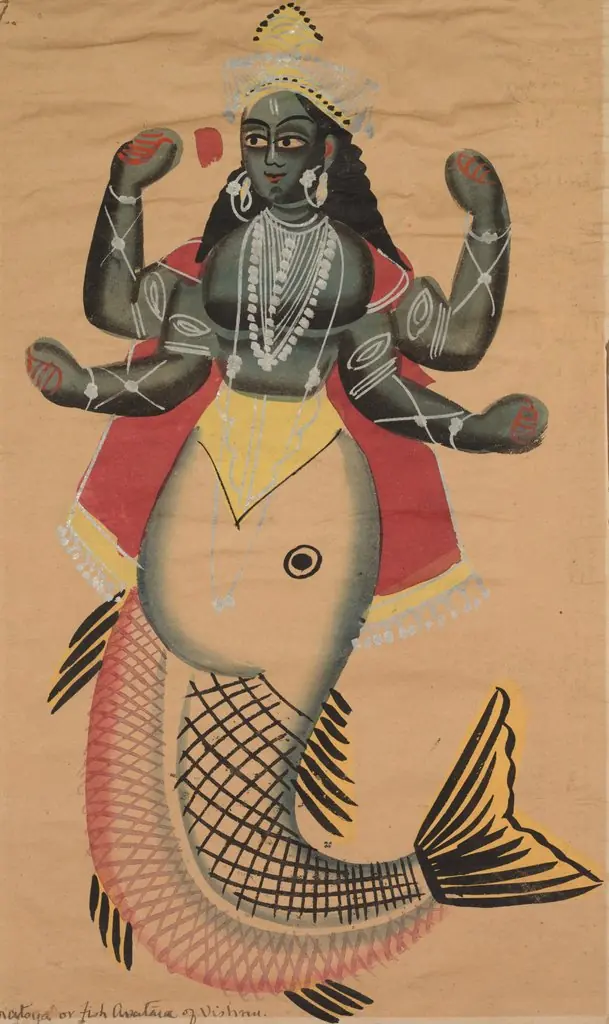
Vishnu as Matsya
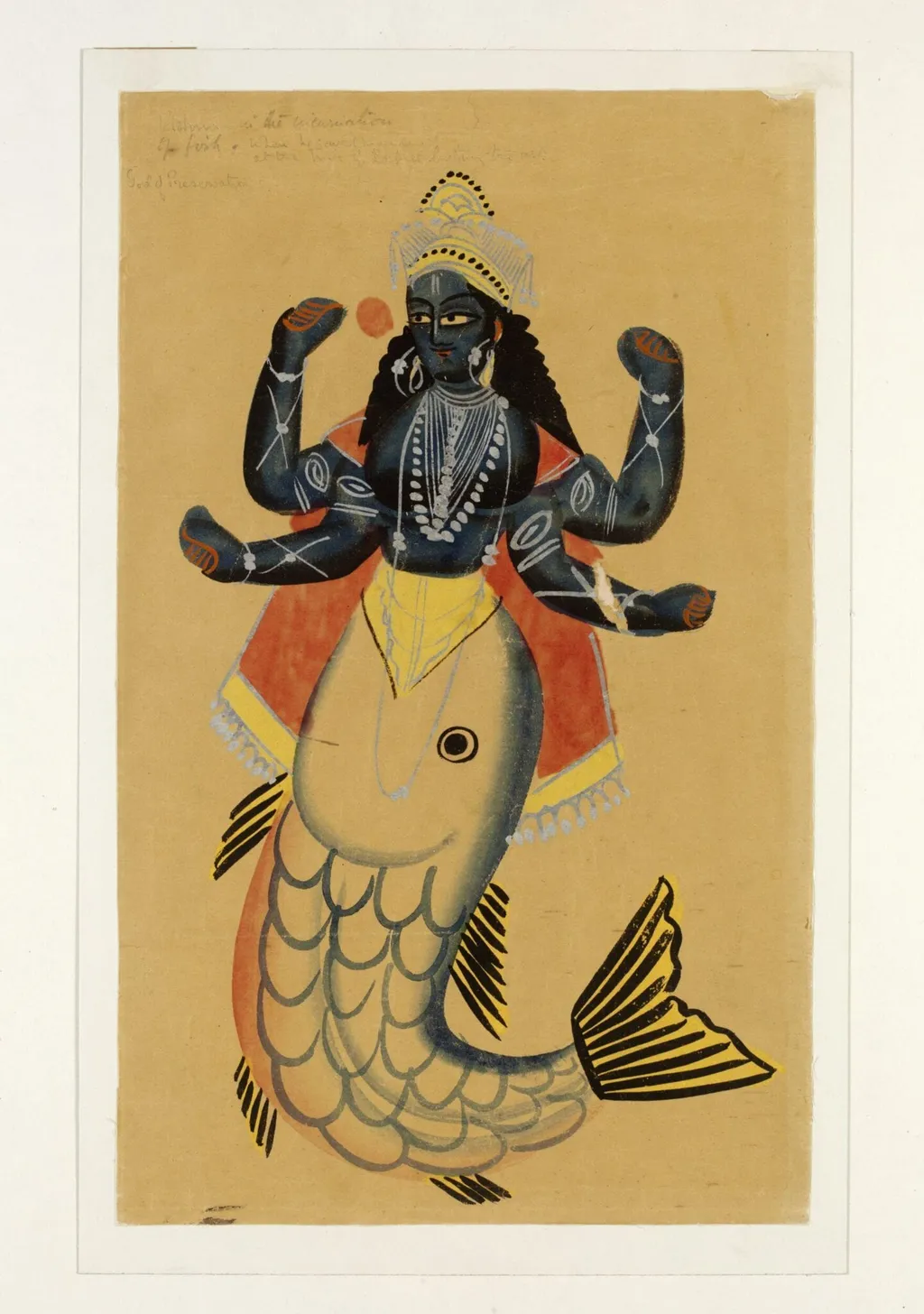
Vishnu as Matsya is a paint painting by the Impressionist artist Unknown. It dates from 1885 and is held in the collection of the Victoria and Albert Museum.
About this work
Overview
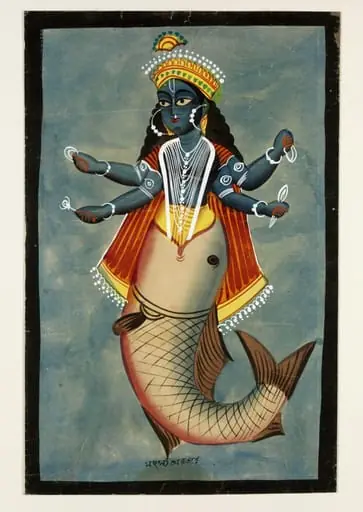
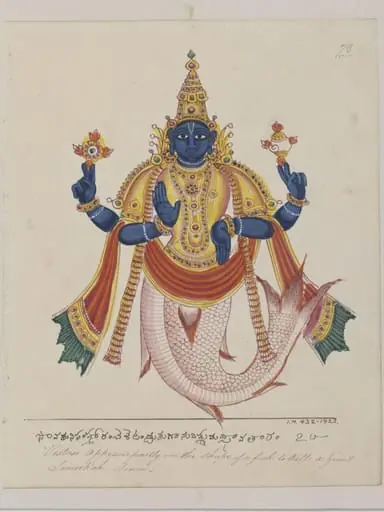
This opaque watercolor painting on paper depicts Vishnu in his Matsya avatar, characterized by a blue-skinned, four-armed figure seated on a giant fish. Bold, flat colors and simple shapes define the composition, set against a plain background.
Subject & Meaning
The painting illustrates a specific incarnation of the Hindu deity Vishnu, embodying his role as a preserver in Hindu mythology. The figure's attire, including a yellow waist cloth and a red draped shoulder cloth, and the object (possibly a ball or fruit) it holds, contribute to the iconic representation of Matsya.
Technique & Style
Executed in the Kalighat style, originating from a distinct Indian region, the painting features distinctive bold colors, simple forms, and a lack of intricate detail, aligning with the style's emphasis on accessibility and vivid narrative depiction.
History & Provenance
Acquired by the museum in 1950 from Miss M. Steele, the painting's lineage traces back to her mother, a Cambridge Sanskrit scholar who inherited it in 1894, potentially collected by Steele’s grandmother during her time in India, hinting at colonial-era collecting practices.
Context
Created within the Kalighat tradition, this work reflects the style's emergence in response to colonial influence and local patronage, blending traditional themes with simplified, colorful aesthetics appealing to both Indian and European audiences.
Legacy
As part of the Kalighat style collection, this painting contributes to the understanding of 19th-century Indian art's adaptation to colonial contexts. For similar works, the Victoria and Albert Museum holds a notable collection.
Artist & collection

 Domestic Scene
 Giacomo and Cardinal Marco, investing Andrea, Abbot of San Zeno, with his Benefice
 The Nymph of Fontainebleau
 Portrait of a Woman
 Madonna and Child with Saints in the Enclosed Garden
 Venus and Minerva
 Family Group of Four on Sofa
 Wall painting from Room H of the Villa of P. Fannius Synistor at Boscoreale