Artwork
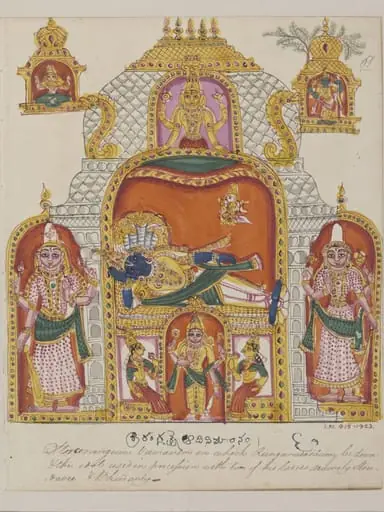
Vishnu seated in his heaven, Vaikuntha, upon the coils of the serpent of eternity, Ananta.
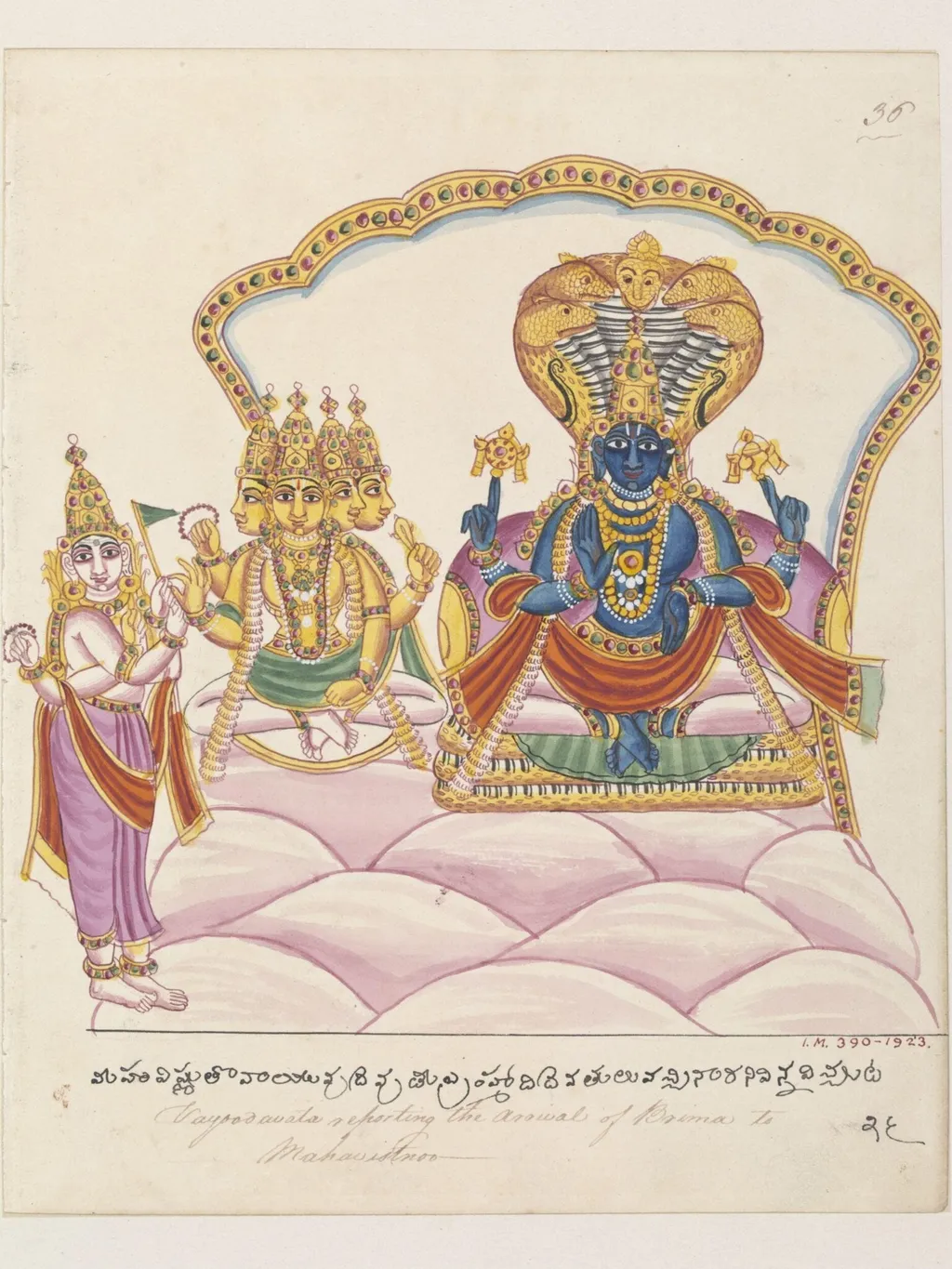
Vishnu seated in his heaven, Vaikuntha, upon the coils of the serpent of eternity, Ananta. is a paint painting by the Patna School of Painting artist Unknown. It dates from 1820 and is held in the collection of the Victoria and Albert Museum.
About this work
Overview
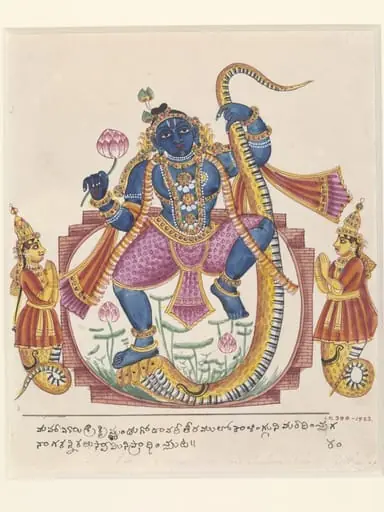
This painting portrays Vishnu, the Hindu preserver, in his celestial realm of Vaikuntha, reclining upon the coiled body of Ananta, the infinite serpent.
This painting portrays Vishnu, the Hindu preserver, in his celestial realm of Vaikuntha, reclining upon the coiled body of Ananta, the infinite serpent. The scene is rendered with meticulous detail and luminous pigments, emphasizing divine stillness. Vishnu’s form is framed by the serpent’s arching coils, while two attendants—Brahma and Vayu—observe from adjacent clouds. The composition balances symmetry and serenity, reflecting theological ideals of cosmic order.
Subject & Meaning
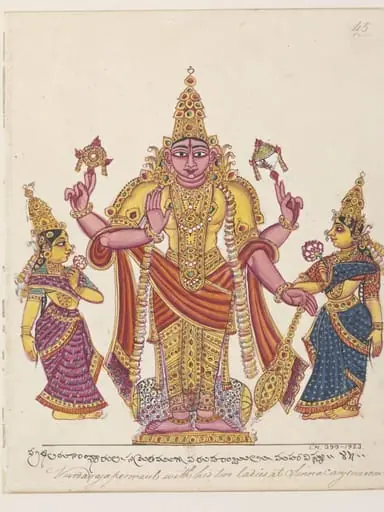
Vishnu, depicted with four arms holding symbolic objects—conch, discus, lotus, and mace—represents preservation and cosmic balance. His reclining posture on Ananta signifies the cyclical nature of time and creation. Brahma, seated on a lotus emerging from Vishnu’s navel, embodies creation, while Vayu, the wind god, signifies motion and breath. Together, they illustrate the triad of cosmic functions within Hindu cosmology, rendered as a tranquil, eternal moment.
Technique & Style
The work employs fine brushwork and mineral pigments to achieve rich blues, pinks, and golds, typical of Rajput court painting traditions. Details in Vishnu’s crown and jewelry are rendered with precision, using gold leaf for luminosity. The clouds are stylized as soft, floating platforms, and the serpent’s scales are delicately outlined. The composition avoids perspective, favoring flat, decorative space to elevate the sacred over the naturalistic.
History & Provenance
Created in the late 17th or early 18th century, likely in the Pahari or Rajasthani region, this painting was produced for a royal patron seeking devotional imagery. It reflects the influence of Bhakti traditions that emphasized personal devotion to Vishnu. The painting’s preservation suggests it was housed in a temple or palace shrine, used for ritual contemplation rather than public display.
Context
This image belongs to a broader tradition of Hindu devotional art that visualized divine realms as accessible, ordered spaces. Unlike Western Romanticism, which prioritized individual emotion, this work expresses collective spiritual ideals through symbolic form. Its aesthetic aligns with regional courtly styles that fused religious narrative with refined craftsmanship, serving both worship and royal legitimacy.
Legacy
The painting continues to be studied as an exemplar of Indian miniature painting’s capacity to convey theological depth through visual economy. Its iconography remains influential in modern Hindu devotional art, and its preservation in museum collections underscores its role in transmitting pre-colonial religious aesthetics. It stands as a quiet testament to centuries of artistic devotion.
Artist & collection

 Domestic Scene
 Giacomo and Cardinal Marco, investing Andrea, Abbot of San Zeno, with his Benefice
 The Nymph of Fontainebleau
 Portrait of a Woman
 Madonna and Child with Saints in the Enclosed Garden
 Venus and Minerva
 Family Group of Four on Sofa
 Wall painting from Room H of the Villa of P. Fannius Synistor at Boscoreale