Artwork
Untitled
Untitled is an ink print by Velox Ward, Ben Schonzeit, Raymond Saunders, Edward Ruscha, James Rosenquist, Robert Rauschenberg, Robert Andrew Parker, Costantino Nivola, Roy Lichtenstein, Allan D'Arcangelo, James Brooks, William Bailey Various Artists. It dates from 1975 and is held in the collection of the Museum of Modern Art. This 1975 print portfolio comprises eleven works by twelve artists, including Roy Lichtenstein, Robert Rauschenberg, and Edward Ruscha.
About this work
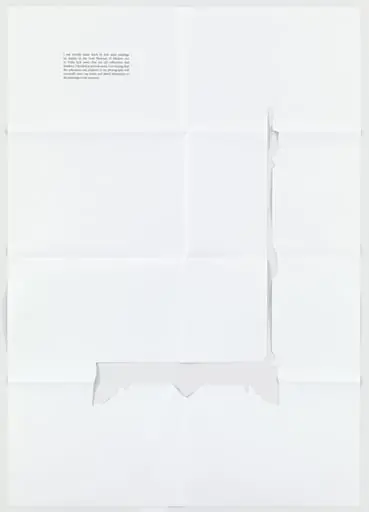
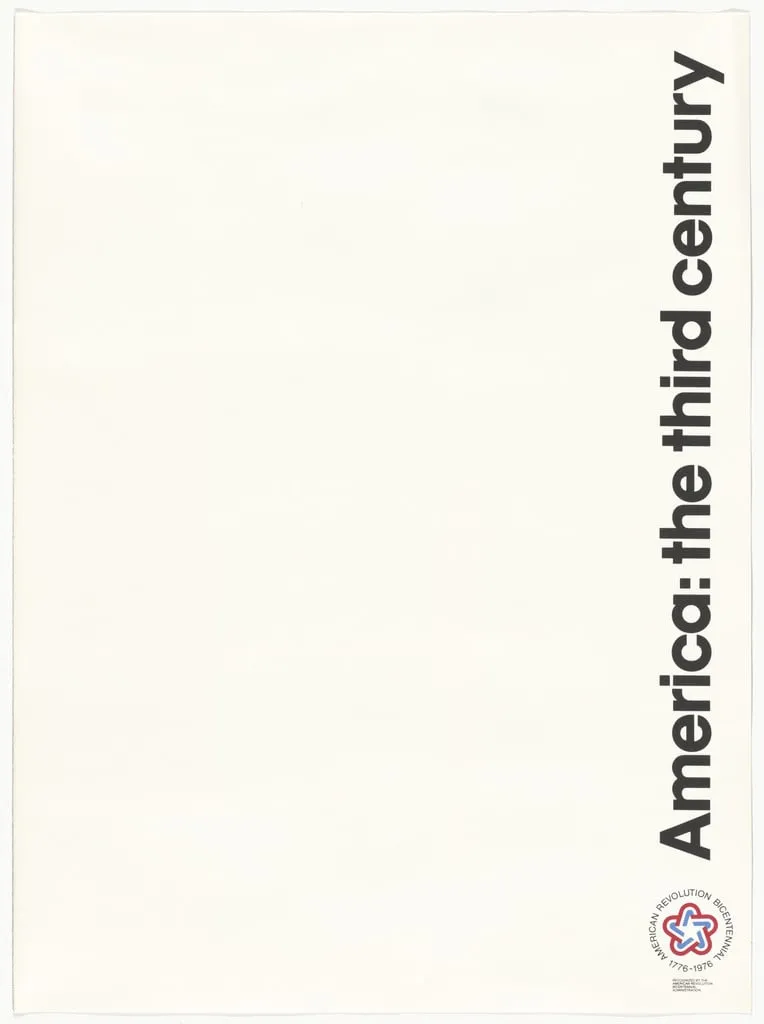
This image is mostly blank white space with a single phrase in bold black letters along the right edge: *"America: the third century.
This image is mostly blank white space with a single phrase in bold black letters along the right edge: *"America: the third century."* The text is simple and clean, with no other shapes or colors. In the bottom corner, there’s a small red, white, and blue logo that reads *"American Revolution Bicentennial 1776–1976."*
The empty space feels intentional—like the artists left room for the viewer to fill in their own thoughts. The text hints at a connection to America’s past and future, but nothing else is shown.
If you’re curious about how artists use blank space like this, look up lithography.
Overview
This 1975 print portfolio comprises eleven works by twelve artists, including Roy Lichtenstein, Robert Rauschenberg, and Edward Ruscha. It was produced as part of a commemorative project for the American Bicentennial. Each piece is distinct in technique—combining lithography, screenprinting, and collotype—but shares a minimalist aesthetic. The portfolio was organized under the collective title 'Untitled' and is held in the collection of The Museum of Modern Art.
Subject & Meaning
One print in the series features the phrase 'America: the third century' in bold black type along the right edge, set against a vast white field. The absence of imagery invites reflection on national identity, historical continuity, and uncertainty. The small red, white, and blue Bicentennial logo in the corner anchors the work to its temporal context, yet the emptiness resists definitive interpretation, suggesting open-ended inquiry rather than celebration.
Technique & Style
The portfolio employs a range of printmaking methods, including lithography and screenprinting, each chosen for its capacity to render precise text and subtle tonal variation. The dominant style across the works is reductive: clean lines, limited color, and deliberate negative space. This restraint reflects a broader trend in 1970s conceptual art, where meaning emerges from omission rather than accumulation.
History & Provenance
Commissioned for the 1976 American Bicentennial, the portfolio was produced by a group of prominent artists under a collaborative initiative. It was distributed to institutions and collectors as part of a cultural commemoration. The Museum of Modern Art acquired the complete set shortly after its release, preserving it as a document of artistic engagement with national memory during a period of social reflection.
Context
Created during a time of national introspection following the Vietnam War and Watergate, the portfolio responded to a cultural moment marked by skepticism toward patriotic symbolism. Rather than overt imagery, the artists used silence and text to evoke ambiguity. This approach contrasted with traditional celebratory monuments, offering instead a quiet, critical space for reconsidering American identity.
Legacy
The portfolio remains a significant example of how artists used print media to engage with public history without didacticism. Its emphasis on minimalism and textual ambiguity influenced later conceptual and text-based practices. While not widely exhibited, it endures as a quiet artifact of 1970s artistic dissent—a record of artists choosing absence as a form of commentary.
Artist & collection
Artist
Various Artists, Velox Ward, Ben Schonzeit, Raymond Saunders, Edward Ruscha, James Rosenquist, Robert Rauschenberg, Robert Andrew Parker, Costantino Nivola, Roy Lichtenstein, Allan D'Arcangelo, James Brooks, William Bailey was an American…