Artwork
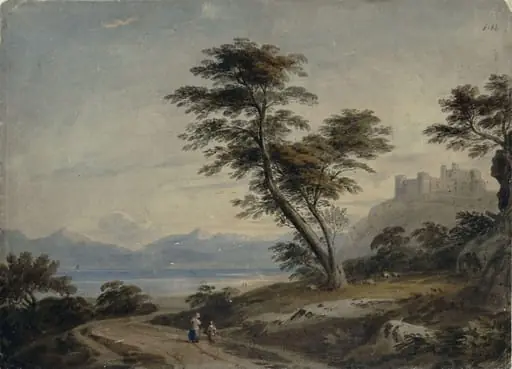
Coast scene in Merionethshire, with Harlech Castle
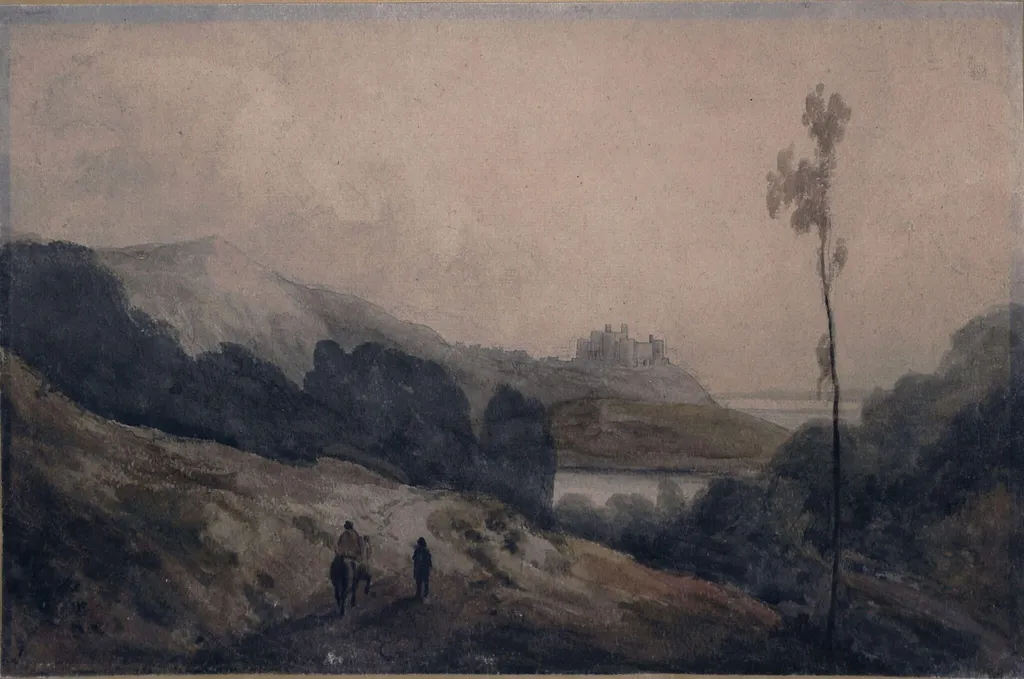
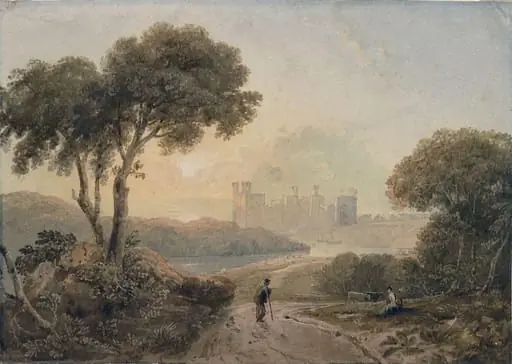
Coast scene in Merionethshire, with Harlech Castle is a watercolor work on paper by the British Romanticist artist John Varley. It dates from 1804 and is held in the collection of the Victoria and Albert Museum. This watercolour captures a quiet coastal stretch in Merionethshire, with Harlech Castle rising on a rocky promontory above the sea.
About this work
Overview
The composition balances natural elements—rolling hills, scattered trees, and calm water—with the imposing silhouette of the fortress.
This watercolour captures a quiet coastal stretch in Merionethshire, with Harlech Castle rising on a rocky promontory above the sea. The composition balances natural elements—rolling hills, scattered trees, and calm water—with the imposing silhouette of the fortress. A winding path connects the foreground to the castle, guiding the viewer’s gaze inward. The muted sky and soft tones reinforce a still, contemplative mood.
Subject & Meaning
The scene presents a harmonious relationship between human presence and the landscape. Two figures—a rider and a pedestrian—move along a path, their small scale emphasizing the vastness of the land and the enduring presence of the castle. The work suggests quiet contemplation rather than narrative, inviting reflection on time, place, and the quiet persistence of history embedded in the terrain.
Technique & Style
The artist employs delicate washes of watercolour to build subtle gradations of tone, creating depth without heavy detail. The castle is rendered with restrained precision, while the surrounding hills and sky dissolve into soft, atmospheric layers. Light is suggested through pale highlights and translucent shadows, enhancing the sense of air and distance. The technique prioritizes mood over realism, aligning with Romantic-era landscape conventions.
History & Provenance
The work originates from the early 19th century, a period when watercolour became a respected medium for topographical and scenic studies in Britain. Though the artist’s identity is not recorded here, such scenes were often produced for private collectors interested in the picturesque qualities of Wales. The painting likely circulated in regional circles before entering institutional or private collections.
Context
Harlech Castle, a 13th-century fortress built by Edward I, was a symbol of English royal authority in Wales. By the 1800s, it had become a subject of romantic interest, admired for its ruinous grandeur and dramatic setting. Artists and travelers frequently depicted it as a quiet monument to history, reflecting broader cultural fascination with medieval ruins and the sublime beauty of the Welsh landscape.
Legacy
This watercolour contributes to a broader tradition of Welsh landscape representation that valued atmosphere and restraint over dramatic spectacle. It reflects a shift in perception: from viewing castles as military relics to appreciating them as poetic elements within nature. Such works helped shape the visual identity of Wales in the 19th-century imagination, influencing later topographical and artistic traditions.
Artist & collection
Artist
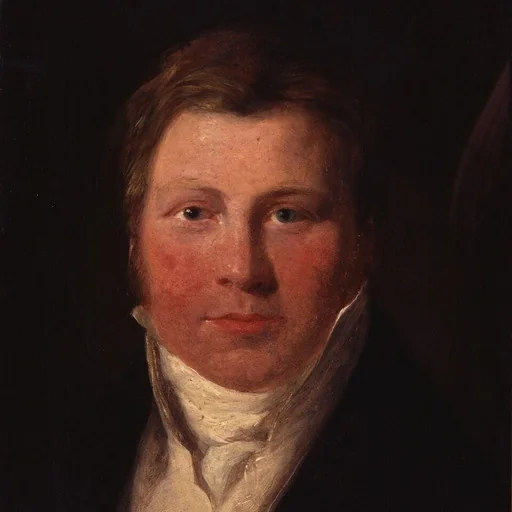
John Varley (17 August 1778 – 17 November 1842) was an English watercolour painter and astrologer, and a close friend of William Blake.

![Study of a Head in Profile [verso], by John Varley](https://artifactworldgallery.com/img/john-varley--study-of-a-head-in-profile-verso--3e16e84b6ceccae1-w320.webp)
![Two Studies of a Figure Holding a Basket [verso], by John Varley](https://artifactworldgallery.com/img/john-varley--two-studies-of-a-figure-holding-a-basket-verso--7e8aaeb3f643e9b3-w320.webp)