Artwork
Young Herdsman with a Bull
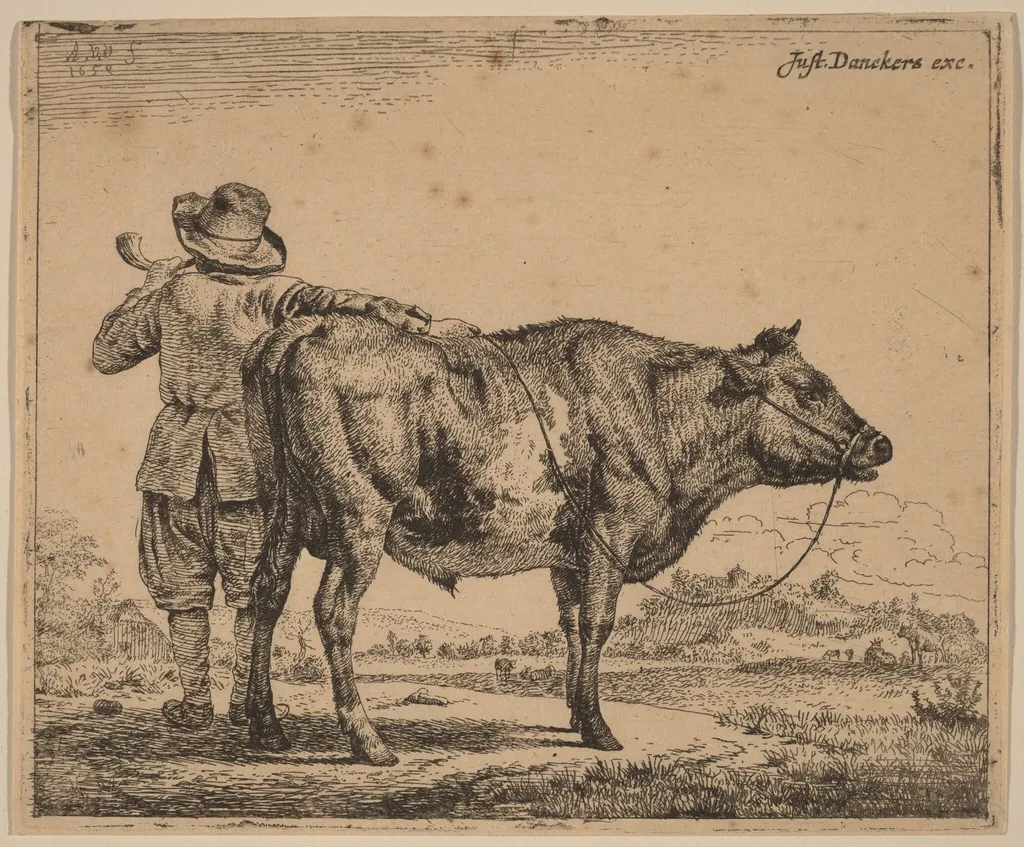
Young Herdsman with a Bull is an ink print by the Baroque artist Adriaen van de Velde. It dates from 1659 and is held in the collection of the National Gallery of Art.
About this work
Overview
Unlike his painted works, this print focuses on a solitary herdsman and his bull, rendered with precision through incised lines on a metal plate.
Adriaen van de Velde produced this etching in 1659 as part of his exploration of rural life in the Dutch Golden Age. Unlike his painted works, this print focuses on a solitary herdsman and his bull, rendered with precision through incised lines on a metal plate. The composition reflects his interest in quiet, observational scenes rather than dramatic narratives, emphasizing stillness and naturalism.
Subject & Meaning
The figure, dressed in simple rural attire and wearing a broad hat, stands calmly beside a massive bull, its strength conveyed through thick, textured lines. The rope around the bull’s neck suggests control without force, hinting at a daily, unremarkable moment in pastoral labor. There is no overt symbolism; the scene’s value lies in its quiet authenticity, capturing the rhythm of agricultural life without idealization.
Technique & Style
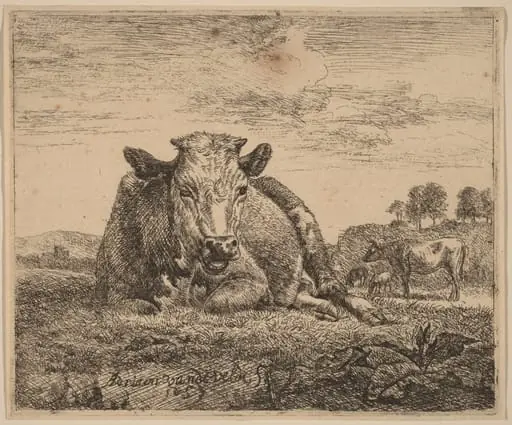
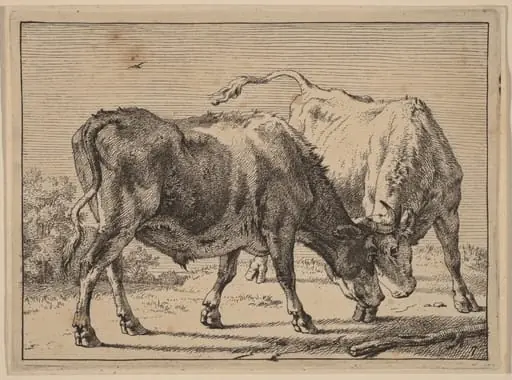
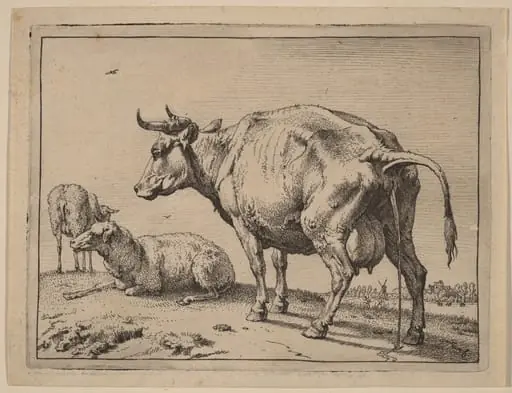
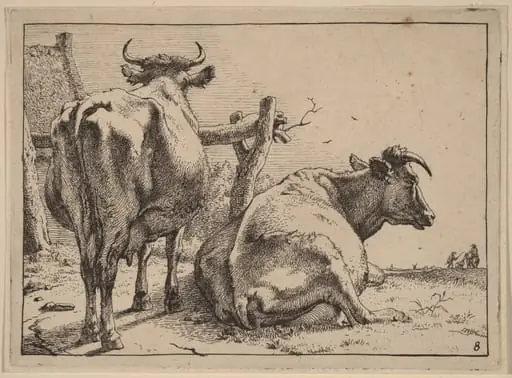
Van de Velde employed etching to achieve fine, controlled detail, using acid to bite lines into a copper plate. The bull’s shaggy hide and the herdsman’s loose garments are rendered with delicate, varied strokes that suggest texture without heavy shading. The background is minimally defined—sparse trees and a distant structure create depth without distraction, showcasing his skill in balancing detail with atmospheric restraint.
History & Provenance
Created during a period when Dutch artists increasingly turned to printmaking for broader dissemination, this etching was likely produced in small editions for collectors and fellow artists. While specific early ownership records are sparse, van de Velde’s prints circulated widely in the Netherlands and beyond, valued for their technical finesse and intimate subject matter.
Context
Van de Velde was part of a generation of Dutch artists influenced by Italianate landscape traditions, though this work avoids overt classical references. Instead, it aligns with the Dutch preference for truthful depictions of everyday rural existence. His etchings complemented his paintings, offering a more accessible format to convey the same sensitivity to light, form, and quiet human interaction with nature.
Legacy
Though less celebrated than his paintings, this etching exemplifies van de Velde’s contribution to printmaking’s elevation in the 17th century. His ability to convey texture and mood with minimal lines influenced later artists working in the medium. The work remains a quiet testament to the dignity of labor and the aesthetic potential of everyday rural scenes in Dutch art.
Artist & collection

Artist
Adriaen van de Velde, was a Dutch painter, draughtsman, and print artist. His favorite subjects were landscapes with animals and genre scenes. He also painted beaches, dunes, forests, winter scenes, portraits in…