Artwork
Water Village

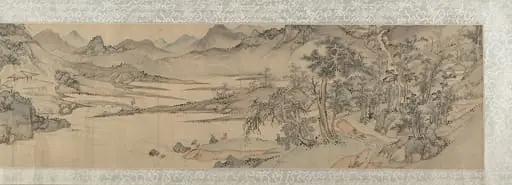
Water Village is an unspecified painting by the Ming dynasty painting artist Wen Boren. It dates from 1570 and is held in the collection of the Cleveland Museum of Art.
About this work
You see a quiet village hugging a river, low hills rising behind it, and almost no people—just two tiny figures on a path.
You see a quiet village hugging a river, low hills rising behind it, and almost no people—just two tiny figures on a path.
Wen Boren painted this in 1570, when he was nearly seventy. He was known for his fiery temper, but here everything feels still, like the air before rain. The soft ink washes make the hills look like they’re breathing.
If you like this calm, look up *sfumato*—the way edges blur into mist, just like in this painting.
Overview
Water Village is a painting created by Wen Boren in 1570, when the artist was nearly seventy years old. It depicts a serene landscape with a village situated near a river, backed by low hills.
Subject & Meaning
The scene shows a tranquil village with a fishing boat on the shore and two small figures on a path, conveying a sense of stillness. The restrained atmosphere contrasts with Wen Boren's known volatile personality, raising questions about the artist's intentions and the effort required to achieve this calm.
Technique & Style
Soft ink washes are used to create a sense of depth and atmosphere, with the hills appearing to breathe. The blurring of edges into mist is reminiscent of sfumato, a technique that creates a soft, hazy effect.
History & Provenance
Wen Boren was associated with the Wu School and trained under his uncle, Wen Zhengming, a prominent Ming dynasty painter. The artist's turbulent personality and history of conflict, including a lawsuit with his uncle, are at odds with the serene quality of his landscapes.
Artist & collection



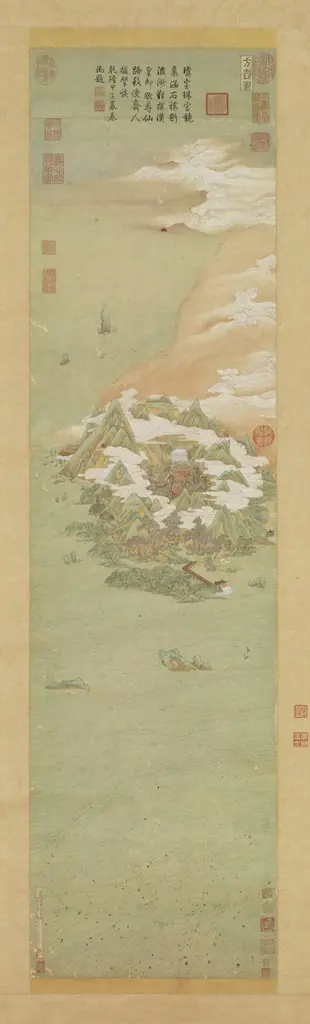
 Snow Coloring the World White
 Buddha's Conversion of Five Bhiksu
 Mt. Taibo in the Style of Wang Meng
 Snow Coloring the World White
 Painting of Mountain Villa
 元 趙孟頫 雙松平遠圖 卷|Twin Pines, Level Distance
 Mt. Taibo in the Style of Wang Meng
 Eight Views of Xiao-Xiang
 Landscape in the Style of Huang Gongwang
 Landscape in the Style of Huang Gongwang
 A Hundred Sparrows in a Lofty Grove
 Cloudy Mountains