Artwork
Thames Police
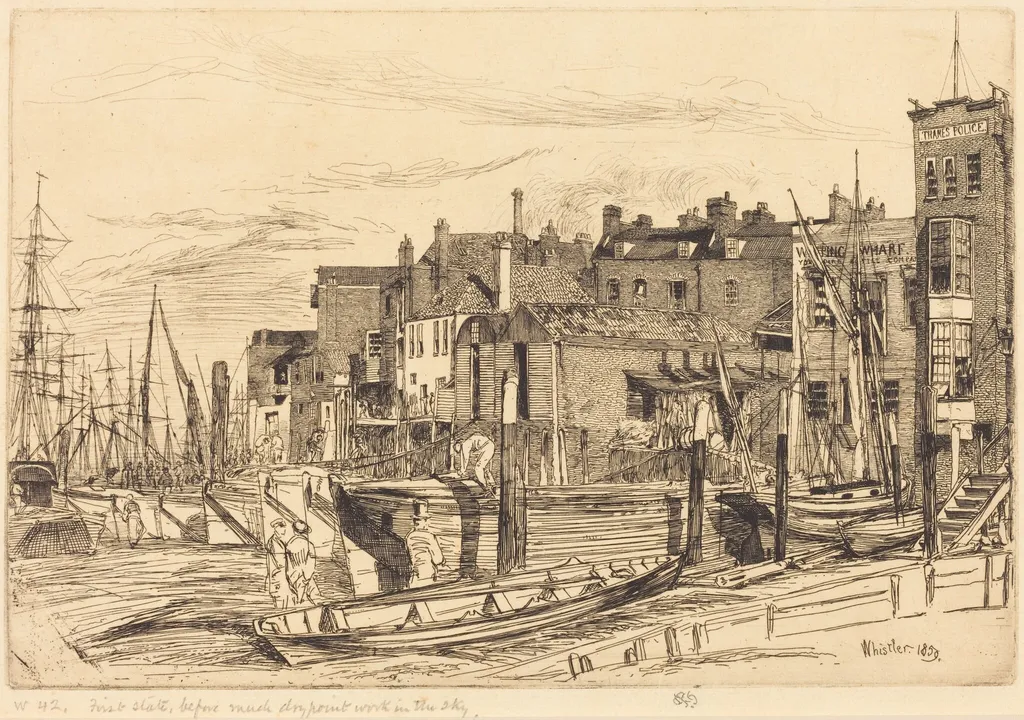
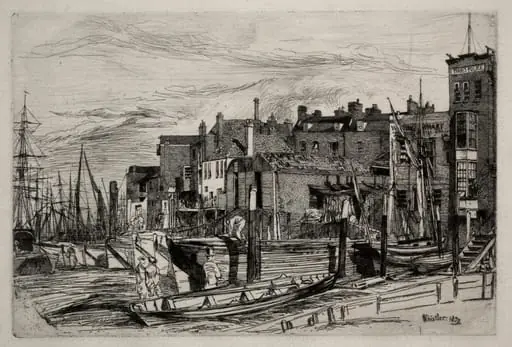
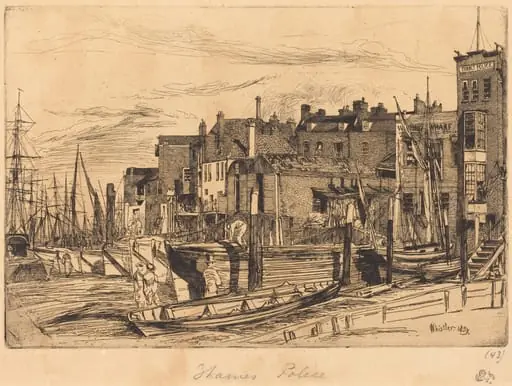
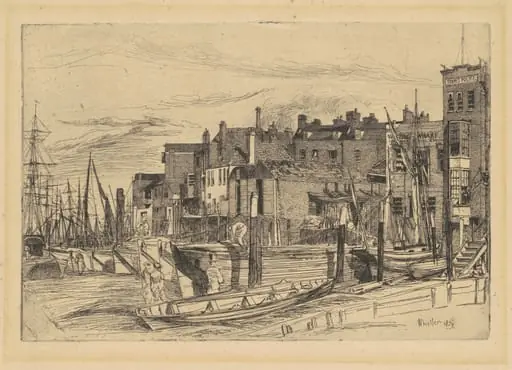
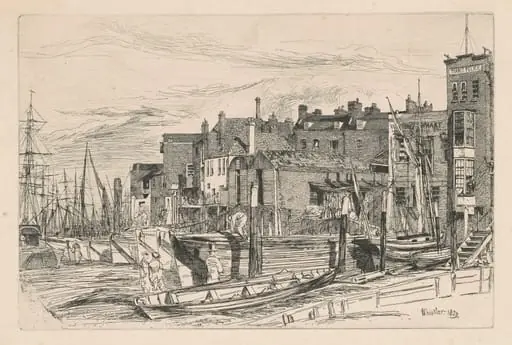
Thames Police is an ink print by the Impressionist artist James McNeill Whistler. It dates from 1859 and is held in the collection of the National Gallery of Art.
About this work
Overview
Created in 1859, *Thames Police* is an etching and drypoint by American artist James McNeill Whistler, executed in monochrome ink.
Created in 1859, *Thames Police* is an etching and drypoint by American artist James McNeill Whistler, executed in monochrome ink. It captures a bustling riverside locale along the Thames, reflecting Whistler’s focus on urban atmosphere over storytelling. The work belongs to a series of prints in which he explored the quiet rhythms of London’s docklands, favoring tonal nuance and compositional balance over explicit narrative.
Subject & Meaning
The scene portrays a working wharf at Wapping, with moored vessels, low buildings bearing commercial signs, and figures moving along the shore. Rather than dramatizing labor or crime, Whistler presents the harbor as a lived-in environment, where activity unfolds without moral judgment. The title references the Thames River Police, a real force patrolling the waterway, yet the image avoids sensationalism, treating the setting as a study in urban texture.
Technique & Style
Whistler combined etching with drypoint to achieve both precision and spontaneity. Drypoint’s burr produced rich, velvety lines, while etching allowed for finer, controlled details. The dense, sketchy marks suggest motion and depth without heavy shading. His hand is evident in the rapid, almost improvisational strokes that convey the bustle of the dock without literalism, aligning with his aesthetic principle of art as arrangement rather than illustration.
History & Provenance
Executed during Whistler’s early years in London, *Thames Police* emerged from his engagement with the city’s underbelly and its printmaking traditions. It was likely produced for private circulation among artists and collectors, not mass distribution. The work remained within his personal oeuvre until later acquisitions by institutions, where it came to represent his formative period in British printmaking.
Context
In the late 1850s, London’s riverfront was a hub of commerce and social contrast, frequently depicted in illustrated newspapers. Whistler diverged from journalistic realism, instead pursuing tonal harmony and compositional rhythm. His approach echoed contemporary French etchers and Japanese prints, both of which influenced his emphasis on selective detail and asymmetrical balance over conventional perspective.
Legacy
Though not widely exhibited in his lifetime, *Thames Police* exemplifies Whistler’s shift toward abstraction in printmaking. His use of drypoint to evoke atmosphere rather than detail influenced later generations of printmakers. The work’s quiet intensity and technical innovation helped redefine etching as a medium for modern sensibility, detached from narrative obligation.
Own this work as a print
Artist & collection
Artist
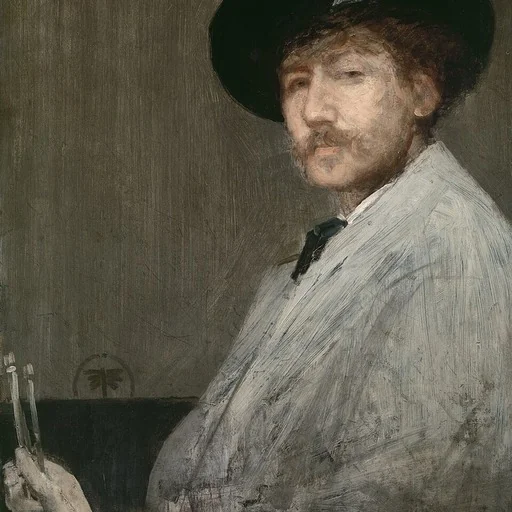
James Abbott McNeill Whistler was an American painter in oils and watercolor, and printmaker, active during the American Gilded Age and based primarily in the United Kingdom.

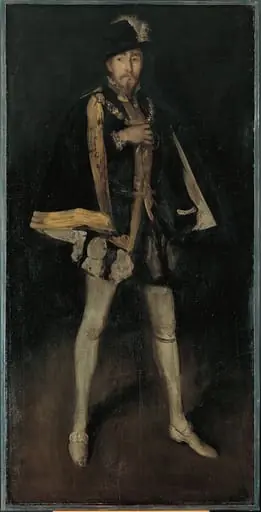 Arrangement in Black, No. 3: Sir Henry Irving as Philip II of Spain
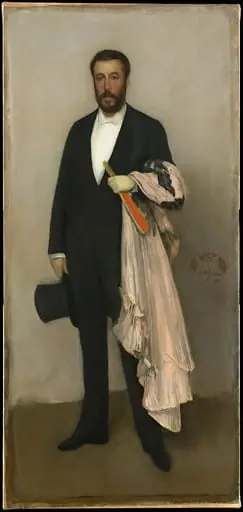 Arrangement in Flesh Colour and Black: Portrait of Theodore Duret
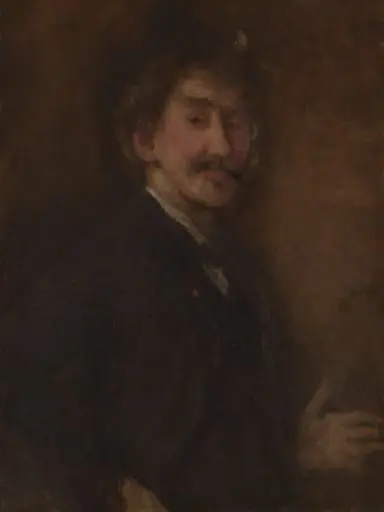 Gold and Brown: Self-Portrait
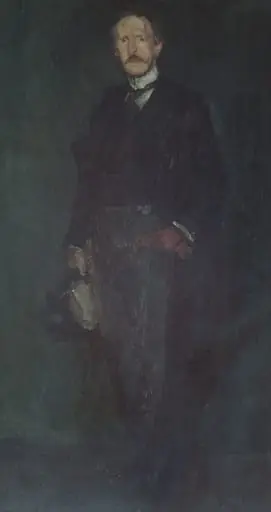 Edward Guthrie Kennedy
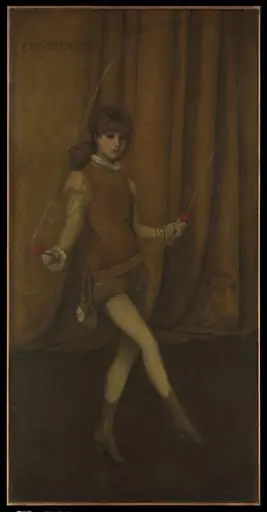 Harmony in Yellow and Gold: The Gold Girl—Connie Gilchrist
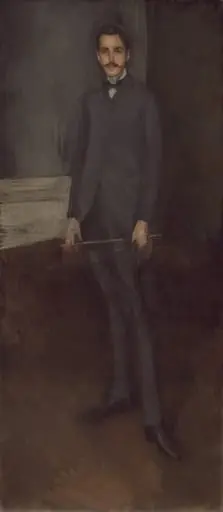 George W. Vanderbilt
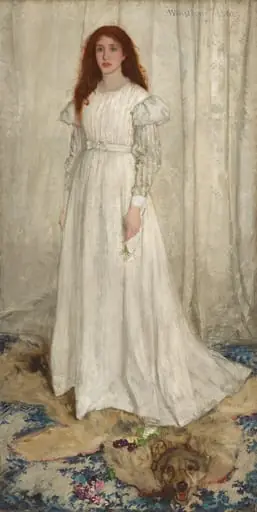 Symphony in White, No. 1: The White Girl
 Henry Irving as Philip II of Spain